
Volcano Safety & Preparedness
Volcanoes are among Earth’s most powerful and unpredictable forces, but with the right knowledge, you can dramatically reduce risk to yourself, your family, and your community. Volcano safety and preparedness is not just about reacting to an eruption—it’s about proactive planning, understanding the specific hazards you may face, and knowing exactly what to do before, during, and after an event. From fast-moving pyroclastic flows and devastating lahars to widespread ashfall and invisible volcanic gases, each threat requires a unique response. Our expert guidance covers emergency evacuation procedures, the importance of early warning systems and alert levels, and how to build a comprehensive volcano preparedness kit. We also delve into community-level strategies, including shelter design, building codes in volcanic zones, and real-time monitoring networks that save lives. Whether you live near an active volcano or simply want to be informed, this category equips you with essential, actionable tools to stay safe, resilient, and confident in the face of volcanic activity. Prepare today, and you can face tomorrow’s eruption with clarity and calm.
 Volcanic Hazards: Tsunamis from Volcanoes
 Psychological Impact of Living Near Active Volcanoes
 Volcanic Hazards: Volcanic Gases
 Building Codes and Infrastructure in Volcanic Zones
 Volcano Early Warning Systems: Real-time Monitoring Networks
 Volcanic Hazards: Ashfall
 Volcano Preparedness Kits: What to Include
 First Aid for Volcanic Ash Exposure and Respiratory Issues
 Volcanic Shelters and Safety Measures during Eruptions
 Community Volcano Preparedness Plans
 Volcano Early Warning Systems: Alert Levels and Communication
 Volcanic Hazards: Lava Flows
 Emergency Evacuation Procedures for Volcanic Eruptions
 Volcanic Hazards: Pyroclastic Flows
 Volcanic Hazards: Lahars (Mudflows)
Volcano Safety & Preparedness at VolcanoExplorers.org
Living near a volcano offers breathtaking views but demands serious respect for the forces beneath your feet. At VolcanoExplorers.org, our Volcano Safety & Preparedness category provides actionable, science-backed guidance to help you, your family, and your community survive and thrive in volcanic zones. From understanding deadly lahars and pyroclastic flows to building a robust preparedness kit, we cover every layer of risk and response. Explore our subcategories below to turn passive awareness into active resilience.
🌋 Volcanic Hazards: Lahars (Mudflows)
Lahars are fast-moving slurries of volcanic debris, rock, and water that can race down river valleys at speeds over 50 mph, often triggered by rainfall or melted snow during eruptions. Our guide explains how to identify lahar-prone zones, recognize warning signs like sudden ground shaking or water level changes, and establish evacuation routes on high ground. Never underestimate lahars — they can travel many miles from the volcano and destroy bridges and buildings, making pre-planned escape paths essential for survival.
We also detail how to monitor official lahar alerts, use community sirens effectively, and prepare your property with sandbags or trenches where feasible. For families, we provide checklists to practice "lahar drills" with children, ensuring everyone knows to move perpendicular to drainage channels. Understanding the difference between hot, wet lahars and cold debris flows helps you react appropriately to each scenario.
🔥 Volcanic Hazards: Pyroclastic Flows
Pyroclastic flows are the most lethal volcanic phenomenon — avalanches of superheated gas, ash, and rock that can exceed 1,000°F and move faster than a jet aircraft. Our content emphasizes that no amount of physical preparedness can outrun these flows; the only defense is early evacuation from exclusion zones. We explain the typical paths these flows follow, often funneling through valleys and over ridges, and why staying indoors offers zero protection against their heat and force.
We review historical case studies, like Vesuvius and Mount St. Helens, to illustrate the speed of destruction and the importance of respecting official volcano hazard maps. Practical guidance includes identifying safe shelters at least 10 kilometers away, using N95 masks to filter ash if caught outdoors, and never attempting to outdrive a pyroclastic flow in a car — turn around immediately when an alert sounds.
🚨 Emergency Evacuation Procedures for Volcanic Eruptions
Effective evacuation is a coordinated dance between authorities and residents. This subcategory breaks down the phased alert system, from Normal (Green) to Warning (Red), so you know exactly when to pack, when to leave, and which routes are safest. We provide templates for family communication plans, including out-of-state contacts and meeting points, because cell networks often fail during eruptions. You'll learn how to pre-register for community notifications and understand local siren meanings.
We also cover evacuation timing — leaving before the official order can save lives but also causes congestion, so we teach you to balance urgency with order. For those with pets or livestock, we offer specific checklists for transportation and shelter. Our guides emphasize practicing your evacuation route at least twice a year, accounting for road closures, ash accumulation, and reduced visibility, ensuring your plan works under real stress.
🌊 Volcanic Hazards: Lava Flows
Lava flows are slow-moving (usually 1-10 mph) but relentless, destroying everything in their path as they advance. Our subcategory explains the two main types: pahoehoe (smooth, ropey) and a'a (rough, blocky), and how their speed affects your response time. We teach you to monitor lava fronts through official webcams and drones, and why building barriers or water-cooling efforts rarely work — instead, prioritize property insurance and structural hardening if you live in a flow path.
We also cover the hidden dangers of lava interacting with vegetation, water, or infrastructure, creating methane explosions or toxic steam. For homeowners, we discuss choosing fire-resistant materials and creating defensible space. Crucially, we emphasize that lava flows can shift direction due to topography, so always rely on official flow maps rather than visual observation, and never approach a lava front even if it seems slow — the heat radiated can cause severe burns from dozens of feet away.
📡 Volcano Early Warning Systems: Alert Levels and Communication
Alert levels are your first line of defense. We demystify the four-color system used globally (Green, Yellow, Orange, Red) and what each means for your daily life — from elevated seismicity to an imminent eruption. Our subcategory explains how agencies like USGS and VAAC (Volcanic Ash Advisory Centers) issue alerts, and how to subscribe to real-time SMS, email, and app notifications tailored to your location. You'll learn to interpret terms like "unrest," "eruption imminent," and "major eruption" without panic.
Communication breakdown during eruptions is common, so we detail redundant methods: NOAA weather radios, community sirens, and social media channels (Twitter/Facebook) used by local authorities. We also cover how to verify information from unofficial sources, avoiding rumors that cause chaotic evacuations. For visitors, we explain how to check alert levels before traveling, and for residents, how to establish neighborhood watch systems to relay warnings to the elderly or disabled.
🏘️ Community Volcano Preparedness Plans
Community resilience starts long before an eruption. This subcategory guides you in creating or joining a neighborhood preparedness council that maps safe zones, identifies vulnerable residents, and stocks communal supplies. We provide step-by-step guides to conduct hazard mapping using official GIS data, organize volunteer teams for traffic control and first aid, and designate assembly areas with clear signage. Collaboration with local emergency managers is key, so we share templates for memorandums of understanding.
We also discuss drills — tabletop exercises for leaders and full-scale simulations for residents — to test communication and routing. Funding ideas include applying for government grants for retrofitting community shelters. And we emphasize the importance of regular review: update plans after every eruption news event or staff change, ensuring your plan stays practical and relevant.
🛡️ Volcanic Shelters and Safety Measures during Eruptions
When evacuation isn't possible, shelters save lives. We review the multi-tier shelter concept: interior safe rooms for ash, community shelters for short-term stays, and regional shelters for extended displacement. Our subcategory explains how to seal windows and doors with plastic sheeting, use HEPA filters, and shut off HVAC systems to prevent ash and gas ingress. For those sheltering in place, we cover structural reinforcement, such as bracing roofs for heavy ash accumulation.
We also detail safety measures during the actual eruption: staying indoors, keeping pets inside, wearing long sleeves and goggles, and avoiding running engines or air conditioners that draw in ash. For community shelters, we list essential features like backup power, water storage, and medical supplies, plus why you should register your family at check-in for accountability. Maps and floor plans are provided for typical public buildings converted into shelters.
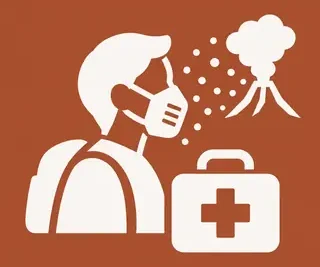
🩹 First Aid for Volcanic Ash Exposure and Respiratory Issues
Ash is silica-laden and extremely abrasive, causing severe respiratory distress. Our first aid guide covers immediate actions: move to clean air, use N95 or P100 masks, and administer saline eye drops to flush ash particles. We teach you to recognize symptoms of acute silicosis — coughing, chest tightness, and shortness of breath — and when to seek emergency care for those with asthma, COPD, or heart conditions. For children, we provide dosage guidance for pediatric inhalers and nebulizers.
Longer-term, we cover cleaning procedures to reduce indoor ash: damp cloths over brooms to avoid stirring dust, and HEPA-based vacuum cleaners. We also address skin irritations from ash contact, recommending protective gloves and barrier creams. For medical kits, we list specific items like anti-inflammatory inhalers, electrolyte solutions, and pulse oximeters to monitor oxygen levels without leaving shelter.
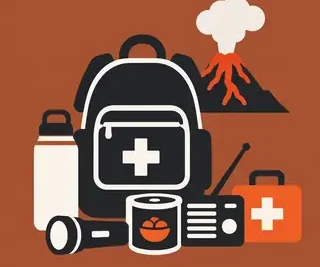
🎒 Volcano Preparedness Kits: What to Include
Your kit must sustain you for at least 72 hours. We offer a comprehensive checklist beyond basics: N95 masks (one per person per day), safety goggles, long-sleeved clothing, and sturdy boots to protect against ash. Include a battery-powered or hand-crank NOAA radio, extra batteries, and a well-stocked first aid kit with respiratory supplies. For water, plan one gallon per person per day, and food that requires no cooking. Add important documents in waterproof bags.
We also suggest eruption-specific extras: a plastic tarp and duct tape for sealing windows, a fire extinguisher, and a portable air purifier for your shelter room. For those with vehicles, keep a separate car kit with a shovel, tow strap, and extra fuel. Finally, we advise rotating perishables every six months and refreshing paper maps, since GPS may fail. Download our free printable kit checklist, organized by priority levels.
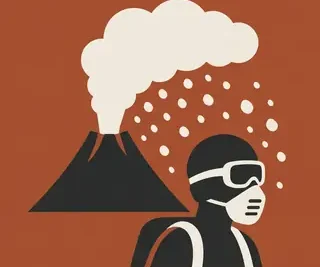
🌫️ Volcanic Hazards: Ashfall
Ashfall can affect areas hundreds of miles from the vent, disrupting agriculture, infrastructure, and health. Our subcategory details how to prepare for heavy ash: stockpile masks, clear gutters, and protect electronics from gritty particulates. We explain that wet ash conducts electricity, so unplug devices and avoid touching downed lines. For roofs, we warn that more than 4 inches of wet ash can collapse structures, so remove ash continuously.
We cover water purification — ash contaminates open sources, so use bottled or filtered water. For vehicles, we advise avoiding driving, but if necessary, use low speeds and check air filters frequently. For agriculture, we provide measures to protect livestock and crops, including covering feed and ensuring shelter ventilation. Finally, we explain ash climatology: prevailing winds determine impact zones, so consult real-time dispersion models provided by authorities.
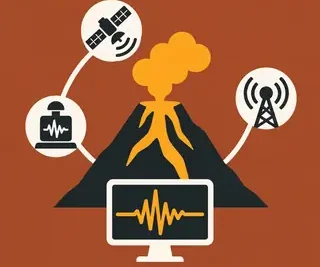
📊 Volcano Early Warning Systems: Real-time Monitoring Networks
Behind every alert is a dense network of instruments. This subcategory introduces you to seismometers, GPS, tiltmeters, gas sensors, and satellites that track ground deformation, quake swarms, and gas emissions. We demystify how volcanologists interpret data — e.g., harmonic tremor indicating magma movement — and explain the concept of "reduced seismic velocity" as a precursor. You'll learn how to access public data portals from USGS, IMO, and other agencies, viewing real-time spectrograms and GPS graphs.
We also cover emerging tech: machine learning models that predict eruptions days ahead, and drone-based gas sampling. For community engagement, we discuss how to participate in citizen science by installing low-cost seismic sensors at home, feeding data to research networks. Understanding the limitations of monitoring — like the difficulty of forecasting exact eruption timing — helps you appreciate why official warnings are conservative but vital.
🏗️ Building Codes and Infrastructure in Volcanic Zones
Engineering can mitigate volcanic risk. Our subcategory reviews modern building codes for volcanic regions, including steep roofs to shed ash, reinforced concrete for blast resistance, and sealed windows to prevent ash ingress. We discuss retrofitting older structures with fire-resistant roofing and cladding, and installing ground-level vents with filters to prevent gas accumulation. We also cover the importance of structural anchors against volcanic earthquakes, and bracing for tephra load.
Infrastructure resilience is equally critical: roads must be designed with gentle grades and wide shoulders for evacuation; utilities buried underground to avoid ash-induced outages; bridges reinforced against lahar scour. We provide case studies from Japan, Iceland, and the Philippines, highlighting successful designs. For residents, we offer guidance on working with inspectors and engineers to assess your home's vulnerability, and applying for grants to strengthen load-bearing walls.
☠️ Volcanic Hazards: Volcanic Gases
Gases like SO₂, CO₂, H₂S, and HCl can be lethal even without eruption. This subcategory explains gas behavior: CO₂ is heavier than air, pooling in low-lying areas, while H₂S causes olfactory fatigue — you stop smelling it before it becomes deadly. We teach you to recognize symptoms of gas exposure, from eye and throat irritation to dizziness and unconsciousness. Stay informed through gas monitoring stations that alert to hazardous thresholds, and avoid basements or depressions during quiescent degassing.
We provide practical mitigation: install gas detectors in homes, ensure good ventilation, and keep windows closed overnight when gases accumulate. For farmers, we cover grazing restrictions near gas-rich craters. And we explain how authorities use weather data to forecast gas dispersal, helping you plan outdoor activities on safe days. Always heed "gas warnings" even if no eruption is imminent — these gases are persistent hazards.
🧠 Psychological Impact of Living Near Active Volcanoes
Chronic uncertainty and repeated evacuations take a toll on mental health. Our subcategory addresses volcano anxiety, hypervigilance, and post-disaster stress, offering coping strategies such as mindfulness, community support groups, and setting limits on alert-checking. We explain how to create "worry time" to manage anxious thoughts, and when to seek professional help for PTSD symptoms. We also provide guidance for parents on reassuring children with age-appropriate facts, not distant promises.
We emphasize the importance of routines and preparedness rituals to restore a sense of control. And we highlight local resources—crisis hotlines, counseling services—often underutilized. Remember, feeling fear is natural; normalizing those emotions and talking openly with neighbors reduces isolation. Building a "psychological preparedness kit" with comfort items and a support network is just as crucial as physical supplies.
🌊 Volcanic Hazards: Tsunamis from Volcanoes
Volcanic tsunamis can strike without warning, generated by landslides, caldera collapse, or undersea eruptions. This subcategory teaches you to recognize immediate natural warnings: a sudden receding of water, unusual roaring sounds, or ground shaking lasting more than 20 seconds. If near a coast, move to higher ground instantly, do not wait for official sirens. We discuss historical events like Krakatoa (1883) and Tonga (2022), emphasizing that islands and fjord regions are highest risk.
We explain how monitoring systems, such as DART buoys and pressure sensors, detect volcanic tsunamis, but note their limited coverage near distant chains. For residents, we cover building evacuation routes to 30-meter elevation, and for travelers, how to identify safe spots. Also, we address secondary hazards: tsunamis can travel far across oceans, so even non-local volcanic eruptions can pose a threat — always heed global tsunami advisories.
❓ Frequently Asked Questions
How quickly should I evacuate when a volcanic eruption is imminent?
Leave immediately when a Red alert or evacuation order is issued. Do not wait to see the eruption — early departure is safer, as roads may quickly clog with ash and debris. Plan for 30 minutes to pack pre-prepared kits and 2 hours to reach your designated safe zone.
Can I rely on my car to outrun a lahar or pyroclastic flow?
No. Lahar speeds can match cars, and pyroclastic flows are far faster. Never attempt to drive away from a pyroclastic flow — it can overtake vehicles in seconds. Instead, move perpendicular to flow paths and seek high ground immediately.
What is the most essential item in a volcano preparedness kit?
An N95 or P100 mask is non-negotiable, since ash and gases cause rapid respiratory harm. Also, a battery-powered NOAA radio ensures you receive alerts when cellular networks fail. Combine these with water, food, and first aid for a complete kit.
How do I know if my home is safe from volcanic gas?
Install a CO₂ and H₂S detector, and keep windows sealed during degassing episodes. Check local gas monitoring websites daily. If you live in a low-lying area near vents, consult an expert to assess ventilation and consider relocating during active degassing.
Are children more vulnerable to volcanic ash?
Yes, their smaller airways and faster breathing rates make them more susceptible. Keep them indoors during ashfall, use properly fitted child-sized N95 masks, and monitor for coughing. Ensure they have access to asthma medications if prescribed.