Beyond Lava: How Volcanoes Trigger Devastating Tsunamis
Volcanoes aren't just about lava flows; underwater eruptions can trigger devastating tsunamis. Discover the surprising volcanoes and tsunamis connection and learn how…
Read article
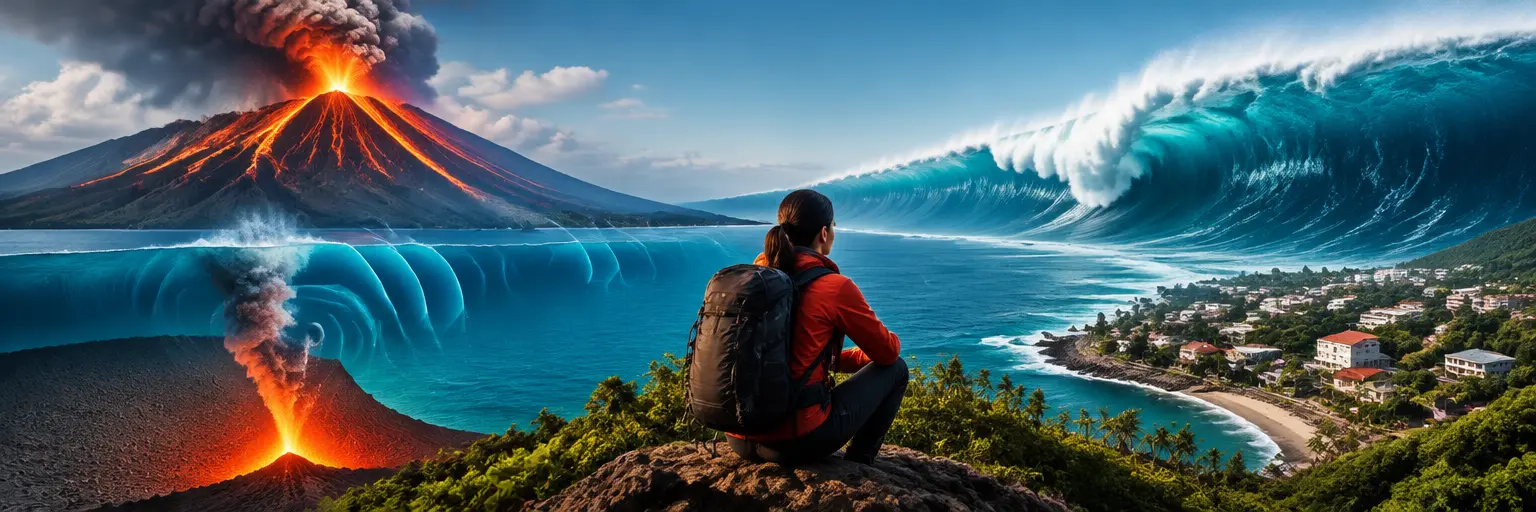
Volcanic eruptions are among nature’s most spectacular and destructive forces, but their impact can extend far beyond the crater’s rim. Tsunamis from volcanoes represent a rare yet catastrophic hazard, capable of generating towering waves that travel across entire ocean basins at jet-aircraft speed. When a volcano collapses, explodes, or triggers an underwater landslide, the displaced water can morph into a series of deadly surges, striking coastlines hundreds or even thousands of miles away with little warning. For coastal communities, understanding this connection is vital—not all tsunamis are earthquake-born, and volcanic sources demand unique detection and response strategies. On VolcanoExplorers.org, we cut through the complexity to explain how these giant waves form, the historical events that shocked the world (like the 1883 Krakatoa eruption), and the modern monitoring systems that help forecast and mitigate their threat. Whether you live near a volcanic coastline or simply crave scientific insight, this knowledge is your first line of defense. Dive in to discover how volcanoes can turn the ocean into an enemy—and what you can do to stay safe.
Volcanoes aren't just about lava flows; underwater eruptions can trigger devastating tsunamis. Discover the surprising volcanoes and tsunamis connection and learn how…
Read article
VolcanoExplorers.org reveals the often-overlooked danger of volcanic tsunamis. Learn about their formation and discover crucial safety tips to protect yourself from this…
Read article
Uncover the hidden danger: VolcanoExplorers.org reveals the unsettling reality of volcanic tsunami risk assessment, mapping global threats and providing crucial insights into…
Read article
VolcanoExplorers.org provides crucial real-time volcano monitoring, offering vital insights into volcanic activity and its potential for tsunami generation, ensuring public safety through…
Read article
Uncover the terrifying power of caldera collapse and tsunami risk. VolcanoExplorers.org reveals the science behind these catastrophic events, offering vital safety information…
Read articleFor visitors to VolcanoExplorers.org, few volcanic phenomena combine oceanographic fury with geological power as dramatically as tsunamis generated by volcanoes. While most people associate tsunamis with earthquakes, volcanic eruptions can trigger equally devastating waves through flank collapses, underwater explosions, pyroclastic flows entering the sea, or caldera subsidence. This subcategory within Volcano Safety & Preparedness illuminates the mechanisms, historical precedents, and mitigation strategies for volcanic tsunamis, offering critical knowledge for coastal communities, researchers, and enthusiasts alike.
Volcanic tsunamis arise from several distinct processes, each with unique warning signs and wave characteristics. Flank collapse—where a portion of a volcano slides into the ocean—displaces massive water volumes, as seen in the 2018 Anak Krakatau event in Indonesia, which generated waves up to 5 meters high. Underwater explosions, such as those from submarine volcanoes, can lift the water column directly, creating localized but powerful waves. Additionally, pyroclastic flows entering the sea rapidly boil water and push waves outward, while caldera collapse can create sudden depressions that send tsunamis radially.
Each mechanism produces tsunamis with different travel times and energy distributions. Flank collapses tend to generate directionally focused waves that strike nearby coastlines within minutes, offering little warning. In contrast, atmospheric pressure waves from large eruptions (like the 2022 Hunga Tonga–Hunga Haʻapai event) can create meteotsunamis that travel across entire ocean basins. Understanding these distinctions helps coastal managers design effective alert systems, as volcano-induced tsunamis often require monitoring volcanic deformation alongside ocean buoys.
History provides sobering lessons. The 1883 Krakatoa eruption remains the deadliest volcanic tsunami, with waves reaching 46 meters high killing over 36,000 people, primarily on Java and Sumatra. The collapse of the volcano’s northern cone produced multiple waves that destroyed 165 coastal villages. More recently, the 2018 Anak Krakatau event demonstrated that even relatively small eruptions with partial collapses can trigger deadly tsunamis, catching officials off-guard because no significant earthquake preceded the wave.
The 1792 Unzen disaster in Japan offers another example, where a post-eruption flank collapse generated a tsunami that killed nearly 15,000 people on opposite shores of Shimabara Bay. These cases underscore a critical pattern: volcanic tsunamis frequently occur without clear seismic precursors, making them particularly dangerous for populations accustomed to earthquake-tsunami protocols. Studying these events helps volcanologists identify precursory ground deformation, gas emissions, or seismic swarms that might signal an impending flank failure, improving future preparedness.
Modern technology offers advanced tools for detecting volcanic tsunami threats. Seafloor pressure sensors (tsunameters) can detect wave passage in deep water, while coastal tide gauges record sea-level changes near shore. For volcano-specific monitoring, InSAR radar interferometry and GNSS ground stations track subtle deformation of volcanic flanks, identifying instability zones before collapse. Additionally, acoustic sensors can detect underwater explosions, and infrasound networks pick up low-frequency atmospheric waves from large eruptions.
Integrating these datasets into early warning systems is complex but essential. The 2022 Tonga event proved that atmospheric pressure waves can trigger tsunamis thousands of kilometers away, prompting updates to global warning protocols. VolcanoExplorers.org recommends that coastal communities near active volcanic islands implement multi-hazard communication plans that include not just seismic alerts but also visual monitoring of volcanic activity, as many volcanic tsunamis are preceded by visible ash plumes or glow. Real-time data sharing between volcanic observatories and tsunami warning centers is vital for saving lives.
Not all coastlines face equal risk from volcanic tsunamis. Proximity to active volcanoes—especially island or coastal stratovolcanoes—is the primary factor, but local bathymetry and topography significantly amplify or dampen wave heights. Steep submarine slopes can accelerate wave run-up, while fringing reefs provide natural buffers. Communities on low-lying islands near submarine volcanoes or calderas are particularly exposed, as a single event can inundate entire populations with little advance notice.
Risk assessment must also consider secondary hazards. Volcanic tsunamis often arrive amid falling ash, gas emissions, and potential debris flows, complicating evacuation. The 2018 Palu event (earthquake-triggered, but pertinent) showed that bays with narrow entrances can amplify tsunami height unnervingly. For volcanic tsunamis, hazard mapping should incorporate potential collapse scenarios, wave propagation models, and historical event data. VolcanoExplorers.org advises residents to identify pre-assigned evacuation routes to high ground at least 20 meters above sea level and to practice drills that account for simultaneous volcanic threats.
Effective preparedness transforms knowledge into action. For individuals living near volcanic coastlines, the first step is understanding local warning signals—which may include sirens, text alerts, or official announcements—and recognizing natural indicators like sudden sea withdrawal or unusual waves. Creating a family emergency kit with fresh water, non-perishable food, radios, and first-aid supplies is crucial, as volcanic tsunamis may disrupt infrastructure for days. Evacuation plans should prioritize moving to higher ground immediately, never waiting for official confirmation if you observe volcanic activity nearby.
Community-level resilience involves regular tsunami drills that incorporate volcanic scenarios, plus land-use planning that restricts development in high-risk zones. Local governments should partner with volcanologists to install real-time monitoring stations and develop public education campaigns that stress the difference between earthquake and volcanic tsunamis—the latter may arrive faster and with less warning. VolcanoExplorers.org champions "know your volcano, know your wave," encouraging residents to learn the specific eruption history of nearby volcanoes, as past behavior often hints at future risks, but with the caveat that volcanoes can surprise.
The most common cause is a flank collapse, where a large section of a volcano slides into the ocean, displacing water and creating waves. This occurred at Anak Krakatau in 2018 and Unzen in 1792. Underwater explosions and pyroclastic flows entering water are less frequent but still significant, each producing distinct wave patterns that demand specific monitoring approaches.
Warning time varies dramatically. Local tsunamis from flank collapses can strike nearby coasts within 10 to 30 minutes, offering minimal time for evacuation. However, atmospherically triggered tsunamis from massive eruptions may travel across oceans over hours, permitting broader alerts. Continuous volcanic monitoring improves lead time, but no system can guarantee more than a few minutes for the most immediate hazards.
Yes, and this is a key danger. Many volcanic tsunamis—such as those from flank collapses—produce little detectable seismic activity beforehand. The 2018 Anak Krakatau event had no significant earthquake. This means relying on earthquake-triggered tsunami warning systems is insufficient for volcanic sources, necessitating dedicated volcanic activity monitoring to provide early cues.
They are not inherently larger, but they are often more locally destructive due to rapid onset and lack of earthquake precursors. While earthquake tsunamis can affect entire ocean basins, volcanic tsunamis tend to be concentrated near the volcano, yet they can travel surprisingly far if the eruption is powerful, as the 2022 Tonga event demonstrated. Danger depends on proximity, bathymetry, and warning systems.
Immediately move to high ground or inland, at least 20 meters above sea level, or roughly 1 kilometer inland if no elevation is available. Do not stop to gather belongings. If you see the sea recede unusually or hear a loud roaring sound, treat it as a warning. Follow local evacuation routes, but do not wait for officials—act on your own observation of volcanic activity.