Emergency Evacuation Procedures for Volcanic Eruptions
When a volcano roars to life, every second counts. At VolcanoExplorers.org, we understand that knowing exactly what to do before, during, and after an eruption can mean the difference between life and death. This subcategory is your definitive guide to emergency evacuation procedures for volcanic eruptions, blending expert advice with practical, step-by-step action plans. From understanding alert levels to packing a volcano-specific go-bag, we cover the critical protocols that keep you and your loved ones safe. Whether you live in a volcanic hazard zone or simply visit one, mastering these evacuation strategies is non-negotiable for responsible preparedness.
🌋 Decoding Volcanic Alert Levels & Evacuation Triggers
Volcanoes communicate through a standardized alert system, but interpreting it correctly is essential for timely action. The U.S. Geological Survey (USGS) uses a four-level scale from "Normal" to "Warning," each with distinct implications for evacuation. When a volcano shifts to "Watch" or "Warning," local authorities may issue mandatory or voluntary evacuation orders based on proximity to hazard zones. You must learn to differentiate between advisory messages, which recommend preparation, and mandatory evacuations, which require immediate departure. Monitoring official channels like local emergency management or volcano observatories is critical—don’t rely on social media rumors.
Understanding the science behind these triggers also helps you anticipate events. Seismic swarms, ground deformation, and increased gas emissions often precede eruptions, giving you a precious window. In this section, we break down each alert level with real-world examples, such as the 2018 Kīlauea eruption, where escalation from Watch to Warning prompted rapid evacuations. We also explain how hazard maps—color-coded zones from red (highest risk) to yellow—dictate evacuation routes. By the end, you’ll be able to read volcanic warnings fluently, ensuring you never hesitate when the order comes.
🚨 Step-by-Step Evacuation Planning Before an Eruption
Preparation isn’t about fear; it’s about freedom—freedom to act decisively when chaos unfolds. Start by identifying your primary and secondary evacuation routes, avoiding valleys and low-lying areas where lahars (volcanic mudflows) and pyroclastic flows travel fast. Map out at least two exits from your home or workplace, and practice them with your family every six months. Your emergency kit must include N95 masks to filter ash, goggles, a battery-powered radio, and a three-day supply of water and non-perishable food. Also, pre-arrange a reunion point outside the hazard zone, and designate an out-of-state contact who can relay messages if local networks fail.
Critical to this phase is also securing your property: disconnect gas lines, anchor heavy furniture, and cover electronics to protect against ash. If you have pets or livestock, identify shelters that accept them—many standard shelters don’t. We provide downloadable checklists tailored for volcanic scenarios, including how to seal windows and doors against ash infiltration. Crucially, we stress the importance of community coordination—neighbors who share resources and information can fill gaps in official communication. Proactive planning transforms panic into a rehearsed routine, boosting survival odds exponentially.
🏃 During the Eruption: Executing a Safe Evacuation
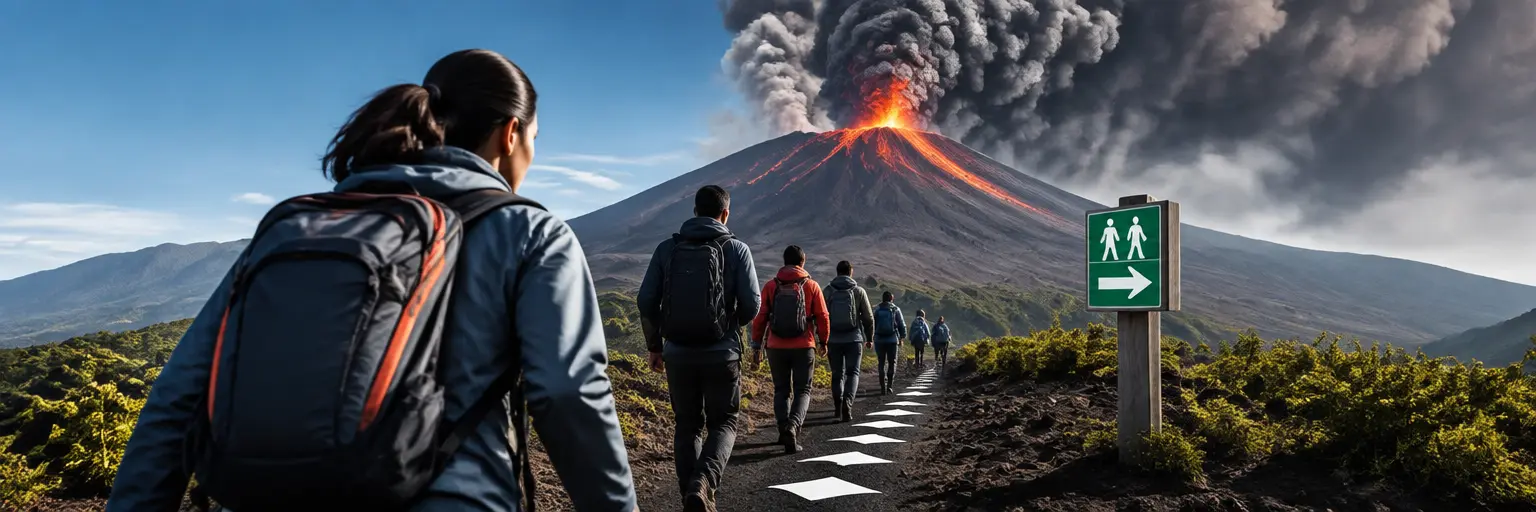
When the ground shakes and ash darkens the sky, your rehearsed plan must kick in instantly. If authorities order evacuation, leave immediately—do not wait for a second warning. Follow designated routes, but keep an ear on radio updates for road closures or new hazards like lava flows crossing highways. Drive with headlights on, even during the day, and maintain slow speeds on ash-covered roads where traction is poor. If your car stalls, abandon it and proceed on foot, carrying your emergency kit with you. For those without vehicles, pre-arranged rides or community evacuation buses are lifesavers—don’t rely on last-minute arrangements.
Safety during movement is paramount. Wear long sleeves, pants, and a dust mask, as ash is not only abrasive but contains tiny glass particles that can damage lungs. Avoid crossing bridges over rivers flowing from the volcano—lahars can surge without warning. If caught in a pyroclastic flow’s path, seek shelter in a sturdy building’s interior or lower level, though these flows rarely give time. We emphasize staying calm and adaptive, using your senses—smell of sulfur, vibrations, or falling rocks—to adjust tactics. Real-time survival stories, like the 1991 Mount Pinatubo evacuations, show that clear-headed execution saves thousands.
🎒 Building Your Volcano-Specific Emergency Go-Bag
Your go-bag is your lifeline, and generic kits won’t cut it for volcanic emergencies. Standard items—water, food, first aid—are essential, but volcanic eruptions demand specialty gear. Pack multiple N95 or P100 masks for every family member, plus replacement filters, since ash clogs them quickly. Include safety goggles or swim goggles to protect eyes from fine particles, and a flashlight with extra batteries for ash-induced darkness. A battery-operated or hand-crank radio is non-negotiable for receiving updates when cellular towers fail. Add a multi-tool, duct tape, tarps, and plastic sheeting to seal rooms against ash infiltration if you shelter in place temporarily.
Also, prepare a document kit: copies of IDs, insurance policies, medical prescriptions, and a map of your area with evacuation zones marked. For pets, include carriers, a week’s worth of food, and a photo ID tag. Consider a portable phone charger with solar capability, as power outages are common. We recommend testing your go-bag every six months, rotating perishable items and updating contact lists. Each bag should be lightweight yet comprehensive, weighing no more than 15–20 pounds for easy carrying during long walks. With the right gear, you transform from passive victim to active survivor, ready for enduring post-eruption conditions.
🏠 Shelter-in-Place vs. Evacuation: Making the Right Call
Not every volcanic threat demands immediate evacuation—sometimes sheltering in place is safer, such as when ash fall is moderate but pyroclastic flows aren’t imminent. Yet, your decision must be based on official guidance and hazard maps, not hope. If authorities say evacuate, do so; if they advise staying, you must fortify your home. This includes sealing windows, doors, and vents with wet towels or plastic, turning off ventilation systems, and moving to an interior room with minimal windows. Use this time to monitor radio updates, not wander outside. However, remember that ash accumulation on roofs can cause collapse—if you see more than 4 inches, evacuate even without an order.
Striking the balance requires understanding your specific volcano’s hazards. For example, a shield volcano like Mauna Loa erupts fluid lava that moves slowly, often allowing sheltering; but a stratovolcano like Mount St. Helens can send deadly lahars and blasts without warning. We provide case studies contrasting successful sheltering with tragic evacuation delays, helping you develop a decision framework. Always have a pre-determined “trigger point”—like visible lava or shaking—that forces evacuation regardless of official word. This proactive mindset prevents second-guessing under stress, giving you a clear, textual script to follow in the heat of crisis.
Frequently Asked Questions
How much time do I typically have to evacuate during a volcanic eruption?
It varies dramatically—some eruptions give days of warning, while others, like phreatic blasts, occur with minutes. Authorities base orders on real-time monitoring, and you should treat every “Warning” as immediate. In general, prepare at least a 15-minute quick-departure plan, but also have a 72-hour survival strategy for extended displacement.
Can I use my car to escape a pyroclastic flow?
Absolutely not—pyroclastic flows travel at speeds over 100 mph with temperatures exceeding 1,000°F, and no vehicle can outrun them. Your only hope is to avoid their path entirely via early evacuation or seek refuge in a deep, sturdy bunker. Never park in low-lying areas or valleys where these flows accumulate.
What should I do if I inhale volcanic ash?
Move indoors immediately and dampen a cloth to cover your mouth and nose. Rinse your eyes with clean water, and drink fluids to help your lungs expel particles. If you experience wheezing or chest pain, seek medical help urgently, as ash contains silica, which can cause severe respiratory damage. N95 masks are your best defense.
Where can I find the most reliable evacuation route information?
Always follow local emergency management agencies, such as civil defense or police, via official radio or their websites. Volcano observatories (e.g., USGS) provide hazard maps and updates. Never rely on social media or word-of-mouth, as misinformation can be deadly. Pre-download route maps before any crisis.
How do I protect pets and livestock during an emergency evacuation?
Prepare a pet go-bag with carriers, leashes, food, and vaccination records. For livestock, pre-identify a safe pasture away from ash and low-lying areas, or arrange transport early. Many shelters don’t accept pets, so list pet-friendly accommodations ahead. Never leave animals chained—they can’t flee. If evacuation is ordered, take them with you.