The Iceland Plume: A Window into the Deep Mantle
Uncover the secrets of Iceland's fiery heart! VolcanoExplorers.org explores the Iceland plume's volcanic activity, revealing insights into deep mantle processes and the…
Read article
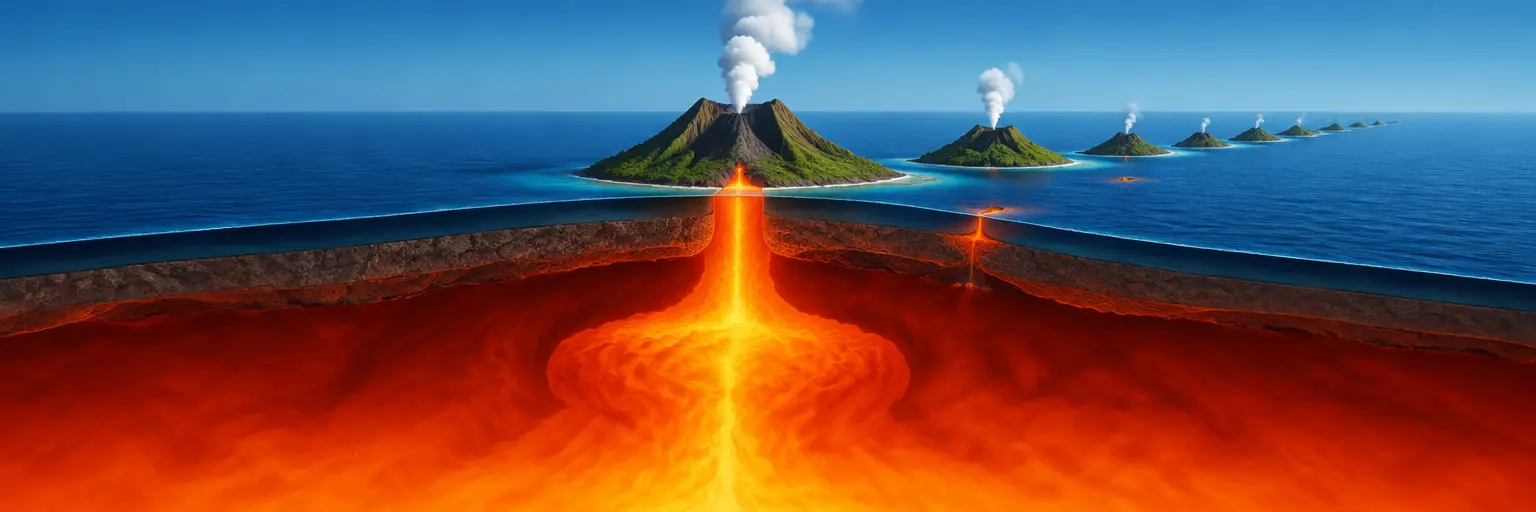
Discover the fiery forces that forge some of Earth’s most iconic islands and underwater mountains—volcanic hotspots born from deep-seated mantle plumes. Unlike the ring of fire’s tectonic plate boundaries, these stationary, scorching upwellings punch through moving plates like a blowtorch, creating sequential island chains that chart the slow drift of Earth’s crust over millions of years. From the dramatic eruptions of Hawaii’s Kīlauea to the towering peaks of Iceland, this region of VolcanoExplorers.org unravels the plume theory, the age-progressive trail of seamounts, and the unique chemistry of hotspot lavas. Explore how these “windows into the mantle” build volcanic archipelagos, shape biodiversity, and pose both hazards and wonders for nearby communities. Whether you’re a geology enthusiast or a curious traveler, dive into the story of mantle plumes, hotspot tracks, and the relentless dance between deep Earth heat and drifting continents.
Uncover the secrets of Iceland's fiery heart! VolcanoExplorers.org explores the Iceland plume's volcanic activity, revealing insights into deep mantle processes and the…
Read article
Unleash the power beneath! VolcanoExplorers.org reveals how geothermal energy from volcanoes harnesses Earth's immense internal heat, transforming volcanic power into sustainable energy.…
Read article
Uncover the dramatic influence of hotspot volcanoes on global climate! VolcanoExplorers.org reveals how these unique volcanic systems impact atmospheric composition and long-term…
Read article
Uncover the mystery of mantle plumes and volcanic hotspots! VolcanoExplorers.org reveals how these deep-Earth plumes fuel iconic volcanic regions, shaping landscapes and…
Read article
Uncover the fiery secrets of our planet! VolcanoExplorers.org explores the dramatic world of volcanoes, including the hidden power of underwater volcanoes and…
Read article
Uncover the mystery of superplumes! Could these colossal upwellings of magma, driving giant mantle plume effects, be the architects of continental reshaping?…
Read articleWelcome to the fascinating world of volcanic hotspots, where towering plumes of molten rock from deep within the Earth’s mantle punch through the crust to create some of the most iconic island chains and volcanic features on our planet. Unlike most volcanoes that form at tectonic plate boundaries, hotspots are stationary anomalies that leave a trail of volcanic activity as tectonic plates drift slowly over them. This section of VolcanoExplorers.org unravels the science behind these powerful forces, explains how they create linear archipelagoes, and explores famous examples like Hawaii and Yellowstone. Discover how mantle plumes work, what makes island chains unique, and how these systems reveal the dynamic, ever-changing nature of our planet’s interior—all in an accessible, engaging format.
Mantle plumes are narrow, cylindrical columns of abnormally hot rock that rise from the core-mantle boundary, located nearly 2,900 kilometers beneath the Earth’s surface. As this material ascends, it partially melts due to decompression, generating magma that eventually reaches the lithosphere. The heat and buoyancy of the plume create a volcanic center that remains relatively fixed in position for tens of millions of years, unlike the moving tectonic plates above.
When a plate moves over a stationary plume, it leaves a chain of volcanoes behind, with the oldest volcanoes located farthest from the active hotspot. This process explains why volcanic islands like the Hawaiian-Emperor seamount chain stretch for thousands of kilometers, showing a clear age progression. The plume’s deep origin makes it distinct from subduction-related volcanism, and scientists use seismic tomography to image these structures, confirming that they originate far below conventional plate boundaries.
Island chains are the most visible expressions of hotspot volcanism. As a tectonic plate moves over a hotspot, each new volcano grows on the seafloor, eventually emerging above the ocean surface as an island. Over time, the plate carries the island away from the hotspot, cutting off its magma supply. Erosion, subsidence, and coral reef growth then transform the island into a seamount or an atoll, while a new island forms over the hotspot.
This process creates a predictable sequence of island ages along the chain, which geologists use to reconstruct plate motion history. For example, the Hawaiian Islands are just the youngest segment of a chain that extends all the way to the Aleutian Trench, with the oldest volcanic rocks dating back over 80 million years. The interaction between plume buoyancy, plate velocity, and magma supply dictates whether the chain appears as a continuous ridge or a series of distinct islands, as seen in the Galápagos and Société archipelagos.
Hawaii is the quintessential hotspot, with its active volcanoes like Kīlauea and Mauna Loa sitting atop a plume that has been active for at least 80 million years. The islands are part of the Hawaiian-Emperor chain, which bends sharply due to a change in plate motion around 47 million years ago. Yellowstone, on the other hand, is a continental hotspot beneath Wyoming, known for its massive caldera and geysers, fueled by a plume that has generated super-eruptions over the past two million years.
Iceland offers a unique case where a hotspot coincides with a mid-ocean ridge, creating a volcanically active island that is both splitting apart and being uplifted by the plume. These examples illustrate that hotspots can occur beneath oceanic and continental plates alike, producing diverse volcanic landscapes. Each site provides invaluable research opportunities, from studying mantle chemistry to monitoring volcanic hazards, and they serve as natural laboratories for understanding Earth’s internal dynamics.
Oceanic hotspots, like Hawaii and Tahiti, create shield volcanoes with gentle slopes, formed by fluid basaltic lava flows. These eruptions are typically effusive rather than explosive, but they can still pose threats to local communities through lava inundation. Continental hotspots, such as Yellowstone, often produce more silica-rich, viscous magmas, leading to explosive eruptions and the formation of large calderas. The difference in magma composition is due to the interaction with continental crust, which melts and mixes with the plume material.
The geological impact extends beyond volcanoes themselves. Oceanic hotspots contribute to the formation of guyots (flat-topped seamounts) and coral atolls, while continental hotspots can create extensive volcanic plateaus, such as the Deccan Traps in India, which have been linked to mass extinctions. Understanding these differences helps volcanologists predict eruption styles and assess hazards, especially for densely populated regions near active hotspots like Iceland or the Canary Islands.
Today, scientists use a combination of seismology, GPS-based geodesy, and satellite remote sensing to monitor hotspots in real time. Seismic arrays detect magma movement beneath the surface, while GPS stations track ground deformation, signaling potential eruptions. Thermal satellite imagery can identify heat anomalies and lava flows, and gas monitoring helps predict explosive activity, especially for continental hotspots like Yellowstone.
Geochemical analysis of lava samples reveals the composition and temperature of mantle plumes, providing clues about their deep origins. Numerical models simulate plume dynamics, helping researchers understand why some hotspots are long-lived while others fade. Citizen science projects and open data platforms allow enthusiasts to follow volcanic activity, but professional monitoring remains vital for early warning systems. This multidisciplinary approach ensures that we can both appreciate the beauty of these geological wonders and prepare for their potential dangers.
A mantle plume is a rising column of exceptionally hot rock that originates near the Earth’s core-mantle boundary. As it ascends, it melts to form magma, which can generate volcanoes at the surface. Plumes are relatively fixed, so moving tectonic plates create volcanic chains over time.
Typically, it takes hundreds of thousands to several million years for a volcano to grow from the seafloor to become an island. The exact time depends on magma supply and eruption rate. Hawaii’s newest island, Loʻihi, is still about 1,000 meters below the ocean surface.
Explosivity depends on magma composition and gas content. Continental hotspots often produce silica-rich, viscous magmas that trap gases, leading to violent eruptions. Oceanic hotspots like Hawaii yield low-silica basaltic magmas, which flow freely and erupt less explosively.
Yes, hotspots can weaken or become dormant over geological time, often as the mantle plume’s heat supply diminishes. The Yellowstone hotspot, for example, has shifted and shown reduced activity over millions of years. However, extinction is not permanent; plumes can reactivate in certain conditions.
Since hotspots are stationary, the age and position of volcanic islands along a chain reveal the direction and speed of tectonic plate movement. By dating rocks from each island, scientists reconstruct past plate motions with high precision, which is essential for understanding Earth’s geological history.