Volcanic Eruptions and the Fall of Civilizations: How Nature Reshaped Human History
Volcanic eruptions have not only shaped landscapes but also redirected the course of human societies. This subcategory at VolcanoExplorers.org examines the dramatic intersections where superheated ash, pyroclastic flows, and climatic shifts toppled empires, ended dynasties, and forced entire populations to abandon their homelands. From the Bronze Age collapse of the Minoans to the mysterious disappearance of the Maya, you will discover how geological fury acted as an unforeseen hand in history’s most pivotal turning points. Here, we blend volcanology with archaeology to reveal the fragility of civilizations when the Earth decides to speak.
🌋 Thera’s Cataclysm: The Minoan Demise
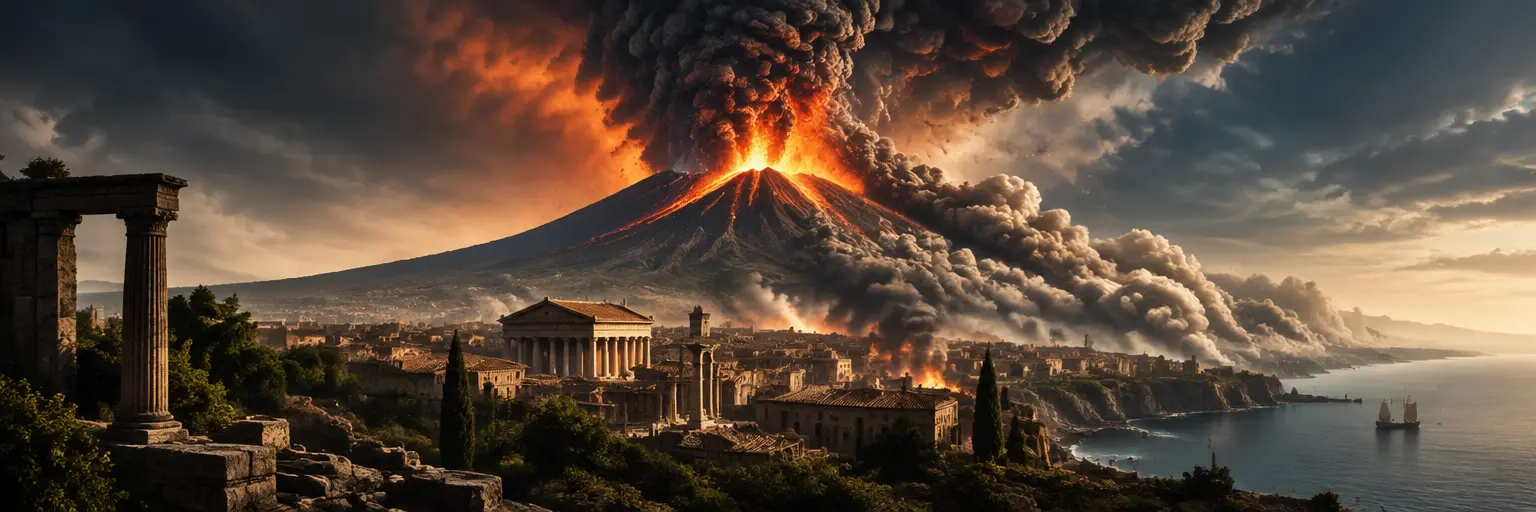
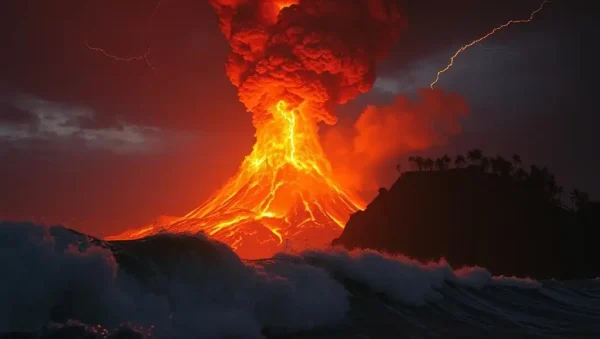
Around 1600 BCE, the island of Thera (modern Santorini) erupted with a force estimated at 40 times that of Krakatoa, spewing ash across the eastern Mediterranean. This catastrophic event buried the vibrant Minoan city of Akrotiri under meters of pumice and triggered massive tsunamis that devastated coastal settlements on Crete, the heart of Minoan power. The eruption severely weakened their economy, naval strength, and food supplies, opening the door for mainland Greek (Mycenaean) conquest. Recent ice-core and tree-ring studies suggest the eruption’s volcanic winter may have caused years of crop failures, accelerating the civilization’s decline.
For history buffs and volcanologists alike, Thera offers a stark case study in how a single eruption can dismantle a superpower of its era. The Minoan fall is not merely a legend—archaeological evidence reveals abandoned palaces, broken trade networks, and a rapid cultural shift. By examining sediment layers and tsunami deposits, researchers reconstruct the day-by-day horror. This subcategory provides timelines, interactive maps of the ash dispersal, and firsthand accounts from ancient texts that may reference the event, such as the eruption’s possible link to the biblical plagues. Understanding Thera helps us gauge modern risks for densely populated volcanic islands like Japan or Indonesia.
🏺 The Roman Empire’s Forgotten Volcanic Crises
While Vesuvius’s 79 CE eruption buried Pompeii, other volcanic events quietly undermined Roman stability. The massive 536 CE eruption (likely from an unknown volcano, possibly in Iceland or North America) veiled Europe in a dry fog, collapsing temperatures and causing famine that killed millions. Chroniclers like Procopius described a “sun without brightness” that lasted over a year, leading to plague, political unrest, and the eventual weakening of Eastern Rome. Additionally, the 472 CE eruption of Vesuvius deposited ash as far as Constantinople, disrupting grain shipments and fueling inflation. These climate anomalies are now confirmed by ice cores that show sulfate spikes precisely matching those years.
This section explores how volcanic aerosols triggered the Late Antique Little Ice Age, a period of social upheaval that facilitated the rise of Islam and the collapse of the Western Roman Empire. You will find comparative analyses of eruption data from Greenland and Antarctic ice sheets, linking specific sulfate signals to historical records of famine and barbarian invasions. The Roman case demonstrates that even the mightiest armies are no match for atmospheric forcing. For modern policymakers, it underscores the need for global food reserves and climate resilience, as a similar event today would cripple global agriculture within months.
🌾 The Maya Collapse: Volcanic Ash and Drought
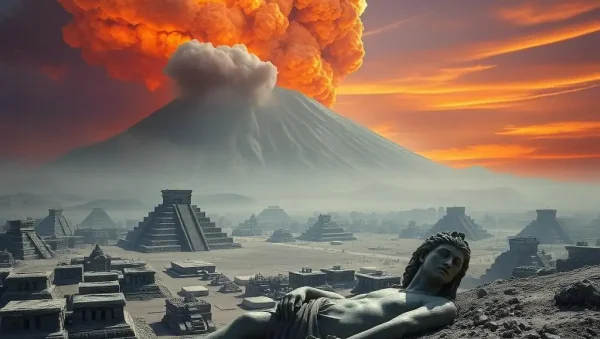
For centuries, the ancient Maya in Central America thrived, but between 750 and 950 CE, their civilization fragmented into warring city-states. While overpopulation and deforestation played roles, new paleoclimate research links volcanic eruptions to extended droughts that shattered their agricultural base. Analyses of lake sediments in the Yucatán reveal distinct layers of volcanic ash from the El Chichón volcano (c. 800 CE) mixed with evidence of severe evapotranspiration. The eruption’s sulfate aerosols disrupted the monsoon patterns, causing multi-year dry spells that led to famine, migration, and the collapse of monumental construction. Tree-ring chronologies from the region confirm these dry periods, aligning with the abandonment of major sites like Tikal and Copán.
Here, you’ll discover how volcanology meets archaeology to solve one of history’s greatest mysteries. We provide high-resolution climate models showing how a single eruption can tip a fragile tropical ecosystem into water stress. The Maya example is crucial for contemporary Central America, where millions live near active volcanoes like Fuego and Pacaya. By understanding how pre-industrial societies failed to adapt, we can better design water conservation and fungiculture systems to prevent future collapses. This subcategory also offers satellite imagery of ancient reservoirs and cisterns, illustrating how advanced the Maya were—yet even their engineering could not offset years of volcanic winter.
⚔️ Tambora 1815: The Year Without a Summer and Global Famine
When Mount Tambora in Indonesia erupted in April 1815, it was the largest in recorded history, expelling 160 cubic kilometers of material. The subsequent volcanic winter, termed the “Year Without a Summer” in 1816, caused snow in July in New England, crop failures across Europe, and a typhus pandemic in Ireland. This led to the deaths of an estimated 100,000 people worldwide from starvation and disease. The eruption directly destabilized many political regimes, triggering food riots in France, mass emigration from Switzerland, and even the invention of the bicycle as people sought cheaper transportation for scarce grain. Historians argue this period influenced the writing of Mary Shelley’s Frankenstein during that gloomy summer.
In this section, you will read primary sources—diaries, ship logs, and government decrees—that capture the despair and resilience of societies facing sudden climatic chaos. We break down the eruption mechanics, from its massive plume to the sulfate aerosols that circled the globe, and correlate them with temperature records from Europe, North America, and Asia. Tambora remains the benchmark for evaluating worst-case eruption scenarios, such as a future Yellowstone supereruption. For those studying disaster response, this historical case provides invaluable lessons on international aid, food storage, and the economic cascades that follow a single geological event.
🏜️ The Greenland Norse: Eruptions, Isolation, and Extinction
The Norse settlements in Greenland (c. 985–1450 CE) mysteriously vanished, and volcanic activity played a key role in their demise. Ice cores from Greenland show a series of major eruptions in the 1340s and 1380s that caused severe volcanic winters, leading to short growing seasons and advancing sea ice that blocked supply ships from Europe. The Norse relied on cattle and hay, which could not withstand prolonged cold, while the nearby Inuit thrived by hunting marine mammals. Archaeological digs reveal that the Norse ate seabirds and seals in desperation, but their refusal to abandon European lifestyles proved fatal. By 1450, the last skeleton was buried as the colony starved.
This subcategory contrasts the Norse failure with the Inuit’s successful adaptation, highlighting how cultural rigidities amplify volcanic risks. You will analyze paleoenvironmental records—such as insect remains and pollen studies—that track the growing cold. The Greenland saga serves as a warning for modern Arctic communities facing both volcanic and climate-induced changes. We also present GIS reconstructions of fjord ice extent and trade route blockages to illustrate how a few eruptions can sever remote populations. For anthropologists, this is a compelling case of environmental determinism, but for volcanologists, it’s a reminder that eruptions do not just affect those in the blast zone—they ripple across continents and decades.
Frequently Asked Questions
Can a volcanic eruption actually cause the fall of an entire civilization?
Yes, though usually as a trigger rather than a sole cause. A volcanic eruption can initiate cascading effects—crop failure, economic ruin, disease, and political instability—that overwhelm a society already stressed by drought, war, or overpopulation. The Minoan and Roman cases show that even empire-level systems can collapse if the eruption’s climate impact lasts for years.
How do researchers link an ancient eruption to a civilization’s decline?
Researchers use ice cores, lake sediments, and tree rings to identify volcanic sulfate spikes and ash layers that align with dates of historical abandonment. Radiocarbon dating of organic material above or below ash deposits helps pinpoint the timeline. They then compare these records to historical texts, archaeological artifacts, and pollen evidence showing abrupt agricultural decline.
Are there any civilizations that successfully adapted to volcanic eruptions?
Yes—the Inuit in Greenland adapted by switching to marine hunting during volcanic winters, unlike the Norse who perished. Similarly, some Polynesian cultures shifted crop types after eruptions. Modern adaptations include earthquake-resistant buildings, volcano monitoring, and diversified food sources, but historical successes are rare and often require flexible cultural practices.
Which volcanic eruption is considered the most impactful on human history?
Mount Tambora in 1815 is arguably the most impactful because of its well-documented global effects—causing a “Year Without a Summer” that led to famines and disease across the Northern Hemisphere. However, the Thera eruption is also historically crucial as it may have wiped out the Minoan civilization and inspired the Atlantis myth.
Could a future eruption trigger a similar collapse in modern civilization?
Yes, a supereruption like Toba or Yellowstone could inject enough sulfur to lower global temperatures by several degrees for years, disrupting agriculture worldwide. Modern civilization relies on globalized food supply chains, which would fail without international coordination. However, our monitoring systems and emergency planning provide a buffer, but they are not fully tested against a century-scale event.