
Frozen History: Unearthing the Volcanic Link to the Little Ice Age

Welcome to Volcano Explorers, where the earth whispers secrets in fire and ash. Ever wonder what frozen landscapes have to do with molten rock? Prepare to uncover a chilling connection as we delve into the fascinating link between volcanic activity and the Little Ice Age. Get ready to explore how eruptions of the past may have shaped the climate we know today... and what that means for tomorrow.
- Introduction: The Little Ice Age and the Volcanic Activity Connection
- Deciphering the Climate Puzzle: Understanding Volcanic Forcing
- Major Eruptions and the Little Ice Age: A Timeline of Events
- Ice Core Evidence: Unveiling the Volcanic Fingerprint in Greenland and Antarctic Ice
- Beyond Sulfate Aerosols: Other Volcanic Impacts on the Little Ice Age
- The Debate Continues: Alternative Theories for the Little Ice Age
- The Legacy of the Little Ice Age: Lessons for Today's Climate Challenges
- Conclusion: Volcanic Activity as a Significant, but Complex, Factor in the Little Ice Age
-
Frequently Asked Questions
- How did volcanic activity contribute to the Little Ice Age?
- What evidence supports the connection between volcanic activity and the Little Ice Age?
- What specific volcanic eruptions are linked to the Little Ice Age?
- How do scientists study the relationship between volcanic activity and past climate?
- Does ongoing volcanic activity pose a threat to our current climate?
- Final Reflection: Echoes of Fire and Ice
- Unveil Earth's Secrets: Your Journey Begins Now!
Introduction: The Little Ice Age and the Volcanic Activity Connection
Setting the Stage: Defining the Little Ice Age Period
The Little Ice Age (LIA) was a period of regional cooling, particularly pronounced in the Northern Hemisphere, that occurred after the Medieval Warm Period. While not a true ice age, this era, roughly spanning from the 13th to the mid-19th centuries, witnessed colder winters, shorter growing seasons, and glacial expansion in many parts of the world. The LIA was not uniformly cold across all regions or consistently cold throughout its duration.
Instead, it was characterized by fluctuations, with periods of more intense cooling interspersed with milder intervals. Evidence for the Little Ice Age comes from a variety of sources, including historical records, tree rings, ice cores, and glacial geology, all pointing to a period of significant climate variability and generally cooler temperatures compared to the preceding and succeeding periods.
The impacts of the Little Ice Age were far-reaching, affecting societies and ecosystems globally. In Europe, for instance, rivers and canals frequently froze over, impacting transportation and trade. Agriculture suffered from shorter growing seasons and increased frost frequency, leading to crop failures and famines in some areas. Art and literature from the period often depict harsh winters and societal adjustments to colder conditions. Understanding the Little Ice Age is not just a matter of historical curiosity; it provides valuable insights into the Earth's climate system and the factors that can drive significant climate shifts on relatively short timescales.
Introducing the Theory: Volcanic Eruptions as a Climate Driver
Among the various theories proposed to explain the Little Ice Age, the role of volcanic eruptions has emerged as a prominent and compelling factor. The theory posits that large volcanic eruptions, particularly those that inject significant amounts of sulfur dioxide into the stratosphere, can lead to a temporary cooling of the Earth's climate.
This cooling effect occurs because sulfur dioxide reacts with water vapor to form sulfate aerosols, which are tiny particles that reflect incoming solar radiation back into space, reducing the amount of sunlight reaching the Earth's surface. The idea that volcanic activity could be a significant driver of the Little Ice Age has gained considerable traction in the scientific community, supported by both historical records of eruptions and paleoclimate data.
The connection between volcanic eruptions and climate cooling is not a new concept. Benjamin Franklin, for example, in 1784, attributed the unusually cold winter of 1783-84 in Europe to the massive Laki eruption in Iceland.
However, it was only in the late 20th and early 21st centuries, with advancements in climate science, ice core analysis, and climate modeling, that the potential role of volcanism in the Little Ice Age began to be rigorously investigated and quantified. Today, many researchers believe that a series of large volcanic eruptions, clustered particularly during certain periods within the LIA, played a crucial role in initiating and sustaining the cooler temperatures characteristic of this era.
Deciphering the Climate Puzzle: Understanding Volcanic Forcing
How Volcanic Eruptions Impact Global Temperatures
Volcanic eruptions don't just spew lava and ash; they also release gases into the atmosphere, some of which have a significant impact on global temperatures. While greenhouse gases like carbon dioxide are also emitted, their warming effect is overshadowed, in the short term, by the cooling effect of sulfur dioxide. When a volcano erupts explosively, it can inject sulfur dioxide gas high into the stratosphere, above the troposphere where weather occurs. In this stable region of the atmosphere, the sulfur dioxide can persist for months to years, undergoing chemical reactions to form sulfate aerosols.
These sulfate aerosols act as tiny mirrors in the stratosphere, reflecting a portion of incoming solar radiation back to space. This reduction in solar energy reaching the Earth's surface leads to a decrease in global average temperatures. The magnitude of the cooling effect depends on several factors, including the size and sulfur content of the eruption, the altitude to which the aerosols are injected, and the prevailing atmospheric conditions. Major eruptions in the tropics tend to have a more global impact because stratospheric winds can distribute aerosols more evenly across both hemispheres.
Sulfate Aerosols: The Key Player in Volcanic Cooling
Sulfate aerosols are the primary agents responsible for volcanic cooling. These microscopic particles, typically ranging in size from 0.1 to 1 micrometer, are highly effective at scattering sunlight. They increase the Earth's albedo, which is the reflectivity of the planet, causing more solar radiation to be reflected back to space and less to be absorbed by the Earth's surface and atmosphere. The effectiveness of sulfate aerosols in scattering sunlight is maximized at wavelengths relevant to solar radiation, making them particularly potent climate forcing agents.
The lifetime of sulfate aerosols in the stratosphere is typically about 1 to 2 years. Over time, these aerosols gradually settle out of the stratosphere due to gravity and atmospheric processes. This relatively short lifespan means that the cooling effect of a volcanic eruption is transient.
However, if multiple large eruptions occur in relatively short succession, the cumulative effect of these eruptions can lead to a more prolonged period of cooling, potentially contributing to longer-term climate shifts like the Little Ice Age. The composition and size distribution of the aerosols also influence their radiative properties and lifetime in the stratosphere.
The Long-Term Effects of Volcanic Aerosols on Climate
While the immediate cooling effect of volcanic aerosols is well-established, the longer-term impacts on climate are more complex and involve various feedback mechanisms within the Earth's climate system. Beyond the direct reflection of solar radiation, volcanic aerosols can also influence atmospheric circulation patterns, ocean temperatures, and even cloud formation. For instance, changes in atmospheric temperature gradients due to volcanic cooling can alter jet streams and wind patterns, affecting regional climate conditions.
Furthermore, volcanic eruptions can have indirect effects on the carbon cycle. Cooler temperatures can lead to increased carbon uptake by the oceans and terrestrial ecosystems, potentially drawing down atmospheric carbon dioxide levels over longer timescales. However, the magnitude and direction of these longer-term feedbacks are still subjects of ongoing research. It's important to recognize that volcanic forcing is just one piece of the complex climate puzzle, and its interaction with other natural climate variations and, more recently, human-induced climate change, needs to be considered to fully understand its role in shaping Earth's climate history and future.
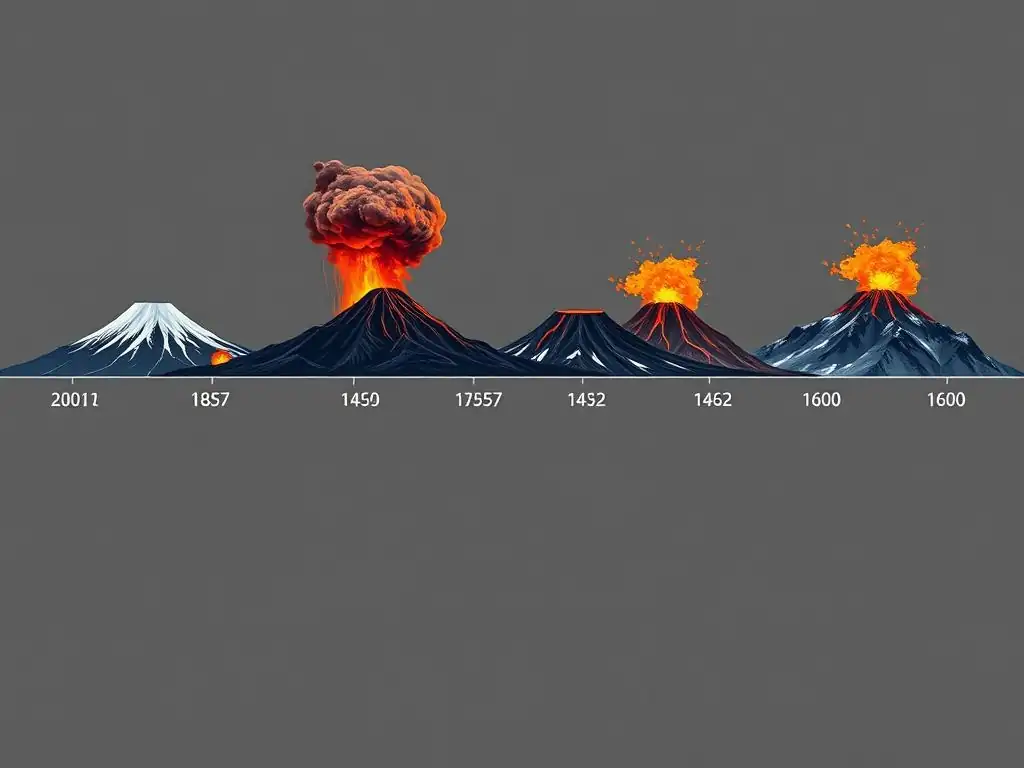
Major Eruptions and the Little Ice Age: A Timeline of Events
The Mystery of the 13th Century: Documenting Major Eruptions and Their Potential Impact
The 13th century is marked by several enigmatic climate anomalies and hints of significant volcanic activity. While specific dates and locations for all major eruptions remain uncertain due to limited historical records, evidence from ice cores suggests a series of powerful volcanic events occurred during this period.
Ice core data from Greenland and Antarctica shows elevated sulfate deposition, indicative of large stratospheric volcanic eruptions. These volcanic signals, though not precisely dated in some cases, point to a period of heightened volcanic activity that could have initiated or contributed to early cooling trends associated with the onset of the Little Ice Age.
Determining the exact impact of these 13th-century eruptions is challenging due to the uncertainties in dating and eruption magnitudes. However, climate reconstructions based on tree rings and other proxies suggest that the 13th century experienced periods of unusually cold summers and glacial advances in some regions.
The combination of ice core evidence for volcanic eruptions and proxy climate data hinting at cooling during this time period strengthens the hypothesis that volcanic forcing played a role in the early stages of the Little Ice Age. Further research is needed to refine the chronology of 13th-century eruptions and their precise climatic consequences.
The 1450s: A Period of Intense Volcanic Activity and Climate Shift
The 1450s stand out as a decade of particularly intense volcanic activity, coinciding with a pronounced shift towards colder conditions in many parts of the world. Ice core records reveal a cluster of large volcanic eruptions occurring in close succession during this decade. These eruptions are believed to have injected massive amounts of sulfate aerosols into the stratosphere, leading to a significant and sustained period of global cooling. The 1450s are often cited as a critical period in the onset of the Little Ice Age, with volcanic forcing playing a central role in driving this climate transition.
Historical records from Europe and Asia also corroborate the climate shift observed in proxy data during the 1450s. Accounts of unusually severe winters, crop failures, and famines become more frequent around this time. Glacial advances in mountain ranges worldwide also accelerated during the mid-15th century. The convergence of volcanic evidence from ice cores, climate proxy records, and historical accounts strongly suggests that the volcanic eruptions of the 1450s had a profound and widespread impact on global climate, pushing the Earth system into a colder state that characterized the Little Ice Age.
The Kuwae Eruption: A Potential Trigger for the Little Ice Age Onset
Among the eruptions of the 1450s, the eruption of Kuwae volcano in the Vanuatu archipelago is considered a prime candidate for a major trigger of the Little Ice Age onset. While the exact year of the Kuwae eruption is debated, with estimates ranging from 1452 to 1458, ice core evidence points to a massive volcanic event around this time.
The sulfate signal in ice cores associated with Kuwae is exceptionally large, suggesting that it was one of the largest volcanic eruptions of the last millennium. The estimated sulfur dioxide release from Kuwae is comparable to or even greater than the Tambora eruption of 1815.
Climate model simulations that incorporate the estimated radiative forcing from the Kuwae eruption show a significant global cooling, consistent with the observed climate shift in the mid-15th century. Tree ring data and other climate proxies also exhibit a distinct cooling signal around the time of the Kuwae eruption.
While other volcanic eruptions likely contributed to the cooling of the 1450s, the Kuwae eruption stands out as a particularly powerful event that may have acted as a critical tipping point, pushing the climate system into a new, colder regime. The precise timing and magnitude of the Kuwae eruption and its detailed climatic impacts remain active areas of research.
The Tambora Eruption (1815): The "Year Without a Summer" and its Connection to the Little Ice Age
The eruption of Mount Tambora in Indonesia in April 1815 is arguably the most famous volcanic eruption associated with climate cooling and is often referred to as the "Year Without a Summer" in 1816. This colossal eruption, rated a 7 on the Volcanic Explosivity Index (VEI), injected an estimated 50-60 teragrams of sulfur dioxide into the stratosphere.
The resulting sulfate aerosol cloud caused a significant decrease in global temperatures in the years following the eruption. 1816 was characterized by widespread crop failures, famine, and social unrest in many parts of the world, particularly in North America and Europe, due to the unusually cold and stormy weather.
While the Tambora eruption occurred towards the end of the Little Ice Age, its impact serves as a stark reminder of the power of volcanic eruptions to disrupt global climate. The "Year Without a Summer" provides a clear example of the immediate and dramatic cooling that can result from a large stratospheric volcanic injection.
Although the Little Ice Age was already in a declining phase by the early 19th century, the Tambora eruption likely exacerbated the existing cold conditions and contributed to the last gasp of the Little Ice Age climate regime. The event also highlighted the vulnerability of societies to climate shocks and underscored the potential for volcanic eruptions to trigger widespread societal impacts.
Ice Core Evidence: Unveiling the Volcanic Fingerprint in Greenland and Antarctic Ice
Analyzing Ice Core Data: Identifying Volcanic Sulfate Deposits
Ice cores retrieved from Greenland and Antarctica provide invaluable archives of past volcanic activity and climate conditions. As snow accumulates and compresses into ice over time, it traps atmospheric particles and gases, including sulfate aerosols from volcanic eruptions. Scientists analyze ice cores layer by layer, with each layer representing a specific time period, to reconstruct a timeline of volcanic eruptions and their atmospheric impact. Elevated concentrations of sulfate in ice core layers serve as fingerprints of past volcanic events.
The sulfate deposited in ice cores is primarily derived from sulfur dioxide gas injected into the stratosphere during volcanic eruptions. By measuring the concentration of sulfate ions in ice core samples, scientists can identify the timing and relative magnitude of past eruptions.
Furthermore, by analyzing the chemical composition of the sulfate, researchers can sometimes even distinguish between eruptions from different volcanic regions. Ice core data provides a continuous and high-resolution record of volcanic activity extending back hundreds of thousands of years, making it a crucial tool for understanding the role of volcanism in long-term climate variability, including the Little Ice Age.
Correlating Volcanic Signals with Climate Records: A Clearer Picture Emerges
By comparing volcanic sulfate records from ice cores with other paleoclimate archives, such as tree rings, lake sediments, and historical documents, scientists can establish a clearer picture of the relationship between volcanic activity and climate change during the Little Ice Age. When periods of high volcanic sulfate deposition in ice cores coincide with evidence of colder temperatures from other climate proxies, it strengthens the case for a causal link between volcanic eruptions and cooling.
Numerous studies have found such correlations, particularly for the 13th, 15th, and 17th centuries, periods marked by both significant volcanic activity and pronounced cooling during the Little Ice Age.
These correlations are not merely coincidental; statistical analyses and climate modeling studies further support the hypothesis that volcanic forcing played a significant role in driving the cooler temperatures of the Little Ice Age. While natural climate variability and other factors also contributed, the strong temporal correspondence between volcanic eruptions and cooling periods, as revealed by ice core and proxy climate data, provides compelling evidence for the influence of volcanic activity on the climate of the Little Ice Age.
This interdisciplinary approach, combining ice core analysis with other paleoclimate records, is essential for unraveling the complex interplay of factors that shaped past climate changes.
Limitations of Ice Core Data: Addressing uncertainties and potential biases
While ice core data is incredibly valuable, it's important to acknowledge its limitations and potential uncertainties when interpreting volcanic records and their climate impacts. One limitation is the dating uncertainty associated with ice core layers, particularly for older sections of the core. While dating techniques are constantly improving, there is still some inherent uncertainty in assigning precise dates to volcanic events recorded in ice cores. This dating uncertainty can make it challenging to precisely correlate volcanic eruptions with specific climate anomalies.
Another limitation is the potential for post-depositional processes to alter the volcanic sulfate signal in ice cores. Sulfate can migrate within the ice over time, potentially smoothing out or distorting the original volcanic record. Furthermore, not all volcanic eruptions are equally well-recorded in ice cores.
Eruptions at lower latitudes may deposit less sulfate at the polar ice sheets compared to high-latitude eruptions. Despite these limitations, ice core data remains a powerful tool for reconstructing past volcanic activity and its climate impacts, especially when used in conjunction with other paleoclimate archives and climate modeling approaches. Researchers are continually working to refine ice core dating techniques and improve our understanding of post-depositional processes to enhance the accuracy and reliability of volcanic records from ice cores.
Beyond Sulfate Aerosols: Other Volcanic Impacts on the Little Ice Age
Volcanic Ash and Albedo: Explaining the Impact of Ash on Solar Radiation Reflection
While sulfate aerosols are the primary driver of volcanic cooling, volcanic ash, also known as tephra, can also contribute to climate impacts, particularly on a regional scale and over shorter timescales. Volcanic ash consists of fine particles of rock, mineral, and volcanic glass erupted during explosive eruptions. When large quantities of ash are injected into the atmosphere, they can reflect incoming solar radiation back to space, increasing the Earth's albedo, similar to sulfate aerosols. However, the effects of volcanic ash are generally shorter-lived and more localized compared to sulfate aerosols.
Volcanic ash particles are typically larger and heavier than sulfate aerosols, causing them to settle out of the atmosphere more quickly, usually within days to weeks. Heavy ashfall can have significant regional impacts, darkening skies, reducing sunlight penetration, and disrupting ecosystems. In areas directly downwind of a major eruption, ashfall can lead to localized cooling and reduced agricultural productivity. While volcanic ash is not considered a major global climate forcing agent over long periods like the Little Ice Age, it can contribute to regional cooling and exacerbate the impacts of sulfate aerosol-induced cooling in areas affected by significant ashfall.
Ocean Circulation Changes: Investigating Potential Volcanic Influence on Ocean Currents
Volcanic eruptions, through their impact on atmospheric temperatures and wind patterns, can potentially influence ocean circulation, which in turn can have significant effects on regional and global climate. Changes in atmospheric temperature gradients caused by volcanic cooling can alter wind stress on the ocean surface, potentially modifying ocean currents and heat transport. Some research suggests that volcanic eruptions may have played a role in changes in North Atlantic ocean circulation patterns during the Little Ice Age.
For example, a weakening of the Atlantic Meridional Overturning Circulation (AMOC), a major ocean current system that transports warm water northward in the Atlantic, has been proposed as a contributing factor to the Little Ice Age. While the exact mechanisms are still debated, it's hypothesized that volcanic cooling could have altered atmospheric conditions in the North Atlantic, leading to a slowdown of the AMOC and reduced heat transport to the North Atlantic region.
Changes in ocean circulation are complex and influenced by multiple factors, and the precise role of volcanic forcing in driving ocean circulation changes during the Little Ice Age remains an active area of research.
Feedback Mechanisms: Discussing the Interplay of Volcanic Activity and Other Climate Factors
The climate system is complex and interconnected, with various feedback mechanisms amplifying or dampening the initial forcing from volcanic eruptions. For instance, volcanic cooling can lead to increased snow and ice cover, which further increases Earth's albedo, enhancing the initial cooling effect – this is known as the ice-albedo feedback. Similarly, cooler temperatures can reduce water vapor in the atmosphere, a potent greenhouse gas, leading to further cooling – the water vapor feedback. These positive feedback mechanisms can amplify the initial climate response to volcanic forcing.
Conversely, there are also negative feedback mechanisms that can dampen the volcanic cooling. For example, as the Earth cools, it emits less infrared radiation to space, reducing the energy imbalance caused by volcanic aerosols and partially offsetting the cooling. The interplay of positive and negative feedback mechanisms determines the overall climate response to volcanic eruptions and the duration and magnitude of the cooling effect. Understanding these feedback processes is crucial for accurately modeling the climate impacts of volcanic eruptions and their role in longer-term climate changes like the Little Ice Age.
The Debate Continues: Alternative Theories for the Little Ice Age
Solar Variability: Discussing the Role of Solar Activity in Climate Fluctuations
While volcanic forcing is a leading contender for explaining the Little Ice Age, other natural climate drivers have also been proposed, including variations in solar activity. The Sun's energy output is not constant; it fluctuates over various timescales, including the 11-year solar cycle and longer-term variations.
Periods of lower solar activity, such as the Maunder Minimum (roughly 1645 to 1715), which coincided with a particularly cold phase of the Little Ice Age, have been suggested as contributing to the cooler temperatures. Reduced solar irradiance during periods of low solar activity would lead to less energy input into the Earth's climate system, potentially causing cooling.
However, the magnitude of solar variability is relatively small compared to volcanic forcing. While solar changes may have contributed to some of the temperature fluctuations during the Little Ice Age, most studies suggest that solar forcing alone is unlikely to be the primary driver of the overall cooling trend.
The timing and magnitude of volcanic eruptions, particularly those clustered in the 13th, 15th, and 17th centuries, align more closely with the major cooling phases of the Little Ice Age than solar variability alone. It's likely that both volcanic activity and solar variability, along with other factors, played a role in shaping the climate of the Little Ice Age, with volcanic forcing being a more dominant influence.
Changes in Ocean Circulation: Exploring Natural Variations in Ocean Currents
Natural variations in ocean circulation patterns are another potential factor that could have contributed to the Little Ice Age. As discussed earlier, changes in the Atlantic Meridional Overturning Circulation (AMOC) have been implicated in past climate shifts. A slowdown of the AMOC would reduce the transport of warm water to the North Atlantic, potentially leading to cooling in the North Atlantic region and surrounding landmasses. Natural variability within the ocean system can cause fluctuations in the strength of the AMOC and other major ocean currents.
Paleoclimate evidence suggests that changes in ocean circulation may have occurred during the Little Ice Age, potentially contributing to regional cooling, particularly in the North Atlantic. However, the extent to which these ocean circulation changes were driven by internal climate variability versus external forcing, such as volcanic eruptions, is still debated.
It's possible that volcanic eruptions could have triggered or amplified changes in ocean circulation, further contributing to the overall cooling of the Little Ice Age. Disentangling the complex interplay between volcanic forcing, ocean circulation variability, and other climate factors is a key challenge in understanding the Little Ice Age.
Land Use Changes: Investigating Deforestation and Agricultural Practices
Changes in land use, particularly deforestation and agricultural practices, have also been proposed as a potentially contributing factor to the Little Ice Age, although their role is less well-established compared to volcanic forcing and solar variability. Deforestation can increase the albedo of the land surface, as forests are generally darker and absorb more solar radiation than open land or agricultural areas. Increased albedo from deforestation could lead to regional cooling, particularly in areas with extensive land clearing.
Furthermore, changes in agricultural practices, such as the abandonment of agricultural land during periods of population decline or climate stress, could also affect land surface albedo and carbon cycling. However, the magnitude of the global cooling effect from land use changes during the Little Ice Age is thought to be relatively small compared to volcanic forcing.
While land use changes may have contributed to regional climate variations or amplified cooling in certain areas, they are unlikely to be the primary driver of the global-scale cooling associated with the Little Ice Age. The relative importance of land use changes compared to volcanic forcing and other factors is still a subject of ongoing research.
The Legacy of the Little Ice Age: Lessons for Today's Climate Challenges
Understanding Past Climate Changes to Predict Future Scenarios
Studying the Little Ice Age provides valuable insights into the Earth's climate system and its sensitivity to natural climate forcings, such as volcanic eruptions and solar variability. By understanding how the climate system responded to these forcings in the past, we can improve our ability to predict future climate changes, both natural and human-induced. The Little Ice Age serves as a natural experiment, demonstrating the potential for relatively rapid and significant climate shifts on timescales of decades to centuries.
Analyzing the Little Ice Age also helps us to understand the complex interplay of different climate forcings and feedback mechanisms. It highlights the importance of considering multiple factors when assessing past and future climate changes.
Furthermore, studying the societal impacts of the Little Ice Age provides lessons about human vulnerability to climate variability and the need for adaptation strategies. The Little Ice Age underscores the fact that climate change is a natural part of Earth's history, but also emphasizes the potential for significant societal disruptions even from natural climate fluctuations, which becomes even more relevant in the context of current human-induced climate change.
The Ongoing Threat of Volcanic Eruptions and Climate Change
Volcanic eruptions remain a natural hazard that can pose significant risks to human societies and the global climate system. While we cannot prevent volcanic eruptions, understanding their potential climate impacts is crucial for preparedness and mitigation efforts. Large volcanic eruptions can still occur in the future, and their cooling effect could temporarily offset some of the warming caused by human greenhouse gas emissions. However, the cooling effect of volcanic eruptions is transient, lasting only a few years, whereas the warming effect of greenhouse gases is long-lasting.
Furthermore, the societal impacts of a major volcanic eruption in today's interconnected world could be substantial, potentially disrupting global supply chains, air travel, and agriculture. Monitoring volcanic activity and improving our ability to forecast eruptions are essential for reducing volcanic risks. Integrating volcanic forcing into climate models is also crucial for making accurate climate projections and understanding the full range of factors that can influence future climate change. The threat of volcanic eruptions, both in terms of direct hazards and climate impacts, remains a relevant concern in the 21st century.
The Importance of Continued Research and Monitoring of Volcanic Activity
Continued research on volcanic eruptions and their climate impacts is essential for improving our understanding of the Earth's climate system and mitigating volcanic risks. This research includes monitoring active volcanoes, studying past eruptions through ice cores and other geological archives, and developing more sophisticated climate models that incorporate volcanic forcing. Improved monitoring of volcanic activity can help to provide early warnings of potential eruptions, allowing for timely evacuations and reducing the direct hazards to populations living near volcanoes.
Further research on past eruptions and their climate impacts can refine our understanding of the magnitude and duration of volcanic cooling, as well as the complex feedback mechanisms involved. Developing more comprehensive climate models that accurately represent volcanic processes and their interactions with other climate components is crucial for making more reliable climate projections and assessing the potential risks of future volcanic eruptions in a changing climate. Continued investment in volcanic research and monitoring is vital for both fundamental climate science and societal preparedness for natural hazards.
Conclusion: Volcanic Activity as a Significant, but Complex, Factor in the Little Ice Age
Summarizing the Evidence: The Volcanic Contribution to the Little Ice Age
The evidence strongly suggests that volcanic activity played a significant role in driving the cooler temperatures of the Little Ice Age. Ice core records reveal periods of heightened volcanic activity, particularly in the 13th, 15th, and 17th centuries, coinciding with major cooling phases of the LIA. The injection of sulfate aerosols into the stratosphere from large volcanic eruptions is a well-established mechanism for global cooling. Climate model simulations and paleoclimate proxy data further support the hypothesis that volcanic forcing was a key driver of the Little Ice Age climate.
While other factors, such as solar variability and ocean circulation changes, may have also contributed to the Little Ice Age, volcanic eruptions appear to be a dominant forcing mechanism, particularly for the periods of most intense cooling. The cluster of large eruptions in the 1450s, including the Kuwae eruption, is considered a potential trigger for the onset of the Little Ice Age.
The Tambora eruption of 1815, although occurring at the tail end of the LIA, provides a striking example of the immediate and dramatic cooling that can result from a major volcanic event. Volcanic activity should be considered a significant, albeit complex and intermittent, factor in the climate history of the Little Ice Age.
Future Research Directions: Suggesting Areas for Further Investigation
Despite significant progress in understanding the role of volcanic activity in the Little Ice Age, several research areas warrant further investigation. Refining the dating and magnitude estimates of past volcanic eruptions, particularly those from the pre-instrumental period, is crucial for improving our understanding of volcanic forcing. Further research is needed to better quantify the sulfur dioxide release and aerosol characteristics of past eruptions, and to improve the representation of volcanic processes in climate models.
Investigating the regional climate impacts of volcanic eruptions during the Little Ice Age, and how these impacts varied across different parts of the world, is another important research direction. Understanding the complex interactions between volcanic forcing, ocean circulation changes, and other climate factors is essential for a more complete picture of the Little Ice Age climate. Finally, continued research on the societal impacts of volcanic eruptions, both in the past and present, is crucial for enhancing resilience and preparedness in the face of future volcanic events and their potential climate consequences.
Frequently Asked Questions
How did volcanic activity contribute to the Little Ice Age?
Volcanic eruptions released large amounts of sulfate aerosols into the stratosphere. These aerosols reflected sunlight, leading to a global cooling effect that contributed to the Little Ice Age.
What evidence supports the connection between volcanic activity and the Little Ice Age?
Ice core samples reveal spikes in sulfate deposits coinciding with periods of intense volcanic activity. These spikes correspond with the coldest periods of the Little Ice Age.
What specific volcanic eruptions are linked to the Little Ice Age?
Several large eruptions, including those of Tambora (1815) and unknown eruptions in the 13th and 15th centuries, are strongly linked to the onset and intensification of the Little Ice Age.
How do scientists study the relationship between volcanic activity and past climate?
Scientists analyze ice cores, tree rings, and sedimentary layers to reconstruct past volcanic eruptions and their impact on global temperatures. This helps to understand the influence of volcanic forcing on climate.
Does ongoing volcanic activity pose a threat to our current climate?
Yes, while not on the scale of the Little Ice Age, ongoing volcanic eruptions can release aerosols that temporarily cool the planet. However, the impact of human-caused greenhouse gas emissions far outweighs the cooling effect of modern volcanic activity.
Final Reflection: Echoes of Fire and Ice
The evidence presented throughout this article underscores a profound truth: volcanic activity and climate are inextricably linked. The Little Ice Age, once a historical anomaly, now serves as a stark reminder of the power of natural forces to reshape our world, a power that remains potent and relevant in our era of accelerating climate change. Understanding the volcanic fingerprints on past climate events is not just an academic exercise; it's crucial for predicting and mitigating future environmental shifts.
The impact of the Little Ice Age resonated deeply through societies, shaping economies, cultures, and even artistic expression. This connection between natural events and human experience highlights the fragility of our civilization and the importance of respecting the delicate balance of our planet. The past is never dead. It's not even past.
- William Faulkner. This quote resonates profoundly when considering the Little Ice Age; its lessons are not confined to history books but echo in the challenges we face today.
As we navigate the complexities of our changing climate, let us remember the lessons etched in the frozen history of the Little Ice Age. Consider the power of volcanic eruptions, not just as destructive forces, but as key pieces in the intricate puzzle of Earth's climate system. Let us use this knowledge to inform our actions, to mitigate our impact, and to build a more resilient future for generations to come. The story of the Little Ice Age is a call to awareness, a call to action, and a call to hope.
Unveil Earth's Secrets: Your Journey Begins Now!
Thank you for exploring the fascinating connection between volcanic eruptions and the Little Ice Age! You've gained invaluable insights into how powerful volcanic forces shape our climate. Now, it's time to join the Volcano Explorers community and take the next step!
Here's how you can delve deeper:
- Explore historical volcanic records, comparing eruption dates with documented shifts in global temperatures to further understand this complex relationship.
- Share this article to spark conversations about the profound impact of volcanic activity on our planet's climate.
- Contribute to citizen science by submitting your observations of local weather anomalies or geological events to relevant databases, helping build a more comprehensive understanding.
What piece of the Earth’s volcanic puzzle will you help uncover next? Share your thoughts and planned actions in the comments below!