
Sulfur Dioxide's Signal? Did Gas Emissions Warn of Mount Pelée's Impending Fury?

Welcome to Volcano Explorers, where we uncover the Earth's fiery secrets. But what if the key to predicting a catastrophic eruption lies not in the trembling ground, but in the very air we breathe? Today, we delve into the infamous 1902 eruption of Mount Pelée and explore a chilling question: Did a surge in sulfur dioxide gas emissions hold the silent warning that was tragically missed? Prepare to unravel the science behind this potential precursor and discover what lessons we can learn from history's deadliest volcanic events.
- Introduction: The Catastrophe of Mount Pelée and the Search for Warning Signs
- Mount Pelée: A Timeline of Increasing Volcanic Activity Before the 1902 Eruption
- The Role of Volcanic Gas Emissions in Predicting Eruptions
- Mount Pelée Gas Emissions Warning: Analyzing the Data Before the Eruption
- Alternative Explanations for the Lack of a Clear Gas Emission Warning
- Lessons Learned from Mount Pelée: Improving Volcanic Gas Monitoring Today
- Mount Pelée Gas Emissions Warning: A Missed Opportunity or Unforeseeable Event?
- Further Reading: Resources on Mount Pelée and Volcanic Gas Monitoring
-
Frequently Asked Questions
- What is the main focus of the article "Sulfur Dioxide's Signal? Did Gas Emissions Warn of Mount Pelée's Impending Fury? "?
- What is Mount Pelée, and why is it significant?
- What role do gas emissions, like sulfur dioxide, play in understanding volcanic activity?
- What kind of safety advice can VolcanoExplorers.org offer for those living near active volcanoes?
- How do volcanologists study gas emissions from volcanoes like Mount Pelée?
- Final Reflection: Echoes of Pelée, Lessons for Tomorrow
- Unearth Your Inner Volcanologist: Respond to the Earth's Call!
Introduction: The Catastrophe of Mount Pelée and the Search for Warning Signs
The year 1902 is etched in history as the year Mount Pelée, a volcano on the Caribbean island of Martinique, unleashed its devastating fury upon the unsuspecting city of Saint-Pierre. In a matter of minutes on May 8th, a pyroclastic flow, a superheated avalanche of gas and volcanic debris, engulfed the city, obliterating it and claiming the lives of an estimated 30,000 people. This catastrophic event remains one of the deadliest volcanic disasters of the 20th century, prompting intense scrutiny into the events leading up to the eruption and the potential warning signs that might have been missed or misinterpreted.
Among the many avenues of investigation, the role of volcanic gas emissions, particularly sulfur dioxide (SO2), has emerged as a critical area of study. Could changes in gas emissions have provided a timely warning of Mount Pelée's impending eruption, and if so, why weren't they heeded or even recognized?
This article delves into the question of whether gas emissions, specifically sulfur dioxide, could have served as an early warning signal prior to the catastrophic 1902 eruption of Mount Pelée. We will explore the timeline of volcanic activity leading up to the eruption, examine the science behind volcanic gas monitoring, and analyze the available historical data and accounts concerning gas emissions from Mount Pelée in the weeks and months before the disaster.
By understanding the context of early 20th-century volcanology and the limitations of monitoring technology at the time, we can gain valuable insights into the challenges of predicting volcanic eruptions and appreciate the advancements in modern volcano monitoring that have been shaped by tragedies like the one at Saint-Pierre.
Mount Pelée: A Timeline of Increasing Volcanic Activity Before the 1902 Eruption
Early Signs of Unrest: Steam Vents and Minor Ashfalls
Months before the cataclysmic eruption of May 8th, Mount Pelée exhibited a gradual increase in activity, providing a series of escalating warnings that, in hindsight, should have prompted a more decisive response. As early as April 23rd, 1902, residents of Saint-Pierre began to notice subtle but concerning changes.
Steam vents near the summit, which were known to locals, became more active, emitting stronger plumes of steam and gas. These initial signs, while not overtly alarming, indicated a shift in the volcano's behavior, suggesting that magma was beginning to ascend within the volcanic system and interact with groundwater, leading to increased hydrothermal activity.
Following these initial steam emissions, minor ashfalls began to dust the areas surrounding Mount Pelée. These were not large, explosive events, but rather gentle depositions of fine volcanic ash. While some residents dismissed these as routine volcanic activity, others, particularly those with experience living near volcanoes, recognized them as potential precursors to more significant eruptions. These early ashfalls, though light, served as tangible evidence that magma was moving closer to the surface and that explosive activity was becoming increasingly likely. The combination of increased steam venting and ashfall marked the beginning of a clear upward trend in volcanic unrest.
The Escalation: Phreatic Explosions and Lahars Descend on Saint-Pierre
The volcanic activity at Mount Pelée escalated dramatically in the days immediately preceding May 8th. Starting around May 5th, phreatic explosions, driven by the interaction of magma heat with groundwater, became more frequent and intense. These explosions ejected steam, hot water, mud, and rocks, further increasing the anxiety among the population of Saint-Pierre. The explosions themselves posed a direct threat, but they also triggered another dangerous phenomenon: lahars.
Lahars, volcanic mudflows, are a particularly destructive hazard associated with volcanoes, especially in areas with abundant rainfall like Martinique. The phreatic explosions on Mount Pelée destabilized volcanic debris and saturated it with hot water, creating highly mobile slurries of mud, rocks, and ash. These lahars began to flow down river valleys originating on the volcano's slopes, inundating areas closer to Saint-Pierre.
One significant lahar on May 5th destroyed a rum factory at the base of the volcano and claimed several lives, providing a stark and tragic demonstration of the escalating danger. Despite these increasingly alarming events, a full evacuation of Saint-Pierre was not ordered, and many residents remained in the city, tragically unaware of the imminent catastrophic eruption.
The Role of Volcanic Gas Emissions in Predicting Eruptions
Understanding Volcanic Gases: Sulfur Dioxide (SO2) as a Key Indicator
Volcanic gases are a crucial component of volcanic activity and play a significant role in eruption dynamics and eruption forecasting. Magma, as it rises towards the Earth's surface, releases dissolved gases, much like opening a carbonated drink. The composition of these gases is dominated by water vapor (H2O), carbon dioxide (CO2), and sulfur dioxide (SO2), but also includes smaller amounts of hydrogen sulfide (H2S), hydrogen halides (HCl, HF), and other trace gases. Among these, sulfur dioxide (SO2) stands out as a particularly valuable indicator of volcanic unrest and potential eruptions.
Sulfur dioxide is significant because its release is often directly linked to magma ascent and degassing processes. An increase in SO2 emission rates can signal that fresh magma is rising towards the surface, bringing with it dissolved sulfur. As magma nears the surface and pressure decreases, SO2 is readily exsolved and released into the atmosphere.
Therefore, monitoring changes in SO2 emission rates can provide volcanologists with crucial information about the state of a volcano's magmatic system and the likelihood of an eruption. A rapid and sustained increase in SO2 flux is often considered a strong indication that an eruption may be imminent, making it a key parameter in volcanic monitoring efforts worldwide.
How Gas Monitoring Works: Techniques for Measuring Volcanic Emissions
Monitoring volcanic gas emissions involves a variety of sophisticated techniques, each with its own strengths and limitations. Historically, ground-based methods were the primary means of measuring volcanic gases. One such method is using instruments like spectrometers to analyze the composition and concentration of gases in volcanic plumes.
These instruments can be deployed near active vents or fumaroles to directly sample and measure the gas output. Another ground-based technique involves correlation spectroscopy (COSPEC), which measures the column amount of SO2 in a volcanic plume by analyzing the absorption of ultraviolet light. COSPEC was a significant advancement in volcano monitoring, allowing for more continuous and remote measurements.
In recent decades, satellite-based monitoring has revolutionized volcanic gas detection. Satellites equipped with specialized instruments, such as the Ozone Monitoring Instrument (OMI) and the Tropospheric Monitoring Instrument (TROPOMI), can measure SO2 and other volcanic gases on a global scale. These instruments detect the spectral signature of SO2 in the atmosphere, allowing scientists to track volcanic plumes and estimate SO2 emission rates from space.
Satellite data provides a synoptic view of volcanic activity, especially in remote or inaccessible regions, and complements ground-based measurements. Modern volcanic gas monitoring often integrates both ground and satellite data to provide a comprehensive and real-time assessment of volcanic activity and eruption potential.
Mount Pelée Gas Emissions Warning: Analyzing the Data Before the Eruption
Historical Records: What Was Known About Gas Emissions at the Time?
In the early 20th century, the science of volcanology was still in its nascent stages. While some basic understanding of volcanic gases existed, systematic monitoring and analysis of gas emissions were not standard practices at most volcanoes worldwide. Regarding Mount Pelée in 1902, detailed, quantitative records of gas emissions are scarce. The scientific understanding of the role of specific gases like sulfur dioxide as eruption precursors was also less developed compared to modern volcanology. Observations of volcanic activity at the time largely relied on visual assessments of steam plumes, ashfall, and explosive events.
Historical accounts and reports from the period do mention the presence of sulfurous odors and fumes emanating from Mount Pelée in the weeks leading up to the eruption. These observations suggest that gas emissions were indeed occurring and were noticeable to the local population. For example, reports describe a "sulfurous smell" in Saint-Pierre and surrounding areas.
However, these observations were qualitative rather than quantitative. There were no instruments deployed to measure the concentration or flux of gases like SO2. Therefore, while it is likely that gas emissions were increasing, as is typical during volcanic unrest, there was no systematic way to measure or interpret these changes in terms of eruption forecasting using the scientific tools and knowledge available at the time.
Sulfur Dioxide Levels Before the Catastrophic Pyroclastic Flow: Analysis of Available Data
Given the limitations of monitoring technology in 1902, there is no direct instrumental data available on sulfur dioxide (SO2) levels specifically before the May 8th eruption of Mount Pelée. We must rely on indirect evidence and inferences from historical accounts to assess whether SO2 emissions might have provided a warning. As mentioned previously, accounts describe sulfurous smells, which strongly indicate the presence of sulfur-bearing gases, likely including SO2 and potentially hydrogen sulfide (H2S). Increased steam venting, which was observed, can also be associated with increased gas release from magma.
However, the crucial point is that without quantitative measurements, it is impossible to determine if there was a significant increase in SO2 emissions that could have been interpreted as an eruption warning. The mere presence of sulfurous smells does not necessarily indicate an imminent catastrophic eruption. Many volcanoes constantly emit sulfurous gases at low levels.
To be useful as a warning sign, there needs to be a discernible and anomalous increase above background levels. In the case of Mount Pelée in 1902, we lack the data to definitively say whether such an anomalous increase in SO2 occurred and was detectable with the limited observational capabilities of the time.
Challenges in Interpreting Early 20th Century Gas Emission Data
Even if some rudimentary gas measurements had been attempted in 1902, the interpretation of such data for eruption forecasting would have been extremely challenging given the state of volcanological knowledge at the time. Several factors contribute to these challenges. Firstly, the understanding of the specific relationships between different volcanic gases and eruption mechanisms was not well-established. While the presence of sulfurous gases was recognized as a volcanic phenomenon, the specific significance of SO2 as a precursor to explosive eruptions was not as clearly understood as it is today.
Secondly, natural variations in gas emissions from volcanoes are common. Volcanic gas fluxes can fluctuate due to various factors, not all of which are directly related to impending eruptions. Distinguishing between background variations and eruption-related increases requires long-term monitoring and a robust understanding of a volcano's baseline gas emission behavior.
In 1902, such long-term datasets and baseline understanding were largely absent for most volcanoes, including Mount Pelée. Therefore, even if some gas data had been available, discerning a meaningful warning signal from natural variability would have been a formidable task, requiring expertise and analytical tools that were not readily available at the time.
Alternative Explanations for the Lack of a Clear Gas Emission Warning
Limitations of Monitoring Technology in 1902
The most significant reason for the lack of a clear gas emission warning from Mount Pelée in 1902 was the stark limitations of monitoring technology at that time. As previously discussed, systematic and quantitative volcanic gas monitoring was not a standard practice. The instruments and techniques that are commonplace today, such as spectrometers, COSPEC, and satellite-based sensors, simply did not exist or were not yet applied to volcano monitoring. Observations were primarily visual, relying on human senses to detect changes in steam plumes, ashfall, and other visible signs of activity.
This reliance on visual observation meant that subtle changes in gas emissions, particularly if they were not accompanied by dramatic visual phenomena, could easily be missed or underestimated. Furthermore, even if sulfurous smells were noticed, without instruments to measure the concentration and flux of gases, it was impossible to objectively quantify the changes or compare them to previous levels. The lack of technological capability to accurately measure and track volcanic gas emissions fundamentally hindered the possibility of using gas data as an effective eruption warning system at Mount Pelée in 1902.
The Speed and Nature of Pyroclastic Flows: A Rapidly Escalating Threat
Another crucial factor in the Mount Pelée disaster was the incredibly rapid escalation of the eruption and the nature of pyroclastic flows themselves. Pyroclastic flows are among the most dangerous volcanic phenomena due to their speed, temperature, and destructive power. They can form and travel very quickly, leaving little time for warning or evacuation, even with modern monitoring systems. In the case of Mount Pelée, the eruption sequence leading to the devastating pyroclastic flow on May 8th appears to have been relatively rapid.
While there were weeks of escalating precursory activity, the transition from phreatic explosions and lahars to the formation of a highly mobile and destructive pyroclastic flow may have occurred within a relatively short timeframe. This rapid escalation, combined with the inherent speed of pyroclastic flows, means that even if there had been a clear gas emission warning signal, the window of opportunity for effective evacuation might have been extremely narrow. The speed and nature of pyroclastic flows pose an inherent challenge to eruption forecasting and hazard mitigation, even with advanced monitoring capabilities.
The Role of Conduit Blockage in Gas Emission Patterns
The eruption dynamics of Mount Pelée in 1902 are believed to have been influenced by the formation of a lava dome or plug in the volcano's conduit. This conduit blockage can significantly affect gas emission patterns and potentially complicate the interpretation of gas data for eruption forecasting. When a conduit becomes blocked, the pressure of magma and gases beneath the blockage can build up.
Initially, this might lead to a decrease in gas emissions as the conduit is restricted. This decrease could be misinterpreted as a sign of reduced volcanic activity, when in fact, it might be a sign of increasing pressure and potential for a more explosive eruption.
Eventually, the pressure buildup can overcome the blockage, leading to a sudden and violent release of pent-up magma and gases, potentially resulting in a pyroclastic flow eruption. In the case of Mount Pelée, it is hypothesized that a lava dome formed in the conduit prior to the May 8th eruption. If this was the case, gas emission patterns might have been complex and potentially misleading.
A period of decreasing gas emissions due to conduit blockage could have masked the increasing pressure building up within the volcano, making it even more challenging to anticipate the catastrophic eruption. Understanding the role of conduit processes and their influence on gas emission patterns is crucial for interpreting gas data and improving eruption forecasts, particularly for volcanoes prone to dome-building eruptions.
Lessons Learned from Mount Pelée: Improving Volcanic Gas Monitoring Today
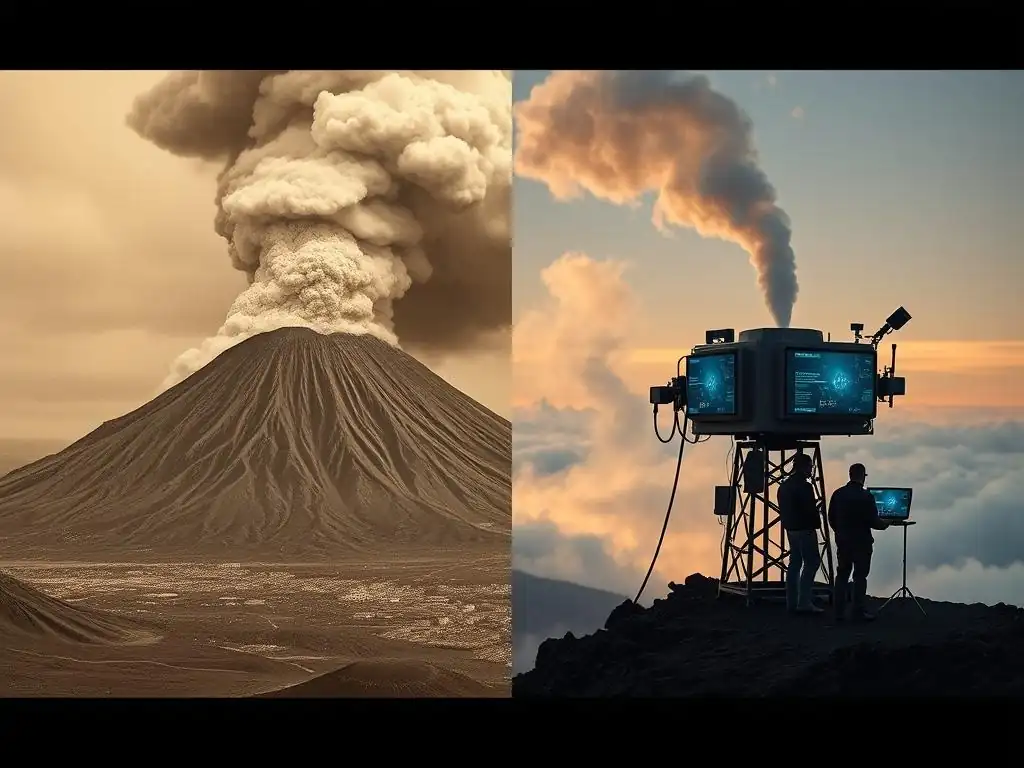
Modern Techniques: Satellite Monitoring and Ground-Based Sensors
The tragedy of Mount Pelée, and other volcanic disasters, has driven significant advancements in volcano monitoring techniques, particularly in the realm of volcanic gas measurements. Modern volcanology utilizes a suite of sophisticated tools for monitoring volcanic gases, both from the ground and from space. As discussed earlier, satellite-based instruments like OMI and TROPOMI provide global and continuous monitoring of SO2 and other volcanic gases, allowing for the detection of changes in emission rates over broad areas and in remote locations. These satellite data are invaluable for regional and global volcanic surveillance.
Complementing satellite monitoring are advanced ground-based sensors. Improved spectrometers and COSPEC instruments are deployed at many active volcanoes, providing high-resolution measurements of gas composition and fluxes. Furthermore, networks of gas sensors, including electrochemical sensors and infrared gas analyzers, can be installed around volcanoes to continuously monitor gas concentrations in near-real-time. These ground-based networks can detect subtle changes in gas emissions that might be missed by satellite observations, and provide crucial information for short-term eruption forecasting. The integration of satellite and ground-based gas monitoring, along with other geophysical and geological data, forms the foundation of modern volcano monitoring systems.
Integrating Gas Data with Other Volcanic Monitoring Systems
Volcanic gas monitoring is most effective when integrated with other volcano monitoring techniques. Gas data is not interpreted in isolation, but rather considered alongside seismic data, ground deformation measurements, thermal infrared imagery, and geological observations. For example, an increase in SO2 emission rates, coupled with an increase in seismicity and ground deformation, would provide a stronger indication of magma ascent and potential eruption than any single parameter alone. Multi-parameter monitoring, where various datasets are analyzed together, is the standard approach in modern volcanology.
Real-time data streams from different monitoring instruments are often integrated into sophisticated volcano monitoring centers. These centers utilize advanced software and algorithms to process and analyze the data, looking for patterns and anomalies that might signal impending eruptions. Volcanologists at these centers interpret the integrated data, considering the volcano's past eruptive history, current activity levels, and regional tectonic setting to assess volcanic hazards and issue warnings when necessary. The holistic approach of integrating gas data with other monitoring streams is crucial for improving the accuracy and reliability of eruption forecasts.
The Importance of Real-Time Analysis and Effective Communication
Even with advanced monitoring technology and integrated data analysis, effective eruption forecasting relies critically on real-time analysis and rapid communication of warnings to at-risk populations. Volcanic activity can escalate rapidly, as tragically demonstrated by Mount Pelée. Therefore, monitoring systems must be capable of providing data in near-real-time, and volcanologists must be able to analyze this data quickly and make timely assessments of volcanic hazards. Modern monitoring systems often employ automated data processing and alert systems to facilitate rapid detection of changes in volcanic activity.
Furthermore, effective communication of warnings to the public and relevant authorities is paramount. Warnings must be clear, concise, and actionable, providing specific information about the nature of the hazard, the areas at risk, and recommended protective measures, such as evacuation routes and shelter locations.
Public education and preparedness programs are also essential to ensure that communities living near volcanoes understand volcanic hazards and know how to respond to warnings. The lessons learned from Mount Pelée and other volcanic disasters underscore the critical importance of not only improving monitoring technology, but also enhancing real-time analysis capabilities and strengthening communication pathways between scientists, authorities, and the public.
Mount Pelée Gas Emissions Warning: A Missed Opportunity or Unforeseeable Event?
Looking back at the 1902 eruption of Mount Pelée, it is difficult to definitively conclude whether gas emissions, specifically sulfur dioxide, could have provided a clear and actionable warning given the limitations of the time. While sulfurous smells were noted, there was no quantitative data or established scientific framework to interpret these observations as a definitive sign of imminent catastrophic eruption.
The lack of monitoring technology and the nascent state of volcanology at the turn of the 20th century meant that even if gas emissions had shown an anomalous increase, it is unlikely to have been recognized as a critical warning signal.
In this context, the Mount Pelée disaster might be considered more of an unforeseeable event given the scientific and technological limitations of the era, rather than a missed opportunity due to neglected gas emission warnings. However, the tragedy undoubtedly served as a catalyst for advancements in volcanology, particularly in the development of volcanic gas monitoring techniques and the understanding of the role of gases in eruption dynamics. The lessons learned from Mount Pelée have contributed significantly to shaping modern volcano monitoring practices and improving eruption forecasting capabilities worldwide, aiming to prevent similar catastrophes in the future.
Further Reading: Resources on Mount Pelée and Volcanic Gas Monitoring
- "Volcano: Mount Pelée, Martinique" by Rupert Furneaux (1965): A detailed historical account of the 1902 eruption.
- "The Eruption of Mount Pelée, 1902-1903" by Angelo Heilprin (1908): A contemporary scientific report on the eruption.
- USGS Volcano Hazards Program: Provides comprehensive information on volcano hazards and monitoring techniques.
- Smithsonian National Museum of Natural History - Global Volcanism Program: Offers a vast database of volcanic eruptions and volcano information.
- Journal of Volcanology and Geothermal Research: A leading scientific journal publishing research on volcanoes and volcanic processes.
Frequently Asked Questions
What is the main focus of the article "Sulfur Dioxide's Signal? Did Gas Emissions Warn of Mount Pelée's Impending Fury? "?
The article explores whether gas emissions, specifically sulfur dioxide, could have served as a warning sign prior to the devastating eruption of Mount Pelée. It examines the potential link between increased emissions and the subsequent volcanic activity.
What is Mount Pelée, and why is it significant?
Mount Pelée is a volcano located on the island of Martinique. It's significant due to its catastrophic eruption in 1902, which destroyed the city of Saint-Pierre and resulted in a massive loss of life, making it a pivotal event in volcanology.
What role do gas emissions, like sulfur dioxide, play in understanding volcanic activity?
Changes in gas emission levels can indicate changes in magma activity beneath the surface. Increased sulfur dioxide emissions, for example, might signal that magma is rising or that pressure is building within the volcano.
What kind of safety advice can VolcanoExplorers.org offer for those living near active volcanoes?
VolcanoExplorers.org provides safety guides and evacuation tips tailored to living near active volcanoes. This includes information on recognizing warning signs, preparing emergency kits, and understanding evacuation routes.
How do volcanologists study gas emissions from volcanoes like Mount Pelée?
Volcanologists use various techniques, including remote sensing, ground-based monitoring, and gas sampling, to measure and analyze the composition of volcanic gases. This data helps them understand volcanic processes and assess potential hazards.
Final Reflection: Echoes of Pelée, Lessons for Tomorrow
The chilling story of Mount Pelée's eruption and the potential warning signs hidden within its gas emissions serves as a stark reminder of nature's power and our ongoing quest to understand it. The ability to accurately interpret volcanic gas signals remains a critical challenge, one that directly impacts the safety and well-being of communities living near active volcanoes around the world. Ignoring these subtle cues can have devastating consequences, as history has tragically demonstrated.
The legacy of Mount Pelée continues to resonate, influencing how volcanologists monitor and interpret volcanic activity today. The pursuit of more precise and reliable methods for detecting and analyzing volcanic gas emissions is not merely an academic exercise; it's a moral imperative, driven by the desire to prevent future catastrophes. The only way to predict the future is to understand the past.
This quote, though often attributed to various sources, perfectly encapsulates the importance of learning from events like the Mount Pelée eruption and applying those lessons to improve our predictive capabilities.
As you reflect on the lessons learned from the study of Mount Pelée's gas emissions, consider the role you can play in supporting scientific advancements and promoting informed decision-making. Whether through advocating for increased funding for volcanic monitoring programs, educating yourself and others about volcanic hazards, or simply appreciating the delicate balance of our planet, your awareness and engagement can contribute to a safer and more resilient future. Let us strive to listen more attentively to the Earth's whispers, so that we may better anticipate and mitigate its potential fury.
Unearth Your Inner Volcanologist: Respond to the Earth's Call!
Thanks for journeying with us as we explored the fascinating (and terrifying) story of Mount Pelée and the clues hidden within sulfur dioxide emissions. Now that you're armed with this knowledge, it's time to put it into action and deepen your understanding of volcanic activity. Here are a few ways to further explore the fascinating world of volcanic warning signs:
- Become a Citizen Scientist: Explore citizen science projects focused on monitoring volcanic gases near you, or in areas you're passionate about. Even small contributions can help scientists understand volcanic behavior.
- Delve deeper into the science: Research the different types of gas sensors used in modern volcanology and the data they provide. Understand how technology helps us predict eruptions.
- Share this article with friends and family to spread awareness about the importance of understanding volcanic warning signs.
What early warning sign, beyond gas emissions, do you think is most crucial for predicting a volcanic eruption? Share your thoughts in the comments below!