
Volcanoes in Verse: Poetry Inspired by 19thCentury Eruptions

Welcome to Volcano Explorers, where the Earth breathes fire! Ever wonder how the raw power of a volcanic eruption has ignited the imaginations of artists and poets? Prepare to be captivated as we journey back to the 19th century, exploring the seismic verses born from some of history's most dramatic eruptions. This isn't just history; it's a fiery fusion of science and art. What secrets lie hidden within the stanzas inspired by these colossal events? Read on to uncover the poetic echoes of the Earth's fury...
- Introduction: 19th Century Volcanic Eruptions Sparking Poetic Inspiration
- The Romantic Era and Volcanic Cataclysms: A Fertile Ground for Poetry
- Prominent 19th Century Volcanic Eruptions That Inspired Poetry
- Common Themes and Motifs in 19th Century Volcanic Poetry
- Analyzing the Poetic Techniques Used to Describe Volcanic Phenomena
- The Legacy of 19th Century Volcanic Poetry: Influencing Later Generations
- Conclusion: Appreciating the Intersection of Volcanology and Poetic Expression
-
Frequently Asked Questions
- What inspired poets in the 19th century to write about volcanic eruptions?
- Can you name some famous 19th-century volcanic eruptions that might have been the subject of poetry?
- What themes are commonly found in 19th-century poetry about volcanoes?
- Where can I find examples of 19th-century poetry inspired by volcanic eruptions?
- How does this poetry reflect the scientific understanding of volcanoes at the time?
- Final Reflection: Echoes of Fire and Ink
- Unleash Your Inner Volcanic Poet!
Introduction: 19th Century Volcanic Eruptions Sparking Poetic Inspiration
The Allure of Volcanoes: From Scientific Curiosity to Artistic Expression
The 19th century witnessed a surge in both scientific exploration and artistic expression, and volcanoes, with their awe-inspiring power and dramatic displays, became a focal point for both. This era marked a significant period in the development of volcanology, as scientists began to systematically study these geological phenomena, driven by curiosity and a desire to understand the Earth's inner workings.
Simultaneously, artists and poets, captivated by the raw power and sublime beauty of volcanic landscapes and eruptions, found in them a rich source of inspiration. The dramatic events of volcanic eruptions, often reshaping landscapes and impacting global climates, resonated deeply with the Romantic sensibilities of the time, providing powerful metaphors for human emotions and the forces of nature.
Volcanoes in the 19th century were not merely geological features; they became symbols of nature's untamed power, capable of both creation and destruction. The scientific community, driven by figures like James Dwight Dana and Scrope, meticulously documented eruptions, laying the groundwork for modern volcanology. Concurrently, poets and artists, from Lord Byron to J.M.W.
Turner, responded to these cataclysmic events with works that explored the emotional and philosophical dimensions of volcanic power. This convergence of scientific inquiry and artistic interpretation during the 19th century provides a fascinating lens through which to understand our enduring fascination with volcanoes, bridging the gap between objective observation and subjective experience.
VolcanoExplorers.org: Exploring the Intersection of Volcanology and Art
VolcanoExplorers.org recognizes this fascinating duality, inviting visitors to explore the world of volcanoes through both a scientific and an artistic lens. The website delves into the geological processes that drive volcanic activity, providing educational content on magma formation, eruption types, and the methods used by volcanologists to study these dynamic systems. It highlights significant eruptions throughout history, including those of the 19th century, placing them within a scientific context. However, VolcanoExplorers.org also acknowledges the profound impact volcanoes have had on human culture and artistic expression.
This article, "Volcanoes in Verse: Poetry Inspired by 19th-Century Eruptions," aims to further explore this intersection, focusing specifically on how the dramatic volcanic events of the 19th century fueled poetic imagination. We will examine how major eruptions, such as Tambora in 1815 and Krakatoa in 1883, resonated with poets of the Romantic and Victorian eras, influencing their themes, imagery, and poetic techniques.
By analyzing specific poems and the historical context of these eruptions, we can gain a deeper appreciation for the enduring power of volcanoes to inspire both scientific inquiry and artistic creativity, a synergy that VolcanoExplorers.org seeks to illuminate.
The Romantic Era and Volcanic Cataclysms: A Fertile Ground for Poetry
Romanticism's Embrace of Nature's Power: A Perfect Match for Volcanic Imagery
The Romantic era, spanning roughly from the late 18th to the mid-19th century, was characterized by a profound shift in artistic and intellectual thought. Rejecting the Enlightenment's emphasis on reason and order, Romanticism celebrated emotion, individualism, and the power of nature. This philosophical and artistic movement found in volcanoes a potent symbol.
Volcanoes, with their immense geological forces and dramatic eruptions, perfectly embodied the Romantic ideal of nature as a powerful and awe-inspiring force, capable of evoking both wonder and terror. The sheer scale of volcanic events, the fiery displays, and the transformative impact on landscapes resonated deeply with the Romantic sensibility that sought to connect with the raw, untamed aspects of the natural world.
For Romantic poets, volcanoes offered a rich tapestry of imagery and metaphor. The fiery lava flows, the plumes of ash, the earth-shattering explosions, and the reshaping of landscapes provided a dramatic vocabulary to express intense emotions and explore profound philosophical themes.
The unpredictability of volcanic eruptions mirrored the tumultuous nature of human emotions and the uncertainties of life, aligning perfectly with the Romantic emphasis on subjective experience and the exploration of the inner self. This era, therefore, provided fertile ground for 19th century volcanic eruptions poetry, where the raw power of nature and the depths of human feeling could be powerfully intertwined.
19th Century Poetry and the Sublime: Experiencing Awe and Terror
Central to the Romantic aesthetic was the concept of the sublime. The sublime, as defined by philosophers like Edmund Burke and Immanuel Kant, described an experience that evoked both awe and terror, exceeding the limits of human comprehension and control. Volcanic eruptions, with their overwhelming scale and destructive potential, were quintessential sublime experiences.
Witnessing or even hearing accounts of these cataclysmic events could inspire a sense of insignificance in the face of nature's power, yet simultaneously evoke a profound sense of wonder and awe at the grandeur of the natural world. 19th century poetry exploring volcanic eruptions frequently engaged with this concept of the sublime.
Poets of the 19th century, influenced by Romantic ideals, sought to capture this sublime experience in their verse. They used vivid imagery and powerful language to convey the overwhelming sensory impact of volcanic phenomena – the deafening roars, the blinding flashes of light, the suffocating ash clouds, and the earth-trembling power.
Through their poetry, they aimed to evoke in the reader a vicarious experience of the sublime, allowing them to confront the immensity and terror of volcanic power from a safe distance. This poetic engagement with the sublime, inspired by 19th century volcanic eruptions, became a defining characteristic of the era's artistic response to these natural cataclysms.
Prominent 19th Century Volcanic Eruptions That Inspired Poetry
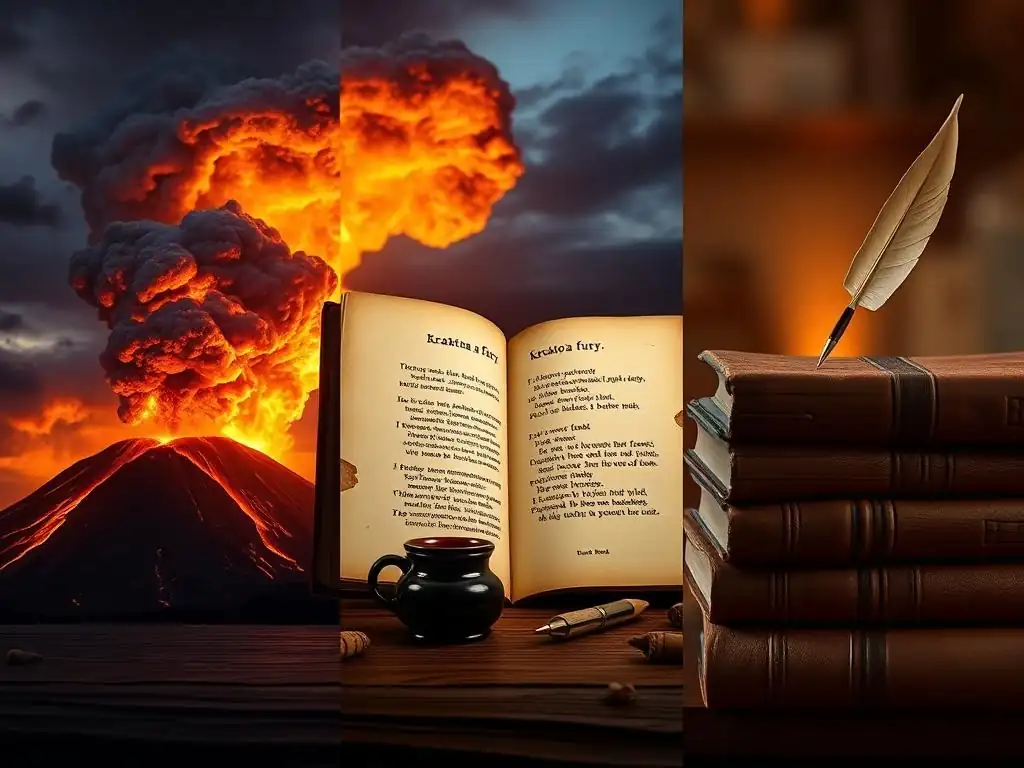
The Tambora Eruption of 1815: "The Year Without a Summer" and its Poetic Echoes
The eruption of Mount Tambora in April 1815, located on the island of Sumbawa in present-day Indonesia, stands as one of the most significant volcanic events in recorded history. Its Volcanic Explosivity Index (VEI) of 7 placed it among the largest eruptions of the last few millennia. The immediate impact was devastating, with pyroclastic flows and tsunami waves causing widespread death and destruction in the surrounding region.
However, the eruption's reach extended far beyond Indonesia. The massive quantities of volcanic ash and sulfur dioxide injected into the stratosphere had a global impact on climate, leading to what became known as "The Year Without a Summer" in 1816.
In 1816, much of the Northern Hemisphere experienced abnormally cold temperatures, widespread crop failures, and famine. Europe and North America suffered through a summer of frost and snow in June, July, and August. This dramatic climatic anomaly, directly linked to the Tambora eruption, profoundly impacted societies and, importantly for our discussion, profoundly influenced artistic and literary output.
The pervasive gloom, the sense of environmental disruption, and the widespread suffering became potent themes in the poetry of the time, providing a stark backdrop for reflections on human vulnerability and the power of nature. The atmospheric effects of the 1815 Tambora eruption served as a tangible and deeply impactful inspiration for 19th century volcanic eruptions poetry.
Lord Byron's Darkness: A Direct Response to Tambora's Atmospheric Impact
Lord Byron's poem "Darkness," written in 1816, is widely considered a direct literary response to the atmospheric effects of the Tambora eruption. The poem paints a bleak and apocalyptic vision of a world plunged into perpetual darkness, where the sun fails to rise and humanity descends into chaos and despair. The opening lines immediately establish this desolate scene: "I had a dream, which was not all a dream.
/ The bright sun was extinguish'd, and the stars / Did wander darkling in the eternal space." This imagery of a sunless world, while metaphorical, directly reflects the observed atmospheric phenomena of 1816, where volcanic aerosols dimmed sunlight and caused spectacular sunsets and sunrises, albeit within a generally darkened sky.
"Darkness" is not merely a descriptive poem; it explores the psychological and societal consequences of such a catastrophic environmental event. Byron depicts the breakdown of civilization, the loss of hope, and the descent into primal struggles for survival.
The poem's themes of societal collapse and existential dread resonate with the anxieties of the time, amplified by the tangible environmental disruptions caused by Tambora. While Byron may not have explicitly named Tambora, the poem's creation in 1816, its thematic focus on darkness and environmental catastrophe, and its powerful imagery strongly suggest that "Darkness" is a powerful and enduring example of 19th century volcanic eruptions poetry, directly inspired by the global impact of the Tambora eruption.
Percy Bysshe Shelley's "Mont Blanc": Reflecting on Nature's Immense Power
While not as direct a response to Tambora as Byron's "Darkness," Percy Bysshe Shelley's poem "Mont Blanc," also written in 1816, reflects the broader intellectual and artistic climate shaped by the eruption's aftermath. Shelley, along with Byron and Mary Shelley, spent the summer of 1816 near Lake Geneva, a period famously marked by inclement weather attributed to Tambora's volcanic aerosols.
"Mont Blanc" is a complex and philosophical poem that meditates on the power of nature, the limits of human understanding, and the relationship between the mind and the external world. The poem uses the majestic Mont Blanc as a symbol of nature's overwhelming power and permanence.
Although "Mont Blanc" does not explicitly mention volcanic eruptions, the poem's themes resonate with the broader context of the Tambora event. The poem's emphasis on the sublime power of nature, its exploration of the vast and indifferent forces shaping the world, and its contemplation of human insignificance in the face of such power can be seen as reflections of the anxieties and awe inspired by the dramatic environmental disruptions of 1816.
Lines like "Power dwells apart in its tranquility, / Remote, serene, and inaccessible" capture the Romantic sense of nature's overwhelming and sometimes terrifying grandeur, a sentiment amplified by the global impact of the 19th century volcanic eruptions like Tambora. Thus, "Mont Blanc," while not directly about volcanoes, can be understood as part of the broader poetic response to the era's heightened awareness of nature's immense and sometimes destructive capabilities.
Krakatoa's Fury in 1883: A Global Event Immortalized in Verse
The eruption of Krakatoa in 1883, another Indonesian volcano, stands as a landmark event in 19th-century volcanism. While Tambora's eruption was larger in scale, Krakatoa's eruption was perhaps more widely witnessed and documented due to advances in communication and global interconnectedness. The cataclysmic eruption on August 27, 1883, generated incredibly loud explosions heard thousands of miles away, devastating tsunami waves that claimed tens of thousands of lives, and injected vast quantities of ash and gas into the atmosphere. The global atmospheric effects of Krakatoa, while less severe than Tambora's, were still significant and widely observed.
Krakatoa's eruption occurred later in the 19th century, during the Victorian era, a period that, while inheriting Romantic sensibilities, also witnessed significant scientific and technological advancements. The eruption became a subject of intense scientific study, contributing greatly to the developing field of volcanology.
Simultaneously, the dramatic and globally witnessed event captured the public imagination and inspired artistic responses, albeit perhaps less directly in poetry than Tambora. However, the profound impact of Krakatoa, its sheer scale of destruction, and its atmospheric effects continued to resonate and potentially influenced artistic visions and themes in the later decades of the 19th century and beyond.
Alfred Tennyson's Possible Influence: Speculation on Krakatoa's Impact on Later Works
While a direct, explicit poem about Krakatoa from a major 19th-century poet is not as readily identifiable as Byron's "Darkness" for Tambora, the eruption's impact may have subtly permeated the artistic consciousness of the late Victorian era. Alfred Tennyson, Poet Laureate during this time, was deeply attuned to the natural world and its dramatic manifestations. While Tennyson did not pen a poem explicitly titled "Krakatoa," some scholars speculate that the eruption and its aftermath might have subtly influenced the darker, more melancholic tones found in some of his later works.
Tennyson’s poetry often explored themes of loss, change, and the passage of time, and the backdrop of a world demonstrably shaped by powerful natural forces like volcanic eruptions could have contributed to these thematic concerns. The spectacular sunsets caused by Krakatoa's ash, while beautiful, were also a constant reminder of a recent global catastrophe.
It is in the realm of subtle influence, thematic resonance, and the broader cultural awareness of volcanic power that Krakatoa may have indirectly contributed to the poetic landscape of the late 19th century, even if not resulting in a singular, iconic poem like "Darkness." Further research into the reception of Krakatoa within Victorian literary circles could potentially reveal more direct, though perhaps less prominent, poetic responses.
The Impact of Krakatoa's Ash Cloud on Artistic Vision
Beyond direct poetic responses, the Krakatoa eruption had a demonstrable impact on visual art, particularly in painting. The volcanic ash cloud from Krakatoa caused spectacular and unusually vivid sunsets around the world for several years after the eruption. These sunsets, characterized by intense reds, oranges, and yellows, were widely observed and commented upon, becoming a subject of fascination and, for some, a source of artistic inspiration. The unusual atmospheric effects were directly attributed to the scattering of sunlight by the fine volcanic particles high in the stratosphere.
Notably, some art historians suggest that the intensely vibrant sunsets depicted in Edvard Munch's famous painting "The Scream," painted in 1893, may have been influenced by the lingering atmospheric effects of Krakatoa's ash cloud. While Munch himself did not explicitly state this connection, the painting's fiery sky and unsettling mood align with the visual and emotional impact of the Krakatoa sunsets.
This example highlights how 19th century volcanic eruptions, beyond directly inspiring poetry, could also shape artistic vision more broadly, influencing color palettes, atmospheric depictions, and the overall emotional tone of artworks in various media, even years after the event itself.
Other Notable 19th Century Eruptions and Their Poetic Representations
Mount Vesuvius Eruptions: The Enduring Myth of Pompeii and Herculaneum
While Tambora and Krakatoa were arguably the most globally impactful 19th-century eruptions, Mount Vesuvius, with its long history of activity and its infamous destruction of Pompeii and Herculaneum in 79 AD, remained a potent source of fascination and inspiration throughout the century. Vesuvius experienced several eruptions during the 19th century, including notable events in 1822, 1855, 1872, and 1906 (just outside the 19th century but relevant as a continuation of the trend).
These eruptions, while not on the scale of Tambora or Krakatoa, served as reminders of Vesuvius's volatile nature and kept the ancient tragedy of Pompeii and Herculaneum alive in the public consciousness.
The rediscovery of Pompeii and Herculaneum in the 18th century had already sparked immense archaeological and cultural interest in Vesuvius and its destructive power. By the 19th century, these Roman cities were major tourist destinations, drawing visitors from across Europe and beyond. The ruins served as a tangible link to the past, a poignant reminder of human vulnerability in the face of natural disasters, and a powerful source of romantic and melancholic contemplation. For poets and writers of the 19th century, Vesuvius and Pompeii offered a rich tapestry of historical, archaeological, and emotional themes to explore.
The Continued Inspiration of Vesuvius on Artists and Writers
The enduring myth of Pompeii and Herculaneum, intertwined with the ongoing volcanic activity of Vesuvius, provided a continuous source of inspiration for 19th-century artists and writers. While perhaps not inspiring specific poems directly about a 19th-century Vesuvius eruption to the same extent as Tambora or Krakatoa, Vesuvius and its Roman victims became recurring motifs in literature, painting, and even opera. The story of Pompeii served as a cautionary tale, a meditation on the transience of human civilization, and a dramatic example of nature's power.
Bulwer-Lytton's novel The Last Days of Pompeii, published in 1834, became immensely popular and solidified the image of Pompeii in the Victorian imagination. While not strictly poetry, this novel, and other literary works inspired by Pompeii, contributed to a broader cultural engagement with volcanic themes.
Poems might evoke Pompeii indirectly, using it as a metaphor for sudden destruction, lost civilizations, or the power of time and nature to overwhelm human creations. Vesuvius, therefore, while not always the subject of poems about specific 19th-century eruptions, remained a constant, underlying presence in the artistic landscape, shaping the broader poetic consciousness of the era regarding volcanoes and their profound implications.
Common Themes and Motifs in 19th Century Volcanic Poetry
The Power of Nature: Volcanoes as Symbols of Untamed Forces
A dominant theme in 19th century volcanic eruptions poetry is the overwhelming power of nature. Volcanoes, in their dramatic eruptions, became potent symbols of forces beyond human control, capable of reshaping landscapes, altering climates, and dwarfing human endeavors. This theme resonated deeply with the Romantic sensibility that emphasized the grandeur and untamed aspects of the natural world. Poets used volcanic imagery to convey the sheer immensity of nature's power, often contrasting it with the fragility and vulnerability of human existence.
Volcanic eruptions served as a stark reminder of humanity's place within a larger, more powerful natural order. Poems frequently depicted volcanoes as agents of destruction, unleashing forces that could obliterate civilizations and humble even the most ambitious human projects. This theme of nature's power was not solely negative; it also encompassed a sense of awe and wonder at the sublime forces at play. Volcanoes represented the raw, untamed energy of the Earth itself, a force both terrifying and captivating, embodying the Romantic ideal of nature as a source of both inspiration and fear.
Human Vulnerability: Confronting Mortality in the Face of Volcanic Destruction
Closely linked to the theme of nature's power is the motif of human vulnerability. 19th century volcanic eruptions poetry often explored the fragility of human life and civilization in the face of volcanic catastrophes. Eruptions like Tambora and Krakatoa, with their widespread devastation and global impact, underscored the precariousness of human existence and the potential for sudden and overwhelming destruction. Poems grappling with these events frequently focused on the human cost of volcanic eruptions, depicting scenes of loss, suffering, and the breakdown of social order.
The destruction of Pompeii and Herculaneum, constantly in the background of 19th-century consciousness, further amplified this theme of human vulnerability. These ancient cities served as a stark historical precedent, a reminder that entire civilizations could be obliterated by volcanic forces. Poets used volcanic eruptions to explore existential anxieties about mortality, the ephemeral nature of human achievements, and the ultimate insignificance of individuals in the face of vast geological time scales and powerful natural processes. This confrontation with mortality, prompted by volcanic destruction, became a recurring and poignant motif in the poetry of the era.
The Sublime and the Beautiful: Finding Aesthetic Value in Catastrophe
As discussed earlier, the concept of the sublime was central to the Romantic aesthetic, and volcanic eruptions provided quintessential sublime experiences. 19th century volcanic eruptions poetry often grappled with the paradox of finding beauty and aesthetic value in events that were inherently destructive and terrifying. Poets sought to capture the awe-inspiring spectacle of volcanic eruptions – the fiery displays, the dramatic plumes, the reshaping of landscapes – even while acknowledging the immense suffering and devastation that accompanied these events.
This aestheticization of catastrophe is a complex and sometimes controversial aspect of Romanticism. However, for 19th-century poets, the sublime experience of witnessing or imagining a volcanic eruption offered a unique opportunity to confront the limits of human perception and understanding. The sheer scale and power of volcanic events could evoke a sense of wonder and awe that transcended the immediate horror of destruction. Poetry sought to capture this paradoxical beauty, finding aesthetic value in the dramatic and often terrifying manifestations of nature's power, reflecting the Romantic fascination with the sublime.
Religious Interpretations: Volcanoes as Divine Wrath or Judgment
In the 19th century, religious interpretations of natural disasters, including volcanic eruptions, were still prevalent, though perhaps waning in influence compared to earlier periods. While scientific understanding of volcanism was advancing, for many, volcanic eruptions could still be seen as acts of God, expressions of divine wrath, or judgments upon humanity. Some 19th century volcanic eruptions poetry reflected these religious interpretations, viewing eruptions as punishments for sin or warnings of divine displeasure.
Poems with religious undertones might depict volcanoes as instruments of God's will, unleashed to punish human wickedness or to remind humanity of its dependence on divine providence. This interpretation often drew upon biblical narratives of divine judgment and apocalyptic visions.
However, even within religious frameworks, the sublime aspect of volcanic eruptions could still be present, with the awe-inspiring power of the volcano seen as a manifestation of God's own immense and sometimes terrifying power. While not universally adopted, religious interpretations formed a significant strand within the tapestry of 19th century volcanic eruptions poetry, reflecting the ongoing interplay between scientific understanding and religious belief in the era.
Analyzing the Poetic Techniques Used to Describe Volcanic Phenomena
Metaphors and Similes: Comparing Volcanoes to Mythological Creatures or Gods
To effectively convey the immense power and dramatic nature of volcanic eruptions, 19th century poets frequently employed metaphors and similes, drawing comparisons to mythological creatures, gods, or other powerful entities. These figurative language devices helped to elevate volcanic phenomena beyond mere geological events, imbuing them with a sense of mythic grandeur and symbolic significance. Volcanoes might be likened to dragons, titans, or even wrathful deities, unleashing their fiery power upon the world.
Metaphors and similes allowed poets to tap into existing cultural narratives and archetypes to enhance the impact of their volcanic descriptions. By comparing volcanoes to mythological figures, poets evoked associations of primordial power, chaos, and the struggle between order and disorder. These comparisons also served to personify volcanoes, giving them agency and intention, further amplifying their dramatic and awe-inspiring qualities in the poetic imagination. The use of mythological and divine comparisons was a key technique in 19th century volcanic eruptions poetry to capture the sublime and often terrifying nature of these geological events.
Imagery and Symbolism: The Use of Fire, Ash, and Lava to Evoke Emotion
Imagery and symbolism are fundamental tools in poetry, and 19th-century poets skillfully utilized the sensory details of volcanic eruptions – fire, ash, lava, smoke, darkness – to evoke specific emotions and create powerful symbolic meanings. Fire, in volcanic poetry, is rarely just fire; it becomes a symbol of destruction, purification, passion, and divine wrath. Ash, often depicted as a suffocating blanket, symbolizes death, decay, and the obliteration of life. Lava, in its molten flow, can represent both destructive force and creative power, reshaping landscapes and forging new earth.
The use of volcanic imagery extended beyond mere description; it aimed to create an immersive sensory experience for the reader, allowing them to vicariously feel the heat, smell the sulfur, see the darkness, and hear the roar of an eruption. Symbolism further deepened the emotional and thematic resonance of volcanic poetry.
Volcanic landscapes could symbolize inner turmoil, societal upheaval, or the fragility of civilization. The specific choice and arrangement of volcanic imagery were crucial in shaping the overall tone and message of 19th century volcanic eruptions poetry, allowing poets to translate the raw power of nature into evocative and meaningful verse.
Personification: Giving Human Qualities to Volcanic Landscapes
Personification, the attribution of human qualities to inanimate objects or natural phenomena, was another common poetic technique employed in 19th century volcanic eruptions poetry. Poets often personified volcanoes and volcanic landscapes, imbuing them with human emotions, intentions, and actions. Volcanoes might be described as "breathing fire," "roaring in anger," or "weeping ash." This personification served to further animate the volcanic world, making it feel alive, active, and even sentient in the poetic imagination.
Personification enhanced the dramatic and emotional impact of volcanic descriptions. By giving volcanoes human-like qualities, poets created a sense of direct confrontation between humanity and the forces of nature. It also allowed for exploration of the psychological dimensions of volcanic experiences, projecting human emotions and anxieties onto the volcanic landscape. Personification could make volcanoes seem even more terrifying or awe-inspiring, depending on the specific human qualities attributed to them. This technique was instrumental in shaping the vivid and emotionally charged portrayals of volcanoes found in 19th century poetry.
The Legacy of 19th Century Volcanic Poetry: Influencing Later Generations
The Enduring Fascination with Volcanoes in Art and Literature
The 19th century's intense engagement with volcanoes in poetry and art laid the foundation for a continuing fascination with these dramatic geological phenomena in subsequent generations. The themes and motifs explored by 19th-century poets – the power of nature, human vulnerability, the sublime, and the aestheticization of catastrophe – have resonated across time and continue to inform artistic and literary representations of volcanoes in the 20th and 21st centuries. The Romantic and Victorian eras established a powerful artistic vocabulary for depicting volcanic eruptions and their impact, which continues to influence contemporary creative expressions.
The legacy of 19th century volcanic eruptions poetry extends beyond direct imitation. It established a cultural framework for understanding and representing volcanoes, shaping how we perceive these events and their significance. The enduring power of volcanoes to inspire awe, fear, and a sense of the sublime continues to attract artists and writers. The visual and emotional vocabulary developed in 19th-century poetry – the imagery of fire, ash, darkness, and overwhelming force – remains potent and readily accessible, providing a rich resource for contemporary artists seeking to engage with volcanic themes.
Volcanoes in Modern Literature and Film: Echoes of Romantic Era Themes
The influence of 19th century volcanic eruptions poetry can be traced in modern literature and film, where echoes of Romantic era themes and motifs continue to surface. In literature, contemporary authors often explore similar themes of nature's power and human vulnerability in the context of volcanic disasters, drawing upon the established artistic vocabulary for depicting these events. In film, volcanoes have become iconic symbols of both destruction and spectacle, often embodying the sublime and terrifying aspects of nature that fascinated 19th-century artists.
Disaster films featuring volcanic eruptions frequently tap into the same emotional and thematic territory explored by 19th-century poets. The visual spectacle of erupting volcanoes, the drama of human survival against overwhelming odds, and the exploration of human responses to catastrophe all resonate with the enduring themes established in the poetic responses to 19th century eruptions. While modern representations may incorporate scientific accuracy and technological advancements, the underlying fascination with the raw power of volcanoes and their profound impact on humanity remains deeply connected to the artistic and literary legacy of the 19th century.
Conclusion: Appreciating the Intersection of Volcanology and Poetic Expression
Further Exploration: Resources for Learning More About 19th Century Volcanic Eruptions and Poetry
The 19th century stands as a pivotal period in the history of volcanology and in the artistic representation of volcanic phenomena. The dramatic eruptions of Tambora, Krakatoa, and Vesuvius, among others, not only spurred scientific inquiry but also ignited poetic imaginations, resulting in a rich body of 19th century volcanic eruptions poetry. This poetry provides a unique window into how people of the era perceived and interpreted these powerful natural events, revealing a fascinating intersection of scientific observation, artistic expression, and profound human emotions. VolcanoExplorers.org encourages further exploration of this captivating intersection.
For those interested in delving deeper into this topic, resources abound. Online archives of 19th-century poetry, such as the Poetry Foundation and Project Gutenberg, offer access to the works of Byron, Shelley, Tennyson, and other poets mentioned in this article.
Historical accounts of the Tambora and Krakatoa eruptions, readily available through online historical databases and academic libraries, provide valuable context for understanding the scientific and social impact of these events. Furthermore, academic studies focusing on Romantic and Victorian literature, as well as interdisciplinary works exploring the relationship between science and literature in the 19th century, can offer further insights into the rich tapestry of 19th century volcanic eruptions poetry and its enduring legacy.
Frequently Asked Questions
What inspired poets in the 19th century to write about volcanic eruptions?
The dramatic scale and destructive power of 19th-century volcanic eruptions, coupled with the Romantic era's fascination with nature's sublime and terrifying aspects, greatly inspired poets. Scientific advancements also provided new insights into these events.
Can you name some famous 19th-century volcanic eruptions that might have been the subject of poetry?
The 1815 eruption of Mount Tambora in Indonesia, which caused a "year without a summer," is a prime example. The Krakatoa eruption of 1883 also likely spurred poetic responses due to its global impact.
What themes are commonly found in 19th-century poetry about volcanoes?
Themes often include the power of nature, the fragility of human life, and the contrast between beauty and destruction. Some poems may also explore the religious or philosophical implications of such events.
Where can I find examples of 19th-century poetry inspired by volcanic eruptions?
Libraries, online archives of 19th-century literature, and anthologies of Romantic and Victorian poetry are good starting points. Search terms like "volcano," "eruption," and specific volcanic names (e.g., "Tambora," "Krakatoa") can be helpful.
How does this poetry reflect the scientific understanding of volcanoes at the time?
While many poems focus on the emotional impact, some may reflect the growing scientific understanding of volcanic processes, albeit often filtered through a romantic or philosophical lens. The poetry may mention specific geological features or effects, but likely with artistic license.
Okay, here's a final reflection designed to fit your article "Volcanoes in Verse: Poetry Inspired by 19th Century Eruptions," optimized for the keyword "19th century volcanic eruptions poetry," and following the requested Markdown structure:
Final Reflection: Echoes of Fire and Ink
The fiery spectacle of 19th-century volcanic eruptions, once a terrifying force of nature, continues to resonate today, not just in geological records, but also in the enduring power of poetry. This intersection of scientific upheaval and artistic expression reveals a profound human need to understand and grapple with the immensity of the natural world. The poems born from these events offer a unique window into the anxieties, awe, and philosophical inquiries of a bygone era, reminding us that even in the face of destruction, creativity can flourish.
The impact of these volcanic events, and the poetry they inspired, extends far beyond mere historical documentation. They serve as a potent reminder of our vulnerability and the delicate balance of our planet, urging us to consider our place within the grand scheme of things. The romanticized, yet often harrowing, depictions of these eruptions in verse shaped the cultural imagination, influencing art, literature, and scientific understanding for generations. The poetry of earth is never dead,
wrote John Keats, and indeed, the verses inspired by these volcanic events continue to breathe life into our understanding of the past and our relationship with the natural world.
As we close this exploration of 19th-century volcanic eruptions poetry, I invite you to consider the power of art to transform fear into understanding and destruction into creation. What lessons can we learn from these poets who dared to confront the raw power of nature with the delicate instrument of language? Let the echoes of fire and ink inspire you to find your own voice, to document your own experiences, and to contribute to the ongoing dialogue between humanity and the ever-changing world around us.
Unleash Your Inner Volcanic Poet!
Thanks for exploring the fascinating intersection of volcanoes and 19th-century poetry! We hope you've discovered a new appreciation for the profound impact volcanic eruptions had, not only on the landscape but also on the artistic spirit. Now it's your turn to ignite your creativity!
Here are some ideas to get you started:
- Write a poem inspired by a volcanic eruption! Choose your favorite eruption—from the 19th century or any era—and let its story unfold on the page.
- Research a poet inspired by volcanoes (like some of those featured in this article) and share a fascinating fact about them with a friend.
- Share your volcanic masterpiece! Post your poem on social media and tag Volcano Explorers, or share it in the comments below.
What fiery verses will you create?