
The Pinatubo Puzzle: Can a Volcano Really Cool the Entire Planet?

Welcome to Volcano Explorers!
Prepare to journey into the fiery heart of our planet! Ever wondered if a single eruption could shift the global thermostat? In " The Pinatubo Puzzle: Can a Volcano Really Cool the Entire Planet?," we delve into the fascinating and often unexpected volcano impact on global climate. Discover how a cataclysmic eruption can send ripples across the world, leaving scientists scrambling to understand the delicate balance of our planet's climate. Intrigued? Keep reading to unravel the secrets hidden within the ash and fire…
- Famous Eruptions and Global Cooling
- Understanding the Volcanic Impact on Global Climate
- The 1991 Eruption of Mount Pinatubo: A Case Study in Volcanic Cooling
- Measuring the Global Cooling Effect of the Pinatubo Eruption
- Beyond Temperature: Other Climate Impacts of Volcanic Eruptions
- The Short-Term vs. Long-Term Effects of Volcanoes on Climate
- Comparing Pinatubo to Other Major Volcanic Eruptions
- Can Volcanoes Be Used to Combat Climate Change? Exploring Geoengineering Proposals
- The Future of Volcanic Climate Research
- Volcanoes and Climate: A Complex Relationship
-
Frequently Asked Questions
- What is the main way a volcano can impact global climate?
- How long does the cooling effect from a major volcanic eruption typically last?
- Did the eruption of Mount Pinatubo in 1991 actually cool the planet?
- Are all volcanic eruptions equally effective at cooling the planet?
- Can volcanoes counteract the effects of human-caused climate change?
- Final Reflection: The Enduring Chill of Pinatubo
- Unearth Your Inner Volcanologist!
Famous Eruptions and Global Cooling
Throughout history, volcanic eruptions have captivated and terrified populations, reshaping landscapes and altering atmospheric conditions on a grand scale. While the immediate devastation caused by pyroclastic flows and lava flows is undeniable, the longer-term, global impacts of these events are equally significant, particularly in relation to climate. Major eruptions inject massive quantities of gases and particles into the stratosphere, the layer of the atmosphere above the troposphere, where weather occurs. This injection can have profound consequences for Earth's energy balance, leading to temporary but measurable shifts in global temperatures and weather patterns.
The link between large volcanic eruptions and global cooling has been recognized for centuries, with historical accounts noting unusually cold years following some of the most powerful volcanic events. For example, the "Year Without a Summer" in 1816, characterized by widespread crop failures and famine, is widely attributed to the massive eruption of Mount Tambora in Indonesia the previous year. Understanding the mechanisms behind this cooling effect and the scale of its influence is crucial to comprehending the complex interplay between natural events and Earth's climate system.
Understanding the Volcanic Impact on Global Climate
How Volcanoes Influence Earth's Temperature
Volcanoes, in their dramatic eruptions, act as powerful injectors of material into the upper atmosphere, far beyond the reach of normal weather systems that quickly remove particles from the lower atmosphere. The primary way volcanoes influence Earth's temperature is through the release of sulfur dioxide gas (SO₂). Once this gas reaches the stratosphere, it undergoes a series of chemical reactions, combining with water vapor to form sulfuric acid aerosols – tiny droplets that are highly reflective to sunlight.
These sulfate aerosols act like a global veil, reflecting a portion of incoming solar radiation back into space before it can reach and warm the Earth's surface. This process effectively reduces the amount of solar energy absorbed by the planet, leading to a temporary cooling effect.
The magnitude and duration of this cooling depend on several factors, including the amount of sulfur dioxide released, the altitude it reaches in the stratosphere, and the prevailing atmospheric conditions. While volcanoes also release greenhouse gases like carbon dioxide (CO₂), the amount is dwarfed by human emissions and, more importantly, the cooling effect of aerosols from major eruptions significantly outweighs the warming effect of volcanic CO₂ in the short to medium term.
The Role of Aerosols in Volcanic Cooling
The effectiveness of volcanic eruptions in causing global cooling hinges on the formation and persistence of sulfate aerosols in the stratosphere. Unlike volcanic ash, which is composed of larger particles and falls out of the atmosphere relatively quickly (within days to weeks), sulfate aerosols are much finer and can remain suspended in the stratosphere for months to years. This longevity is due to the lack of precipitation in the stratosphere, which normally washes out particles in the lower atmosphere.
The size of these aerosols is also critical. They are typically in the micrometer range, which is optimal for scattering incoming sunlight back into space. This scattering effect is known as "backscattering" and it is most efficient for particles with sizes comparable to the wavelength of visible light. Furthermore, the distribution of these aerosols around the globe plays a role. Major tropical eruptions, like Pinatubo, tend to spread their aerosol plumes more globally due to stratospheric circulation patterns, leading to a more widespread and uniform cooling effect compared to eruptions at higher latitudes.
The 1991 Eruption of Mount Pinatubo: A Case Study in Volcanic Cooling
Pinatubo's Eruption: A Timeline of Events
Mount Pinatubo, located in the Philippines, had been dormant for centuries before it began showing signs of reawakening in April 1991. Increased steam and ash emissions, along with a series of earthquakes, signaled escalating volcanic activity. By June, the volcano was exhibiting increasingly explosive behavior, culminating in a series of powerful eruptions starting on June 12th and reaching their peak on June 15th, 1991. This climax was marked by an enormous Plinian eruption, ejecting vast quantities of volcanic material high into the atmosphere.
The June 15th eruption was one of the largest volcanic eruptions of the 20th century. It produced a towering eruption column that reached over 40 kilometers (25 miles) into the stratosphere, blanketing the surrounding area in ash and pyroclastic flows. The eruption also triggered a typhoon that passed directly over Pinatubo, mixing torrential rains with volcanic ash, creating a heavy and destructive lahar flow that further devastated the landscape. The eruption and its immediate aftermath caused significant loss of life and widespread infrastructure damage, but its global impact on climate became apparent in the months and years that followed.
The Sulfur Dioxide Injection into the Stratosphere
The Mount Pinatubo eruption is particularly notable for the massive amount of sulfur dioxide it injected into the stratosphere. Satellite measurements, specifically using instruments like the Total Ozone Mapping Spectrometer (TOMS), estimated that Pinatubo released approximately 20 million tons of sulfur dioxide (SO₂). This was significantly more than other eruptions in recent decades and played a crucial role in the subsequent global cooling observed after the eruption.
This massive injection of SO₂ quickly transformed into a global veil of sulfate aerosols, encircling the planet within a few weeks. The plume of aerosols was initially concentrated over the tropics but spread rapidly poleward due to stratospheric winds. The sheer volume of aerosols and their widespread distribution ensured that the Pinatubo eruption had a substantial and measurable impact on the Earth's radiative balance, making it a landmark event for studying volcano impact on global climate.
Measuring the Global Cooling Effect of the Pinatubo Eruption
Satellite Data and Climate Modeling of the Pinatubo Plume
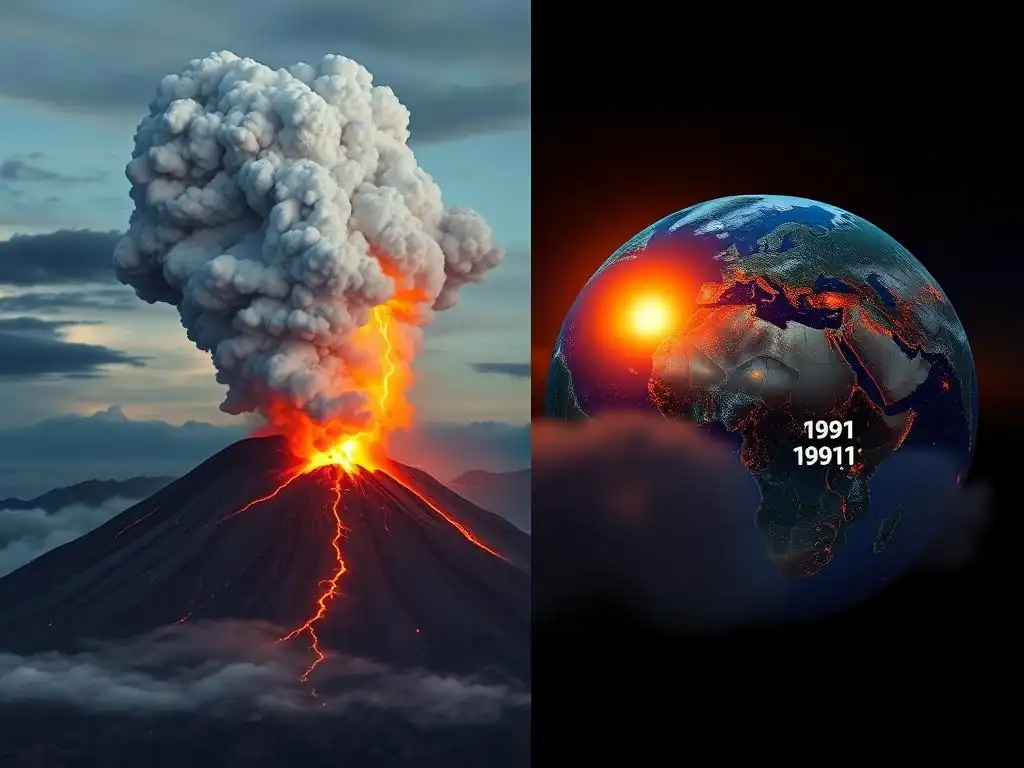
The 1991 Pinatubo eruption occurred during a period of rapidly advancing satellite technology, providing scientists with an unprecedented opportunity to observe and quantify the volcanic impact on global climate. Satellite instruments, such as TOMS and the Stratospheric Aerosol and Gas Experiment (SAGE), provided crucial data on the distribution, concentration, and optical properties of the Pinatubo aerosol plume. These satellite observations confirmed the global spread of the aerosols and allowed for detailed tracking of their evolution over time.
Furthermore, climate models, which are complex computer programs that simulate the Earth's climate system, were used to simulate the effects of the Pinatubo aerosols. By incorporating the satellite-derived aerosol data into these models, scientists could isolate and quantify the climate response specifically attributable to the volcanic eruption. These models helped to disentangle the volcanic signal from other climate forcings, such as solar variability and greenhouse gas increases, allowing for a more precise assessment of the volcano impact on global climate.
Quantifying the Temperature Drop After Pinatubo
The analysis of both observational data and climate model simulations consistently showed a clear global cooling effect following the Pinatubo eruption. Global average temperatures decreased by approximately 0.4 to 0.6 degrees Celsius (0.7 to 1.1 degrees Fahrenheit) in the year following the eruption. This cooling was most pronounced in the Northern Hemisphere and lasted for about two to three years before temperatures began to rebound.
This temperature drop, while seemingly modest, was significant in the context of global climate variability. It effectively offset a portion of the ongoing global warming trend that was already underway due to increasing greenhouse gas concentrations. The Pinatubo eruption provided a real-world demonstration of the potential for large volcanic eruptions to temporarily counteract warming trends, highlighting the powerful, albeit transient, volcano impact on global climate. The observed temperature changes aligned closely with model predictions, further validating the scientific understanding of volcanic cooling mechanisms.
Beyond Temperature: Other Climate Impacts of Volcanic Eruptions
Changes in Rainfall Patterns Following Eruptions
While the most prominent climate impact of volcanic eruptions like Pinatubo is global cooling, the effects extend beyond just temperature changes. Volcanic aerosols can also influence atmospheric circulation patterns, which in turn can alter regional rainfall patterns. Studies following the Pinatubo eruption revealed changes in precipitation in various regions around the world.
For example, some research indicated a decrease in summer monsoon rainfall in parts of Asia and Africa after Pinatubo. Changes in atmospheric heating due to the aerosol layer can disrupt the normal monsoon circulation, potentially leading to drier conditions in these regions. Conversely, other areas might experience increased rainfall. The complexity of atmospheric responses to volcanic eruptions means that rainfall impacts are often regionally variable and less uniform than the global temperature cooling.
The Effect of Volcanic Ash on Solar Radiation
In addition to sulfate aerosols, volcanic eruptions also release volcanic ash, which, while shorter-lived in the stratosphere, can also impact solar radiation. Volcanic ash consists of larger particles of rock and glass fragments ejected during the eruption. While most ash falls out of the atmosphere relatively quickly, finer ash particles can reach the stratosphere and contribute to the scattering and absorption of solar radiation.
Volcanic ash tends to have a more localized and shorter-term effect compared to sulfate aerosols. Heavy ashfall can significantly reduce sunlight at the surface in areas close to the volcano, leading to localized cooling and darkness. However, the global impact of volcanic ash on solar radiation is less pronounced and shorter-lived than that of sulfate aerosols, which are more effective at causing widespread and sustained cooling due to their longer residence time in the stratosphere and their optical properties.
The Short-Term vs. Long-Term Effects of Volcanoes on Climate
The Temporary Nature of Volcanic Cooling
It is crucial to understand that the cooling effect induced by volcanic eruptions like Pinatubo is inherently temporary. Sulfate aerosols in the stratosphere are gradually removed through natural processes. Over time, these aerosols coagulate and grow larger, eventually becoming heavy enough to sink down into the troposphere, where they are washed out by precipitation. This process typically takes a few years, leading to a gradual decline in the aerosol concentration and a corresponding weakening of the cooling effect.
The Pinatubo eruption, for example, caused significant cooling for about two to three years, after which the aerosol veil dissipated, and global temperatures began to rebound. This temporary nature contrasts sharply with the long-term warming effects of greenhouse gases, which accumulate in the atmosphere and persist for decades to centuries. Therefore, while volcanoes can cause noticeable short-term climate fluctuations, they do not represent a long-term solution to counteract or reverse human-caused climate change.
Natural Climate Variability and Volcanic Influence
Volcanic eruptions are a significant component of natural climate variability. Earth's climate is constantly influenced by a range of natural factors, including solar variations, ocean currents, and volcanic activity. Volcanoes represent a powerful episodic forcing that can introduce abrupt shifts in the climate system. Understanding the volcano impact on global climate is essential for distinguishing natural climate fluctuations from human-induced climate change.
The cooling effect from large volcanic eruptions is a clear example of natural climate forcing. By studying past volcanic eruptions and their climate impacts, scientists can better understand the range of natural climate variability and improve climate models to more accurately predict future climate changes. Recognizing the role of volcanoes in the natural climate system provides a crucial context for assessing the magnitude and significance of human-caused warming trends.
Comparing Pinatubo to Other Major Volcanic Eruptions
Comparison of Major Volcanic Eruptions
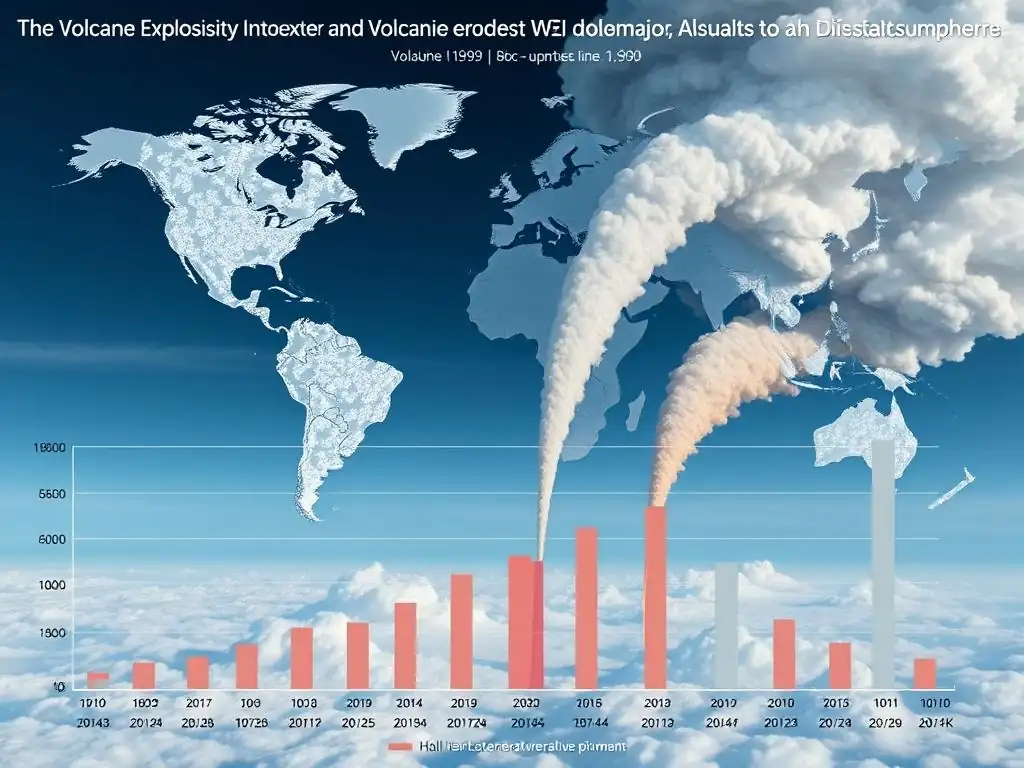
While the Pinatubo eruption is a well-studied example of volcanic cooling in recent times, it is important to place it within the context of other major volcanic eruptions throughout history. The magnitude of volcanic cooling is largely determined by the amount of sulfur dioxide released and the altitude the eruption plume reaches. Eruptions that inject large quantities of SO₂ high into the stratosphere tend to have the most significant global climate impacts.
Several eruptions in the past are thought to have had even larger climate impacts than Pinatubo. These include the 1815 Tambora eruption, the 1783 Laki eruption in Iceland, and the 1257 Samalas eruption in Indonesia (though the exact location was identified later). By studying historical records and ice core data, scientists can reconstruct the scale of these past eruptions and their estimated climate effects.
Krakatoa and Tambora: Case Studies
The 1883 eruption of Krakatoa in Indonesia, while less powerful in terms of sulfur dioxide release than Pinatubo, was still a significant event. Krakatoa injected an estimated 6 to 7 million tons of SO₂ into the stratosphere, leading to a measurable, though smaller, global cooling effect. The eruption was famous for its dramatic atmospheric effects, including vibrant sunsets and "volcanic twilights" observed worldwide for years after the event, caused by the scattering of sunlight by stratospheric aerosols.
The 1815 eruption of Mount Tambora, also in Indonesia, is considered one of the largest volcanic eruptions of the past millennium. Estimates suggest that Tambora released significantly more sulfur dioxide than Pinatubo, possibly around 50 to 100 million tons. This massive injection is believed to have caused the "Year Without a Summer" in 1816, with widespread crop failures, famine, and unusually cold temperatures across Europe and North America. Tambora serves as a stark reminder of the potential for exceptionally large volcanic eruptions to induce significant and disruptive global climate anomalies.
Can Volcanoes Be Used to Combat Climate Change? Exploring Geoengineering Proposals
Stratospheric Aerosol Injection (SAI): Ethics and Risks
The observed global cooling effect of volcanic eruptions has inspired proposals to mimic this process as a geoengineering technique to combat human-caused global warming. Stratospheric Aerosol Injection (SAI) is a proposed geoengineering method that involves intentionally injecting sulfate aerosols, or other reflective particles, into the stratosphere to reflect sunlight back into space and cool the planet. This concept is directly based on the natural mechanism of volcanic cooling.
While SAI might theoretically lower global temperatures, it is a highly controversial and ethically complex proposal. There are numerous potential risks and uncertainties associated with SAI, including the possibility of altering regional rainfall patterns, ozone depletion, and unintended consequences for ecosystems. Furthermore, SAI only addresses the symptom of warming (temperature increase) and does not address the root cause of climate change – the accumulation of greenhouse gases in the atmosphere. It also raises serious ethical questions about who gets to control the Earth's thermostat and the potential for unequal impacts across different regions.
Replicating Volcanic Cooling: A Controversial Solution
The idea of replicating volcanic cooling through geoengineering is attractive because it appears to be a relatively inexpensive and rapidly deployable method to lower global temperatures. However, the scientific community remains highly cautious about SAI due to the numerous unknowns and potential risks. Climate models suggest that while SAI could cool the planet, it might also lead to regional climate disruptions and could mask the ongoing effects of greenhouse gas accumulation.
Moreover, if SAI were to be deployed and then abruptly stopped, there could be a rapid "termination shock," with temperatures suddenly rebounding to levels consistent with greenhouse gas concentrations. This could have devastating consequences for ecosystems and human societies that have adapted to the artificially cooled climate. The scientific consensus is that reducing greenhouse gas emissions remains the most effective and sustainable way to address climate change, and geoengineering approaches like SAI should only be considered as a last resort, if at all, after careful consideration of the risks and ethical implications.
The Future of Volcanic Climate Research
Monitoring Active Volcanoes and Predicting Future Eruptions
Continued research into volcano impact on global climate is crucial for improving our understanding of natural climate variability and for assessing potential future risks. Monitoring active volcanoes around the world is essential for detecting signs of unrest and improving eruption forecasting. Advances in volcano monitoring techniques, including satellite-based observations, ground-based instruments, and seismic networks, are providing increasingly detailed information about volcanic activity.
Improving our ability to predict volcanic eruptions is not only important for mitigating local hazards but also for anticipating potential global climate impacts. Knowing the potential magnitude and sulfur dioxide content of future eruptions would allow for better preparation and assessment of the likely climate response. This requires ongoing research into volcanic processes, magma dynamics, and the factors that control eruption explosivity and gas release.
Improving Climate Models to Understand Volcanic Impacts
Climate models are essential tools for studying volcano impact on global climate. Continued efforts are needed to improve the representation of volcanic aerosols and their interactions with the climate system in these models. This includes refining the simulation of aerosol formation, transport, and removal processes in the stratosphere, as well as improving the representation of aerosol radiative effects and their influence on atmospheric circulation.
By incorporating more detailed and accurate representations of volcanic processes into climate models, scientists can gain a better understanding of the complex climate responses to volcanic eruptions and improve predictions of future climate changes, both natural and human-caused. This enhanced understanding is crucial for making informed decisions about climate change mitigation and adaptation strategies.
Volcanoes and Climate: A Complex Relationship
Understanding Natural Climate Forcing
Volcanoes are a powerful example of natural climate forcing, demonstrating the Earth's climate system's sensitivity to external influences. The cooling effect of volcanic aerosols highlights the delicate balance of Earth's energy budget and how natural events can temporarily disrupt this balance. Understanding these natural forcings is essential for distinguishing them from human-caused climate change and for accurately attributing observed climate trends.
Studying volcano impact on global climate provides valuable insights into the Earth's climate system's response to perturbations and helps to refine our understanding of climate sensitivity. By examining past volcanic eruptions and their climate consequences, we can gain a better appreciation for the scale and timescales of natural climate variability and the relative magnitude of human influences.
Volcanoes and Global Warming: The Ongoing Debate
While volcanic eruptions can cause temporary global cooling, it is crucial to emphasize that they do not negate or counteract the long-term trend of human-caused global warming. The cooling effect of even a large eruption like Pinatubo is relatively short-lived, lasting only a few years. In contrast, the warming caused by greenhouse gas emissions is cumulative and long-lasting, with CO₂ remaining in the atmosphere for centuries.
Furthermore, the amount of CO₂ released by volcanoes is dwarfed by human emissions from burning fossil fuels, deforestation, and other activities. The Intergovernmental Panel on Climate Change (IPCC) estimates that human activities release approximately 100 times more CO₂ per year than all volcanoes on Earth combined. Therefore, while volcanoes play a role in natural climate variability, they are not a significant contributor to the current trend of global warming. The overwhelming scientific consensus is that human activities are the primary driver of the ongoing climate change, and reducing greenhouse gas emissions is the necessary and effective solution.
Frequently Asked Questions
What is the main way a volcano can impact global climate?
Volcanoes primarily impact climate by releasing sulfur dioxide (SO2) into the stratosphere. This gas forms sulfate aerosols, which reflect sunlight back into space, causing a temporary cooling effect.
How long does the cooling effect from a major volcanic eruption typically last?
The cooling effect from a major volcanic eruption is usually temporary, lasting for 1 to 3 years. This is because the sulfate aerosols gradually fall back to Earth due to gravity and atmospheric processes.
Did the eruption of Mount Pinatubo in 1991 actually cool the planet?
Yes, the eruption of Mount Pinatubo in 1991 is a well-documented example. It injected a significant amount of SO2 into the stratosphere, leading to a measurable global cooling of about 0.5 degrees Celsius for several years.
Are all volcanic eruptions equally effective at cooling the planet?
No, the impact depends on several factors. Crucially, the eruption must be explosive enough to inject SO2 into the stratosphere. Also, the amount of SO2 released and the latitude of the volcano are important.
Can volcanoes counteract the effects of human-caused climate change?
While volcanic eruptions can cause temporary cooling, they cannot offset the long-term warming caused by greenhouse gas emissions. The scale and duration of human impact are far greater than volcanic effects.
Final Reflection: The Enduring Chill of Pinatubo
The eruption of Mount Pinatubo in 1991 serves as a stark reminder of nature's immense power, and its profound impact on global climate continues to resonate today. While our article explored the science behind this phenomenon, it's crucial to recognize that understanding these natural events is not merely an academic exercise; it's a vital step in preparing for the future challenges posed by a changing climate.
The Pinatubo eruption, and its subsequent cooling effect, has undeniably shaped our understanding of climate modeling and the role of aerosols in the atmosphere. This event underscored the interconnectedness of our planet and the far-reaching consequences of even localized events. It also highlighted the limitations of our predictive capabilities, urging us to remain vigilant and continuously refine our models. The only constant is change.
This adage, often attributed to Heraclitus, perfectly encapsulates the dynamic nature of our planet and the need for constant adaptation and learning.
As we conclude this exploration of Pinatubo's legacy, I invite you to reflect on the delicate balance of our Earth's systems. Consider how seemingly isolated events can ripple across the globe, influencing weather patterns and impacting ecosystems. Let the lessons learned from Pinatubo inspire you to become a more informed and engaged citizen, advocating for responsible environmental stewardship and contributing to a future where we can better understand and mitigate the impacts of both natural and human-induced climate change.
Unearth Your Inner Volcanologist!
Thank you for joining us on this volcanic journey and uncovering the fascinating impact of Mount Pinatubo on global climate. Now that you've explored the science, it's time to put your knowledge into action!
- Delve Deeper: Explore the NASA Earth Observatory archives for stunning satellite images of volcanic plumes and their global effects.
- Share the Science: Discuss the article's insights with your friends and family and encourage them to visit Volcano Explorers for more fascinating volcanic facts.
- Consider the Future: What steps can be taken to better prepare for the environmental consequences of future volcanic eruptions, and how can we leverage this knowledge to combat climate change?