
Tambora's Shadow: The Year Without Summer and Global Starvation

Welcome to Volcano Explorers!
Prepare to be ignited by the raw power and hidden mysteries of the Earth's fiery heart. Ever wonder how a single eruption could plunge the world into a year of darkness and despair? Our featured article, “Tambora's Shadow: The Year Without Summer and Global Starvation,” delves into the chilling Tambora eruption impact on climate, revealing a story of devastation, resilience, and the profound influence volcanoes have on our world. But this is just the beginning... what other secrets lie dormant beneath the surface? Explore further and uncover the captivating truth!
- Introduction: The Cataclysmic Eruption of Mount Tambora
- The 1815 Tambora Eruption: A Volcanic Apocalypse
- The Year Without Summer: Global Climate Impact of Tambora
- Widespread Crop Failures and Global Starvation
- The Long-Term Consequences of the Tambora Eruption
- Lessons Learned: Tambora and Modern Volcanic Risk Assessment
- Tambora's Legacy: A Reminder of Nature's Power
- Conclusion: Tambora's Shadow Over Our World
-
Frequently Asked Questions
- What was the main impact of the Tambora eruption on global climate?
- How did the "Year Without a Summer" affect agriculture?
- Besides temperature, what other climate changes were observed after the Tambora eruption?
- What were the primary causes of starvation following the Tambora eruption?
- How long did the climate effects of the Tambora eruption last?
- Final Reflection: Echoes of a Silent Spring
- Unearth More Volcanic Truths!
Introduction: The Cataclysmic Eruption of Mount Tambora
Setting the Stage: Global Conditions Before 1815
The year 1815 dawned upon a world already marked by significant upheaval and transition. Europe was just emerging from the Napoleonic Wars, a period of prolonged conflict that had reshaped political landscapes and strained economies across the continent. The Congress of Vienna was underway, attempting to restore order and stability after years of war, but deep-seated social and economic tensions remained.
Beyond Europe, the early 19th century was a time of expansion and change, with nascent industrialization beginning in parts of the world and colonial empires exerting increasing global influence. While not immediately apparent, this era of rebuilding and restructuring was about to be profoundly disrupted by a force of nature far greater than any human conflict.
Globally, the climate in the years leading up to 1815 was within the bounds of the Little Ice Age, a period of generally cooler temperatures that had persisted for centuries. However, there were no indications of imminent widespread climatic distress on the scale that was to follow.
Agricultural practices were largely dependent on seasonal weather patterns, and societies were accustomed to a certain degree of climate variability. Little did the world know that a remote volcano in the Dutch East Indies, Mount Tambora, was on the cusp of unleashing an eruption that would plunge the globe into an unprecedented environmental and humanitarian crisis, fundamentally altering the course of 1816 and leaving a lasting scar on human history.
Mount Tambora: Volcano Profile and Pre-Eruption Activity
Mount Tambora, situated on the island of Sumbawa in present-day Indonesia, is a stratovolcano, a type known for its steep profile and explosive eruptions. Prior to 1815, Tambora was a towering peak, estimated to be around 4,300 meters (14,100 feet) in height.
It was part of the Sunda Arc, a volcanic island arc created by the subduction of the Indo-Australian Plate beneath the Eurasian Plate, a region characterized by intense seismic and volcanic activity. While historical records for pre-19th century Tambora are sparse, geological evidence suggests a long history of eruptions, indicating it was a volcano with a significant magma reservoir and the potential for powerful explosions.
In the years immediately preceding the cataclysmic 1815 event, Tambora displayed increasing signs of unrest. Local accounts and geological studies point to heightened fumarolic activity and possibly minor eruptive events. These precursory activities, while perhaps noticeable to those living in the immediate vicinity, were not widely recognized as harbingers of the immense eruption to come.
The volcano was essentially awakening from a period of relative quiescence, building pressure within its magma chamber, setting the stage for one of the most violent volcanic events in recorded history. The local populations around Tambora, unaware of the scale of the impending disaster, continued their lives, little knowing they were living in the shadow of a volcano about to unleash its full fury.
The 1815 Tambora Eruption: A Volcanic Apocalypse
The Explosive Sequence: Detailing the Stages of the Eruption
The eruption of Mount Tambora in April 1815 was not a single event but a series of escalating explosions that culminated in a colossal cataclysm. The eruptive sequence began with smaller explosions in the preceding days, starting around April 5th, which served as a prelude to the main event. On April 10th, the volcano unleashed its full power.
The eruption reached its peak intensity in the evening, with deafening explosions heard as far away as Sumatra, over 2,000 kilometers (1,200 miles) distant. Eyewitness accounts describe towering columns of fire and ash reaching high into the atmosphere, accompanied by intense lightning.
The most violent phase of the eruption is believed to have lasted for several hours, during which massive quantities of volcanic material were ejected. This included ash, pumice, and volcanic gases propelled into the stratosphere. Pyroclastic flows, searing mixtures of hot gas and volcanic debris, cascaded down the flanks of Tambora, devastating everything in their path.
The force of the eruption was so immense that it triggered tsunamis that impacted the surrounding islands. Following the peak explosions, the eruption gradually subsided over the next few days and weeks, but the aftermath – the atmospheric loading of volcanic aerosols – was just beginning to exert its global influence. The sheer scale and intensity of the Tambora eruption placed it among the most significant volcanic events in human history.
Volcanic Explosivity Index (VEI): Understanding the Scale of Tambora's Power
The Volcanic Explosivity Index, or VEI, is a logarithmic scale used to measure the explosivity of volcanic eruptions. It ranges from 0 to 8, with each increment representing a tenfold increase in the volume of ejected material. The 1815 Tambora eruption is classified as a VEI 7 event, often described as a "super-colossal" eruption.
To put this into perspective, a VEI 7 eruption is ten times more powerful than a VEI 6 eruption and one hundred times more powerful than a VEI 5. Only a handful of eruptions in the last few millennia are believed to have reached VEI 7, and even fewer have reached the maximum VEI 8.
Compared to other well-known eruptions, Tambora's VEI 7 dwarfs events like Mount Vesuvius's eruption in 79 AD (VEI 5) or Mount St. Helens in 1980 (VEI 5). It is even significantly larger than the 1883 Krakatoa eruption (VEI 6).
Estimates suggest that Tambora ejected approximately 150-170 cubic kilometers (36-41 cubic miles) of volcanic material, including vast amounts of sulfur dioxide gas. This immense volume of ejecta and the high altitude reach of the eruption plume into the stratosphere are key factors in understanding the profound and long-lasting global climate impacts that followed, setting Tambora apart as an eruption of truly exceptional magnitude and global consequence.
Ash Plume and Pyroclastic Flows: Immediate Devastation in Indonesia
The immediate consequences of the Tambora eruption in the Indonesian archipelago were catastrophic. The towering ash plume, estimated to have reached over 40 kilometers (25 miles) into the atmosphere, plunged the surrounding islands into darkness for days. Heavy ashfall blanketed the region, collapsing roofs, contaminating water sources, and devastating agricultural lands. The weight of the ash alone caused immense destruction, suffocating vegetation and rendering the land infertile in the short term.
Pyroclastic flows, fast-moving currents of hot gas and volcanic debris, swept down the slopes of Tambora at tremendous speeds, incinerating everything in their path. These flows reached the coast, causing widespread destruction along the shoreline. In addition to ashfall and pyroclastic flows, the eruption triggered powerful tsunamis that ravaged coastal communities on Sumbawa and neighboring islands.
The combination of these immediate hazards resulted in an estimated tens of thousands of fatalities in the immediate vicinity of the volcano. Famine and disease followed in the wake of the eruption, as crops were destroyed and infrastructure was obliterated, further exacerbating the human toll of this volcanic apocalypse in Indonesia.
The Year Without Summer: Global Climate Impact of Tambora
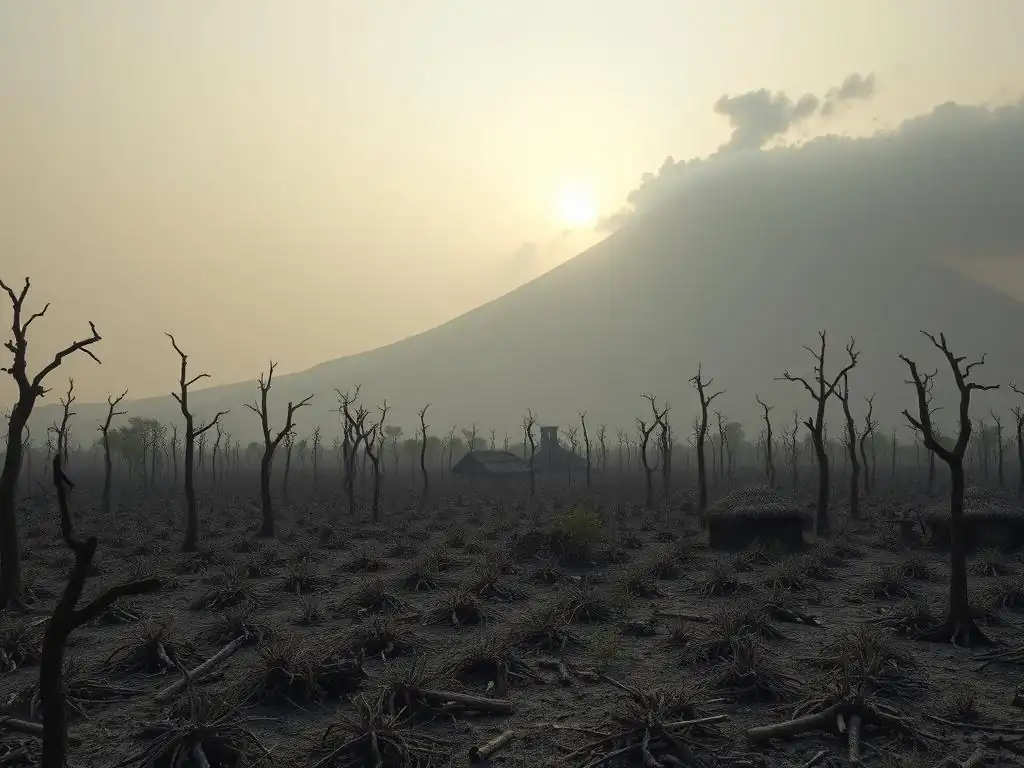
Volcanic Aerosols and Solar Dimming: How Tambora Altered Global Temperatures
The truly global impact of the Tambora eruption stemmed not primarily from the ash itself, which largely settled out of the atmosphere within weeks, but from the massive quantities of sulfur dioxide gas injected into the stratosphere. Unlike ash, sulfur dioxide gas reacts with water vapor in the stratosphere to form sulfate aerosols, tiny particles that can persist in the upper atmosphere for months or even years.
These sulfate aerosols are highly effective at reflecting incoming solar radiation back into space. This process, known as solar dimming, reduces the amount of sunlight reaching the Earth's surface, leading to a decrease in global average temperatures.
The immense volume of sulfur dioxide released by Tambora in 1815 resulted in a significant increase in stratospheric aerosol concentration. Scientists estimate that Tambora injected tens of millions of tons of sulfur dioxide into the stratosphere. This massive aerosol cloud spread globally, encircling the Earth and effectively creating a veil that reduced solar radiation.
The consequence was a measurable and globally distributed cooling effect, disrupting normal weather patterns and triggering the phenomenon that became known as the "Year Without a Summer." The Tambora eruption thus serves as a stark example of how volcanic eruptions can exert a powerful and rapid influence on global climate through the mechanism of volcanic aerosol-induced solar dimming.
The "Year Without a Summer" in 1816: Unprecedented Cold Weather Worldwide
The year 1816 became infamous as the "Year Without a Summer" due to the unprecedented and anomalous cold weather experienced across large parts of the globe, particularly in the Northern Hemisphere. Following the Tambora eruption, global average temperatures dropped by an estimated 0.4–0.7 °C (0.7–1.3 °F).
While this may seem like a small change, it was enough to dramatically disrupt weather patterns and agricultural cycles worldwide. In regions like Europe and North America, 1816 was characterized by persistent cold spells, late frosts in spring, and early frosts in autumn, effectively shortening the growing season and in many areas, eliminating it altogether.
Summer temperatures were significantly depressed. In New England, for example, June brought frosts, and July and August saw repeated cold waves. Snowfall was reported in June in parts of eastern North America.
Europe experienced similar conditions, with unusually cold and wet weather throughout the summer months. These extreme temperature anomalies were not isolated events but persisted throughout the year, leading to widespread crop failures and the ensuing global famine. The "Year Without a Summer" stands as a historical testament to the profound and immediate impact that a major volcanic eruption can have on global climate, transforming a single year into an era of hardship and suffering for millions.
Regional Climate Anomalies: Europe, North America, and Beyond
The climate impacts of the Tambora eruption were not uniform across the globe, but rather manifested in distinct regional anomalies. Europe experienced a particularly harsh year in 1816. The summer months were plagued by incessant rainfall, unseasonably cold temperatures, and widespread flooding. These conditions devastated crops across the continent, leading to widespread famine, especially in Switzerland, France, and parts of Germany. Grain prices soared, and social unrest grew as people struggled to find food.
North America also suffered significantly. The northeastern United States and eastern Canada experienced repeated frosts throughout the summer, destroying crops of corn, wheat, and other staples. The cold weather extended well into the typical growing season, resulting in widespread agricultural failures and food shortages.
Beyond Europe and North America, there is evidence suggesting that the Tambora eruption also influenced weather patterns in other parts of the world. Monsoon patterns in Asia were disrupted, leading to crop failures in India and potentially contributing to famine and disease outbreaks in other regions. While the most documented impacts were in the Northern Hemisphere, the global nature of the atmospheric aerosol cloud meant that the Tambora eruption's climatic shadow extended far beyond the immediate vicinity of the volcano, creating a truly global crisis.
Widespread Crop Failures and Global Starvation
Agricultural Devastation: The Impact on Food Production
The abnormally cold and erratic weather of 1816 had a devastating impact on agriculture worldwide. The shortened growing season, coupled with late spring frosts, summer cold spells, and early autumn frosts, decimated crops in key agricultural regions. In Europe, grain harvests failed across the continent. Wheat, rye, oats, and barley crops were severely reduced or completely lost in many areas. The persistent rainfall and lack of sunshine further hampered crop growth and led to widespread crop diseases.
North America experienced similar agricultural devastation. Corn, a crucial staple crop, was particularly vulnerable to the frost and cold. Many farmers lost their entire corn harvests. Wheat and other grain crops also suffered significant losses.
The agricultural failures were not limited to grains. Vegetable crops and fruit trees were also damaged or destroyed by the unseasonable cold. The widespread and simultaneous crop failures across multiple continents resulted in a global food crisis of immense proportions, triggering widespread famine and social upheaval. The Tambora eruption, through its impact on climate, directly translated into catastrophic agricultural losses and a global food shortage.
The Irish Potato Famine Precursor: Early Signs of Vulnerability
The agricultural devastation of 1816 can be seen as a grim precursor to the later Irish Potato Famine of the 1840s, highlighting pre-existing vulnerabilities in food systems. In Ireland, the potato had become a staple crop for the majority of the population by the early 19th century. The "Year Without a Summer" severely impacted potato harvests in Ireland, leading to significant food shortages. While not as catastrophic as the Great Famine, the events of 1816 caused considerable hardship and revealed the precarious reliance on a single crop and the vulnerability of the Irish population to agricultural shocks.
The crop failures of 1816 in Ireland, combined with existing social and economic inequalities, exacerbated poverty and food insecurity. This early experience of climate-induced food scarcity in Ireland served as a warning sign of the potential for widespread disaster if the potato crop failed again. The Tambora eruption, through its global climate impact, indirectly contributed to setting the stage for the even more devastating Irish Potato Famine decades later, underscoring the long-term and cascading effects of such global environmental events on vulnerable populations and food systems.
Food Shortages and Rising Prices: A Global Economic Crisis
The widespread crop failures of 1816 triggered severe food shortages and a dramatic spike in food prices worldwide, plunging many regions into economic crisis. As grain and other staple crops became scarce, prices soared to unprecedented levels. In Europe, grain prices doubled or even tripled in some areas, making food unaffordable for many, particularly the poor and working classes. Bread riots and social unrest erupted in various European cities as people protested the high cost of food and widespread hunger.
In North America, food prices also rose sharply, although the impact was somewhat less severe than in Europe due to lower population densities and better access to land in some regions. However, food shortages and high prices still caused significant economic hardship, particularly in the northeastern states. The global nature of the food crisis disrupted trade and commerce, further exacerbating economic instability. The Tambora eruption, therefore, not only caused a humanitarian crisis through famine but also triggered a significant global economic downturn, demonstrating the interconnectedness of climate, agriculture, and economic stability.
Disease and Mortality: The Human Cost of the Famine
The widespread famine resulting from the Tambora eruption's climate impacts led to a surge in disease and mortality across affected regions. Malnutrition weakened immune systems, making populations more susceptible to infectious diseases. Outbreaks of typhus, dysentery, and cholera became rampant in Europe and other parts of the world. Crowded living conditions and poor sanitation, exacerbated by poverty and displacement, further facilitated the spread of disease.
Mortality rates soared as a direct consequence of famine and disease. Estimates vary, but it is believed that hundreds of thousands, if not millions, of people perished globally due to the combined effects of starvation and disease in the years following the Tambora eruption. Switzerland and Ireland are believed to have experienced particularly high mortality rates. The Tambora eruption thus had a devastating human cost, not only through the immediate volcanic destruction but also through the indirect but far-reaching consequences of climate change-induced famine and disease, leaving a legacy of suffering that extended far beyond the year 1816.
The Long-Term Consequences of the Tambora Eruption
The widespread famine and economic hardship following the Tambora eruption fueled social and political unrest in many parts of the world. In Europe, food riots and protests erupted in response to soaring food prices and widespread hunger. The existing social and political order was challenged as people demanded government action to address the crisis. In Switzerland, for instance, the famine led to significant social upheaval and migration.
The economic distress and social instability contributed to a climate of discontent and political tension in post-Napoleonic Europe. While the Tambora eruption was not the sole cause of social and political changes in the 19th century, it acted as a significant stressor, exacerbating existing inequalities and contributing to a sense of vulnerability and uncertainty. The event highlighted the fragility of social systems in the face of large-scale environmental shocks and the potential for climate-induced crises to trigger social and political instability.
Economic Downturn and Migration Patterns: Reshaping Communities
The economic consequences of the Tambora eruption extended beyond the immediate food crisis, leading to longer-term economic downturn and significant shifts in migration patterns. Regions heavily reliant on agriculture experienced prolonged economic hardship as crop failures continued for several years after 1816 in some areas. The disruption to trade and commerce further hampered economic recovery. Some regions faced de-population as people migrated in search of better opportunities and food security.
In North America, for example, the harsh conditions in New England contributed to westward migration as people sought more fertile lands and a more favorable climate. In Europe, famine and economic distress drove migration from rural areas to urban centers and, in some cases, emigration to other continents. The Tambora eruption, therefore, not only caused immediate economic disruption but also contributed to longer-term economic restructuring and demographic shifts, reshaping communities and influencing migration patterns in ways that persisted for years and even decades after the event.
Scientific Advancements: Understanding Volcanic Climate Forcing
Despite the immense suffering it caused, the Tambora eruption inadvertently spurred scientific advancements in understanding the relationship between volcanic eruptions and climate. The "Year Without a Summer" prompted early investigations into the causes of the unusual weather patterns. Scientists began to recognize the connection between the volcanic eruption and the global cooling, although the precise mechanisms were not fully understood at the time.
The Tambora event contributed to the nascent field of climatology and helped to establish the concept of volcanic climate forcing – the idea that volcanic eruptions can inject aerosols into the stratosphere, leading to global cooling. Benjamin Franklin had earlier speculated about volcanic influence on climate after the Laki eruption in Iceland in 1783, but Tambora provided a more dramatic and globally evident case study. The eruption spurred further scientific inquiry into atmospheric processes and the role of volcanoes in shaping Earth's climate, laying the groundwork for modern climate science and the understanding of natural climate variability.
Lessons Learned: Tambora and Modern Volcanic Risk Assessment
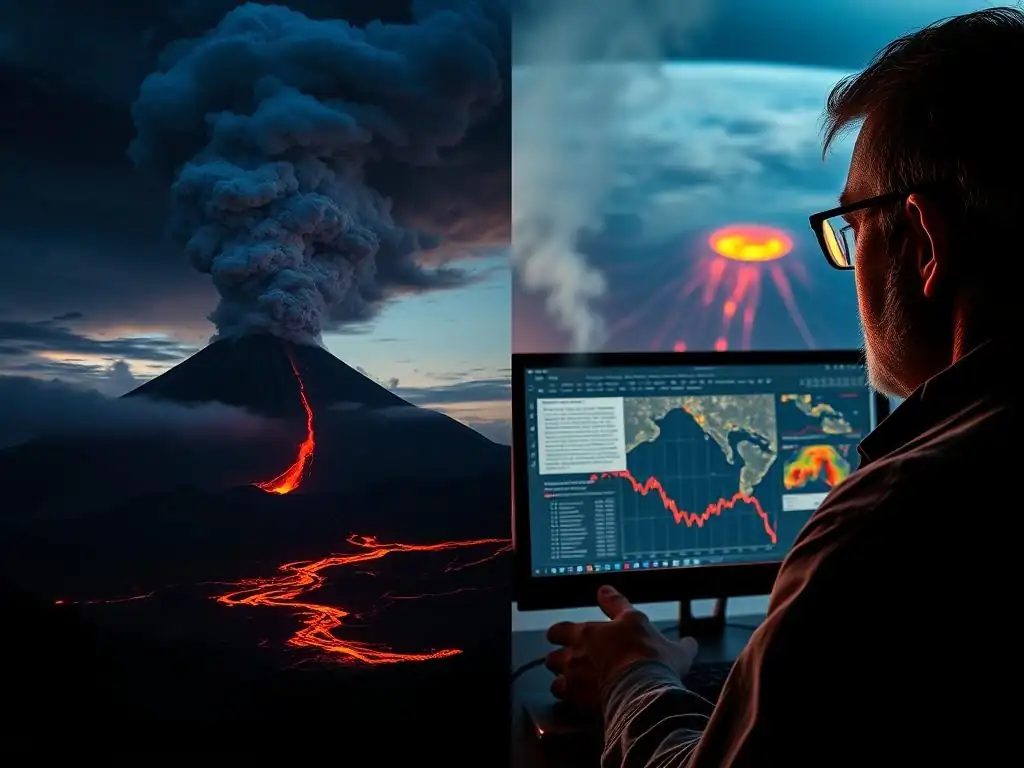
Monitoring Active Volcanoes: Improving Prediction and Preparedness
The Tambora eruption served as a stark reminder of the immense destructive power of volcanoes and the potential for global-scale impacts. One key lesson learned was the importance of monitoring active volcanoes to improve prediction and preparedness. While predicting the exact timing of a major eruption remains a challenge, monitoring volcanic activity for signs of unrest, such as increased seismicity, gas emissions, and ground deformation, can provide valuable early warnings.
In the wake of Tambora, and with growing scientific understanding of volcanic processes, efforts to monitor active volcanoes have become increasingly sophisticated. Modern volcanology employs a range of techniques, including seismometers, GPS instruments, gas sensors, and satellite monitoring, to track volcanic activity and assess eruption potential. Enhanced volcano monitoring networks and improved communication systems are crucial for providing timely warnings to populations at risk and facilitating effective evacuation and mitigation measures, drawing directly from the historical lessons of Tambora's devastating impact.
Climate Modeling and Volcanic Eruptions: Predicting Future Impacts
The Tambora eruption and its global climate consequences have become a crucial case study for climate scientists and modelers. By studying the Tambora event, scientists can refine climate models and improve their ability to predict the potential impacts of future volcanic eruptions on global climate. The Tambora eruption provides valuable data for understanding the relationship between volcanic aerosol injection, solar radiation, and global temperature changes.
Modern climate models incorporate volcanic forcing as a factor influencing climate variability. By simulating the Tambora eruption in climate models, scientists can test and validate model performance and improve projections of future climate scenarios, including the potential for volcanic eruptions to offset or mask anthropogenic warming in the short term. Understanding the climatic impacts of past eruptions like Tambora is essential for developing more robust climate models and improving our ability to anticipate and respond to future volcanic climate forcing events.
Food Security and Climate Change: Building Resilience in a Vulnerable World
The Tambora eruption and the ensuing global famine highlight the critical importance of food security and the vulnerability of food systems to climate shocks. In an increasingly interconnected and globalized world facing the challenges of climate change, ensuring food security is more crucial than ever. The Tambora event underscores the need for resilient food systems that can withstand climate variability and extreme weather events.
Lessons from Tambora emphasize the importance of diversifying crops, improving agricultural practices, developing drought and cold-resistant crop varieties, and strengthening global food distribution networks. Building resilience in agriculture and food systems is essential for mitigating the risks of future climate-related food crises, whether triggered by volcanic eruptions or other climate change impacts. The Tambora eruption serves as a historical warning and a call to action to enhance food security and build resilience in a vulnerable world facing the growing challenges of climate change.
Tambora's Legacy: A Reminder of Nature's Power
The Enduring Effects on Art, Literature, and Culture
The "Year Without a Summer" and the Tambora eruption left an enduring mark on art, literature, and culture. The unusual atmospheric conditions created by volcanic aerosols, such as vivid sunsets and hazy skies, are believed by some art historians to have influenced landscape paintings of the period, perhaps contributing to the dramatic skies seen in the works of J.M.W. Turner. The gloomy and oppressive atmosphere of 1816 may have also resonated with the Romantic literary movement.
Mary Shelley's novel Frankenstein, famously conceived during the unusually cold and dark summer of 1816 in Switzerland, is often seen as reflecting the anxieties and uncertainties of the era, possibly influenced by the environmental and social disruptions caused by the Tambora eruption. Lord Byron's poem "Darkness," written in 1816, vividly depicts a world plunged into perpetual twilight, mirroring the atmospheric effects and sense of despair associated with the "Year Without a Summer."
The Tambora eruption, therefore, indirectly contributed to the cultural and artistic landscape of the 19th century, leaving a subtle but discernible trace in the creative expressions of the time.
Remembering the Victims: Honoring the Lost and Learning from the Past
Remembering the victims of the Tambora eruption and the ensuing global famine is crucial for honoring the lost and learning from the past. The human toll of the Tambora event was immense, with tens of thousands perishing in the immediate eruption and potentially hundreds of thousands more dying from famine and disease in the following years. Acknowledging this tragedy is essential for understanding the full scope of the eruption's impact and for recognizing the human cost of natural disasters.
Honoring the victims also involves learning from the past to prevent similar catastrophes in the future. The Tambora eruption provides valuable lessons about volcanic risk assessment, climate modeling, food security, and disaster preparedness. By studying the Tambora event and its consequences, we can improve our understanding of natural hazards and develop more effective strategies for mitigating their impacts, ultimately helping to protect vulnerable populations and build a more resilient world.
Unresolved Questions and Future Research
Despite extensive research, some questions surrounding the Tambora eruption and its impacts remain unresolved, offering avenues for future research. Scientists continue to refine estimates of the precise volume of volcanic ejecta and sulfur dioxide released, seeking to improve the accuracy of climate models and predictions. Further research is needed to fully understand the regional climate anomalies caused by the Tambora eruption and to disentangle the complex interactions between volcanic forcing and other climate factors.
Ongoing research also explores the social and economic consequences of the Tambora eruption in different regions of the world, seeking to better quantify the mortality rates, migration patterns, and long-term societal impacts. Interdisciplinary studies combining volcanology, climatology, history, and social sciences are crucial for gaining a more comprehensive understanding of the Tambora eruption and its lasting legacy. Future research will undoubtedly continue to shed light on this pivotal event in Earth's and human history, further enhancing our knowledge of volcanic hazards and their global consequences.
Conclusion: Tambora's Shadow Over Our World
The eruption of Mount Tambora in 1815 casts a long shadow over our world, serving as a stark reminder of the immense power of nature and the interconnectedness of Earth's systems. The "Year Without a Summer" and the global famine that followed demonstrate the profound and far-reaching consequences of a single volcanic event, impacting climate, agriculture, societies, and economies across the globe. Tambora's legacy extends beyond the immediate devastation, offering crucial lessons for modern volcanic risk assessment, climate modeling, food security, and disaster preparedness.
As we face the growing challenges of climate change and increasing global interconnectedness, the story of Tambora remains profoundly relevant. It underscores the vulnerability of human societies to natural hazards and the importance of building resilience in a world facing both natural and anthropogenic environmental changes. By remembering the victims of Tambora, learning from its impacts, and continuing to research its complexities, we can better prepare for future volcanic eruptions and other global challenges, ensuring that Tambora's shadow serves not as a source of fear, but as a beacon of knowledge and preparedness for a more resilient future.
Frequently Asked Questions
What was the main impact of the Tambora eruption on global climate?
The Tambora eruption in 1815 caused a significant drop in global temperatures, leading to what became known as the "Year Without a Summer" in 1816. This was primarily due to the sulfate aerosols injected into the stratosphere, reflecting sunlight back into space.
How did the "Year Without a Summer" affect agriculture?
The drastically colder temperatures and unusual weather patterns resulted in widespread crop failures across the Northern Hemisphere. This led to severe food shortages and famine in many regions.
Besides temperature, what other climate changes were observed after the Tambora eruption?
Besides the cooling effect, the Tambora eruption also caused altered precipitation patterns, including heavy rains and floods in some areas and droughts in others. This made agricultural conditions even more challenging.
What were the primary causes of starvation following the Tambora eruption?
The destruction of crops due to frost and other extreme weather events was the primary cause. This was compounded by disrupted trade routes and the inability to store food properly.
How long did the climate effects of the Tambora eruption last?
While the most severe effects were felt in 1816, the global climate took several years to fully recover. Subtle temperature anomalies and weather patterns persisted for several years after the eruption.
Final Reflection: Echoes of a Silent Spring
The chilling narrative of 1816, the "Year Without a Summer," serves as a stark reminder of the profound and far-reaching consequences of natural disasters. Tambora's eruption, a cataclysmic event that plunged the world into darkness and famine, continues to resonate today as a critical case study in climate vulnerability and global interconnectedness. Understanding the Tambora eruption impact on climate is not merely an exercise in historical analysis; it's a vital lesson in preparing for the inevitable challenges posed by our ever-changing planet.
The legacy of Tambora extends beyond scientific data and historical accounts; it has indelibly shaped our understanding of the delicate balance between humanity and nature. The sheer scale of suffering caused by the eruption underscores the fragility of our food systems and the devastating impact of climate anomalies on vulnerable populations. The only thing new in the world is the history you don't know.
- Harry S. Truman. This quote reminds us that understanding past disasters, like the Tambora eruption, is crucial for preventing future catastrophes. We must learn from the past to build more resilient and equitable societies.
As we navigate an era of increasing climate uncertainty, let us remember the lessons etched in the ash of Tambora. Consider how your actions, both big and small, contribute to the global climate. Reflect on the importance of preparedness, resilience, and global cooperation in the face of environmental challenges. Let the shadow of Tambora inspire us to build a future where humanity is not merely a victim of nature's power, but a responsible steward of its delicate balance.
Unearth More Volcanic Truths!
Thank you for exploring the chilling story of Tambora and its devastating impact. Now that you understand the power of volcanic eruptions, consider how this knowledge can inform future action and further exploration.
Here's how you can continue your journey:
- Dive Deeper: Research another significant historical volcanic event, such as Krakatoa or Vesuvius, and compare its global effects to those of Tambora. Consider how modern technology and preparedness could mitigate the impact of a similar disaster today.
- Share your newfound knowledge with friends and family! Help others understand the vital role volcanoes play in shaping our world, both constructively and destructively.
- Explore the Volcano Explorers community forums and share your insights! You might discover unexpected connections between global events.
What lesser-known volcanic event has captured your attention, and what lessons can we learn from it to better prepare for future volcanic activity?