
The Fluid Dynamics of Eruption: Conduit Flow and Explosivity

Welcome, fellow Volcano Explorer!
Prepare to be captivated by the raw power and complex artistry of Earth's fiery giants. Ever wondered what really happens inside a volcano during an eruption? Our latest exploration delves deep into volcanic eruption fluid dynamics, unraveling the secrets of conduit flow and its critical role in determining explosivity. Are you ready to understand the science behind the spectacle? Let's ignite your curiosity and journey into the heart of volcanic power!
- Understanding Volcanic Eruption Fluid Dynamics
- Magma Ascent and Conduit Flow: Key Processes in Volcanic Eruptions
- Factors Influencing Volcanic Explosivity: A Fluid Dynamics Perspective
- Conduit Processes and Eruption Styles: From Effusive to Explosive
- Modeling Volcanic Eruptions: Integrating Fluid Dynamics and Thermodynamics
- Case Studies: Applying Fluid Dynamics to Specific Volcanic Eruptions
- Future Directions in Volcanic Eruption Fluid Dynamics Research
- Conclusion: The Significance of Understanding Volcanic Eruption Fluid Dynamics for Volcano Monitoring and Hazard Mitigation
-
Frequently Asked Questions
- What role does fluid dynamics play in understanding volcanic eruptions?
- How does the viscosity of magma influence the type of volcanic eruption?
- What is conduit flow, and why is it important in the context of volcanic eruptions?
- How do gas bubbles within magma contribute to the explosivity of a volcanic eruption?
- What are some methods volcanologists use to study the fluid dynamics of eruptions?
- Final Reflection: Embracing the Volatile Dance
- Ignite Your Inner Volcanologist!
Understanding Volcanic Eruption Fluid Dynamics
The Critical Role of Fluid Dynamics in Eruption Style
Fluid dynamics is paramount to understanding the diverse and often dramatic styles of volcanic eruptions. The way magma, a complex mixture of molten rock, crystals, and dissolved gases, moves from the depths of the Earth to the surface dictates whether an eruption will be a slow, oozing lava flow or a catastrophic explosion. This is because the principles of fluid dynamics govern the motion and interaction of this multiphase mixture under varying conditions of pressure, temperature, and composition.
Factors like magma viscosity, gas content, and the geometry of the volcanic conduit all play critical roles, and their interplay is best understood through the lens of fluid dynamics. By analyzing these factors, scientists can begin to unravel why some volcanoes erupt effusively, producing rivers of lava, while others erupt explosively, sending ash and gas high into the atmosphere.
The study of volcanic eruption fluid dynamics allows us to move beyond simply describing volcanic phenomena and delve into the underlying physical processes that control them. For instance, consider the difference between basaltic and rhyolitic eruptions. Basaltic magmas, typically less viscous, often result in effusive eruptions characterized by lava flows, like those seen in Hawaii.
In contrast, rhyolitic magmas, being highly viscous and gas-rich, are more prone to explosive eruptions, such as the cataclysmic eruption of Mount Pinatubo in 1991. This stark contrast is fundamentally explained by fluid dynamics: the ease with which gas can escape from less viscous basaltic magma versus the trapping of gas and subsequent pressure build-up in highly viscous rhyolitic magma. Understanding these differences is crucial not only for scientific curiosity but also for hazard assessment and mitigation in volcanically active regions.
Introduction to Volcanic Conduits and Plumbing Systems
Volcanic conduits and plumbing systems are the Earth's natural pipelines for magma, acting as pathways from the magma chamber beneath the surface to the vent at the volcano's summit. These systems are far from simple pipes; they are complex networks of fractures, fissures, and channels within the Earth's crust. Understanding their structure and dynamics is essential for comprehending volcanic eruption fluid dynamics.
The geometry of the conduit system – its shape, size, branching, and roughness – profoundly influences how magma ascends and ultimately erupts. Think of it like plumbing in a house: narrow pipes, constrictions, or rough surfaces can impede flow and alter pressure, similarly impacting magma ascent and eruption style.
The volcanic plumbing system is not static; it evolves over time due to magma flow, pressure changes, and interactions with surrounding rocks. Magma chambers, located kilometers beneath the surface, serve as reservoirs where magma accumulates and differentiates. From these chambers, magma ascends through conduits, driven by buoyancy and pressure gradients.
The conduit itself can be a single, relatively straight pathway, or it can be a complex network of interconnected pathways. The walls of the conduit are formed by the surrounding rock, which can interact with the magma through heat exchange, chemical reactions, and mechanical erosion. Studying these intricate systems, often through geophysical surveys and analysis of erupted products, is vital for deciphering the processes governing volcanic eruption fluid dynamics and predicting eruptive behavior.
Magma Ascent and Conduit Flow: Key Processes in Volcanic Eruptions
The Mechanics of Magma Ascent: Pressure, Density, and Viscosity
Magma ascent, the journey of molten rock from depth to the Earth's surface, is a complex process driven by fundamental physical principles. Three key factors govern this ascent: pressure, density, and viscosity. Deep within the Earth, magma is under immense pressure from the overlying rocks. This pressure is significantly higher than the pressure at the surface. The density difference between magma and the surrounding solid rock is also crucial.
Magma is generally less dense than the surrounding crust, creating buoyancy forces that drive it upwards, much like a bubble rising in water. However, the rate of ascent is significantly controlled by magma viscosity. Viscosity is a measure of a fluid's resistance to flow; highly viscous magmas resist flow more strongly than low-viscosity magmas. These three factors interact to determine the velocity and style of magma ascent, fundamentally influencing volcanic eruption fluid dynamics.
Imagine a hot air balloon rising. The hot air inside is less dense than the surrounding cooler air, creating buoyancy. Similarly, magma, being less dense than the surrounding solid rock, experiences an upward buoyant force. However, unlike the relatively free movement of a balloon in air, magma ascent is resisted by its own viscosity and the friction against the conduit walls.
High-viscosity magmas, like rhyolites, ascend slowly, allowing for gas accumulation and pressure build-up, which can lead to explosive eruptions. Conversely, low-viscosity magmas, like basalts, ascend more readily, allowing gases to escape more easily, often resulting in effusive eruptions. The interplay of pressure, density, and viscosity is therefore central to understanding the mechanics of magma ascent and its role in volcanic eruption fluid dynamics.
Volcanic Conduit Dynamics: Shape, Size, and Roughness
The characteristics of the volcanic conduit itself – its shape, size, and roughness – exert a profound influence on magma flow and ultimately on eruption style. A wider conduit, for instance, offers less resistance to magma flow compared to a narrow one, analogous to water flowing more easily through a wider pipe. The shape of the conduit, whether it's a straight vertical channel or a tortuous, branching network, also affects flow patterns and pressure distribution.
Furthermore, the roughness of the conduit walls, determined by the texture and fractures of the surrounding rock, can introduce friction and turbulence, impacting magma ascent velocity and degassing. These conduit dynamics are integral to understanding volcanic eruption fluid dynamics.
Consider two extreme scenarios. A volcano with a wide, smooth, and relatively straight conduit might experience more effusive eruptions. The low resistance allows for a steady ascent of magma, and gases can escape more readily. In contrast, a volcano with a narrow, constricted, and rough conduit could be prone to explosive eruptions.
The constricted pathway can impede magma flow, leading to pressure build-up beneath the constriction. The rough walls can promote nucleation of gas bubbles and increase friction, further contributing to pressure accumulation. Even subtle changes in conduit geometry, perhaps due to wall rock collapse or magma solidification, can significantly alter the flow regime and transition an eruption from effusive to explosive, highlighting the critical role of conduit dynamics in volcanic eruption fluid dynamics.
Modeling Magma Flow in Volcanic Conduits: Challenges and Approaches
Modeling magma flow within volcanic conduits presents significant challenges due to the complex nature of magma and the extreme conditions within volcanoes. Magma is not a simple fluid; it's a multiphase mixture of molten silicate liquid, crystals of various minerals, and dissolved gases. Its properties, such as viscosity and density, are highly dependent on temperature, pressure, and composition, all of which change dramatically as magma ascends.
Furthermore, the geometry of the conduit is often poorly constrained, and the processes occurring at the conduit walls, like heat transfer and chemical reactions, are complex. Despite these challenges, scientists employ various approaches to model magma flow, aiming to better understand volcanic eruption fluid dynamics.
Numerical simulations are a powerful tool for modeling magma flow. These simulations use computational fluid dynamics (CFD) techniques to solve equations that describe the motion of fluids, incorporating the complex properties of magma and the geometry of the conduit. Researchers are developing increasingly sophisticated models that account for multiphase flow, non-Newtonian viscosity behavior (where viscosity changes with stress), and gas exsolution processes.
Another approach involves laboratory experiments using analog materials that mimic magma behavior under controlled conditions. These experiments can provide valuable insights into flow patterns, fragmentation mechanisms, and the influence of conduit geometry. Combining numerical simulations with experimental data and real-world observations is crucial for advancing our understanding of volcanic eruption fluid dynamics and improving eruption forecasting capabilities.
Factors Influencing Volcanic Explosivity: A Fluid Dynamics Perspective
Gas Content and Exsolution: Driving Explosive Eruptions
Gas content is a primary driver of explosive volcanic eruptions. Magma at depth contains dissolved gases, primarily water vapor, carbon dioxide, sulfur dioxide, and hydrogen sulfide, held in solution by the immense pressure. As magma ascends and pressure decreases, these gases become less soluble and begin to exsolve, forming bubbles.
The process of gas exsolution, and how it interacts with the surrounding magma, is a critical aspect of volcanic eruption fluid dynamics and a key factor in determining eruption explosivity. If gas bubbles can readily escape, the eruption is likely to be effusive. However, if gas is trapped and accumulates, it can lead to a buildup of pressure, ultimately resulting in an explosive eruption.
The rate and style of gas exsolution depend on several factors, including magma composition, ascent rate, and the presence of nucleation sites for bubble formation. Highly viscous magmas, like rhyolites, tend to trap gas bubbles more effectively than low-viscosity magmas, like basalts. As gas bubbles grow and coalesce, they can exert tremendous pressure on the surrounding magma.
If the strength of the surrounding magma and conduit walls is exceeded, a violent fragmentation occurs, propelling magma fragments (pyroclasts) and gas into the atmosphere as an explosive eruption. The 1980 eruption of Mount St. Helens is a stark example of gas-driven explosivity, where the rapid decompression and gas exsolution in a dacitic magma led to a devastating lateral blast and a Plinian eruption column, highlighting the crucial role of gas content in volcanic eruption fluid dynamics.
Viscosity and Fragmentation: Controlling Eruption Style
Viscosity plays a pivotal role in controlling volcanic eruption style, particularly in determining whether an eruption will be effusive or explosive. As mentioned earlier, viscosity is a fluid's resistance to flow. Highly viscous magmas, like rhyolites and andesites, are sticky and resist flow, while low-viscosity magmas, like basalts, are more fluid and flow easily. This fundamental property, governed by the chemical composition and temperature of the magma, significantly influences volcanic eruption fluid dynamics and is directly linked to fragmentation, the process by which magma breaks apart into pyroclasts during explosive eruptions.
High viscosity hinders gas escape from magma. As gas bubbles exsolve in a viscous magma, they struggle to rise and escape, leading to pressure build-up. Furthermore, highly viscous magmas are more prone to fragmentation when subjected to rapid decompression or shear stresses. The fragmentation process can occur through various mechanisms, including brittle failure of the melt, gas bubble expansion and bursting, and shear-induced disruption.
The resulting fragmented magma is ejected explosively, forming ash clouds, pyroclastic flows, and tephra deposits. Conversely, low-viscosity magmas allow gas to escape more readily, and they are less prone to fragmentation. They tend to produce effusive eruptions characterized by lava flows and lava fountains. The contrasting eruption styles of volcanoes like Kīlauea (effusive, basaltic) and Mount Vesuvius (explosive, andesitic to rhyolitic) clearly illustrate the profound control of viscosity on volcanic eruption fluid dynamics.
Role of Water Content in Magma: Phreatomagmatic Eruptions
Water content in magma significantly influences eruption style, especially in the context of phreatomagmatic eruptions. While magmatic gases are primarily derived from within the Earth, external water sources, such as groundwater, surface water (lakes, oceans), or ice, can interact with magma during ascent or eruption. This interaction can dramatically alter the volcanic eruption fluid dynamics and often leads to highly explosive eruptions known as phreatomagmatic eruptions. The rapid heating and vaporization of external water in contact with hot magma generates vast volumes of steam, which can dramatically increase the explosivity of an eruption.
Phreatomagmatic eruptions are characterized by their high explosivity and the production of fine-grained ash and base surges, which are ground-hugging clouds of gas and ash. The efficiency of heat transfer from magma to water is crucial in phreatomagmatic explosions. When magma comes into contact with water, the water rapidly heats up, flashes to steam, and expands violently. This rapid expansion can fragment the surrounding magma, leading to explosive ejection of pyroclasts and steam. The type of phreatomagmatic eruption depends on the water-to-magma ratio, the depth of interaction, and the magma composition. Surtseyan eruptions, for instance, are a type of shallow submarine phreatomagmatic eruption characterized by steam-rich jets and the formation of tuff rings and cones. Understanding the role of water content and magma-water interaction is critical for assessing the hazards associated with volcanoes located in or near water bodies and for comprehending the full spectrum of volcanic eruption fluid dynamics.
Conduit Processes and Eruption Styles: From Effusive to Explosive
Effusive Eruptions: Low Viscosity, Gentle Flow
Effusive eruptions are characterized by the relatively gentle outpouring of lava onto the Earth's surface. These eruptions are typically associated with low-viscosity magmas, such as basaltic magmas, which allow for easy flow and gas escape. The volcanic eruption fluid dynamics of effusive eruptions are dominated by gravity-driven flow and relatively low gas pressures. Effusive eruptions can manifest in various forms, including lava flows, lava fountains, and lava lakes. They are generally less hazardous than explosive eruptions, but lava flows can still pose significant threats to infrastructure and inhabited areas.
Lava flows are streams of molten rock that can travel considerable distances from the vent, depending on the magma viscosity, eruption rate, and topography. Basaltic lava flows, due to their low viscosity, can flow for tens of kilometers, as seen in the long-lived eruptions of Kīlauea volcano in Hawaii. Lava fountains are jets of lava propelled into the air by escaping gases. These are common in basaltic eruptions and can create spectacular displays, though they are generally less hazardous than explosive plumes.
Lava lakes are pools of molten lava confined within volcanic craters or depressions. They represent a relatively steady state of effusive activity, with ongoing convection and degassing. Effusive eruptions, while often perceived as less dramatic than explosive events, are a fundamental expression of volcanic eruption fluid dynamics and play a crucial role in shaping volcanic landscapes.
Explosive Eruptions: High Viscosity, Fragmented Magma
Explosive eruptions stand in stark contrast to effusive eruptions, characterized by the violent fragmentation of magma and the ejection of pyroclasts and gas into the atmosphere. These eruptions are typically associated with high-viscosity magmas, such as rhyolitic and andesitic magmas, which trap gases and resist flow. The volcanic eruption fluid dynamics of explosive eruptions are governed by rapid gas expansion, magma fragmentation, and the generation of high-velocity ejecta. Explosive eruptions can range in intensity from small bursts to cataclysmic events capable of global impacts.
The key to explosivity lies in the build-up of pressure within the magma due to trapped gases. As pressure exceeds the strength of the surrounding magma and conduit walls, a rapid decompression and fragmentation occur. This fragmentation produces pyroclasts of varying sizes, from fine ash to large volcanic bombs and blocks.
The mixture of pyroclasts and hot gases is ejected at high velocities, forming eruption plumes that can reach tens of kilometers into the stratosphere. Pyroclastic flows, ground-hugging currents of hot gas and pyroclasts, are another dangerous manifestation of explosive eruptions. The 1991 eruption of Mount Pinatubo in the Philippines, a Plinian eruption of andesitic magma, serves as a potent example of the destructive power of explosive eruptions driven by volcanic eruption fluid dynamics.
Strombolian Eruptions: Intermittent Explosions Driven by Gas Bubbles
Strombolian eruptions are a type of moderately explosive eruption characterized by intermittent bursts of gas and pyroclasts. They are named after Stromboli volcano in Italy, which has been erupting in this style for centuries. Strombolian eruptions are driven by the bursting of large gas bubbles at the vent surface. The volcanic eruption fluid dynamics of Strombolian eruptions involve the rise and coalescence of gas bubbles within a relatively low-viscosity magma conduit. These eruptions are typically less violent than Plinian eruptions but can still pose localized hazards due to ballistic projectiles and tephra fall.
The mechanism of Strombolian eruptions is thought to involve the accumulation of gas bubbles at the top of the magma column in the conduit. As these bubbles grow and coalesce, they become buoyant and rise rapidly towards the surface. When a large bubble reaches the surface, it bursts, propelling magma fragments and gas into the air.
These bursts are often accompanied by bright flashes of light and loud explosions. The ejected material typically consists of bombs, lapilli, and ash, which fall back to the ground around the vent, building up a cinder cone. Strombolian eruptions are a common eruptive style at many volcanoes worldwide and represent a fascinating intermediate point on the spectrum of volcanic eruption fluid dynamics between effusive and highly explosive eruptions.
Plinian Eruptions: Sustained Explosive Columns and Pyroclastic Flows
Plinian eruptions represent the most explosive and hazardous type of volcanic eruption. They are characterized by sustained, powerful eruption columns that can reach tens of kilometers into the stratosphere, and are often associated with pyroclastic flows and widespread ashfall. The volcanic eruption fluid dynamics of Plinian eruptions involve highly pressurized, gas-rich magma, rapid fragmentation, and sustained ejection of pyroclastic material. Plinian eruptions are typically associated with highly viscous magmas, such as rhyolites and dacites, and are capable of causing catastrophic damage over vast areas.
The eruption column in a Plinian eruption is sustained by the continuous upward flow of gas and pyroclasts. The column rises buoyantly due to its lower density compared to the surrounding atmosphere. As the column ascends, it cools and expands, and eventually, it may become unstable and collapse, leading to the formation of pyroclastic flows.
Pyroclastic flows are hot, ground-hugging mixtures of gas and pyroclasts that can travel at speeds of hundreds of kilometers per hour, incinerating everything in their path. The 79 AD eruption of Mount Vesuvius, which destroyed Pompeii and Herculaneum, is a classic example of a Plinian eruption. Modern examples include the 1980 eruption of Mount St. Helens and the 1991 eruption of Mount Pinatubo, all highlighting the devastating potential of Plinian eruptions and the importance of understanding their volcanic eruption fluid dynamics for hazard mitigation.
Modeling Volcanic Eruptions: Integrating Fluid Dynamics and Thermodynamics
Numerical Simulations of Magma Flow and Fragmentation
Numerical simulations are increasingly vital tools in volcanology, allowing researchers to model the complex processes of magma flow and fragmentation that govern volcanic eruptions. These simulations utilize computational fluid dynamics (CFD) and thermodynamics to solve equations that describe the motion and energy transfer within magma systems. By incorporating the physical properties of magma, conduit geometry, and gas dynamics, numerical models can simulate various aspects of volcanic eruption fluid dynamics, from magma ascent and degassing to fragmentation and pyroclast dispersal.
Sophisticated numerical models are being developed to address key questions in volcanology. For example, models can simulate the multiphase flow of magma, accounting for the interactions between melt, crystals, and gas bubbles. They can also model the process of gas exsolution and bubble growth, which is crucial for understanding explosive eruptions.
Furthermore, simulations can investigate the mechanisms of magma fragmentation under different conditions of pressure, temperature, and strain rate. These numerical models are not just theoretical exercises; they are increasingly being validated against laboratory experiments and real-world observations of volcanic eruptions, providing valuable insights into volcanic eruption fluid dynamics and improving our ability to forecast eruptive behavior.
Experimental Studies of Eruption Dynamics: Analog Models and Real-Time Observation
Experimental studies complement numerical simulations in understanding volcanic eruption dynamics. Analog models, using materials that mimic magma behavior, allow researchers to study eruption processes in a controlled laboratory setting. These experiments can provide valuable insights into flow patterns, fragmentation mechanisms, and the influence of various parameters on volcanic eruption fluid dynamics. Real-time observations of active volcanoes, using advanced monitoring techniques, also provide crucial data for validating models and improving our understanding of eruption processes.
Analog experiments can simulate various aspects of volcanic eruptions, such as magma ascent through conduits, lava flow behavior, and explosive fragmentation. For example, experiments using viscous fluids and pressurized gas can mimic Strombolian explosions, allowing researchers to study the dynamics of gas bubble bursting and pyroclast ejection. Other experiments use granular materials to simulate pyroclastic flows and surges, investigating their flow behavior and depositional patterns.
Real-time monitoring of active volcanoes, using instruments like seismometers, GPS, gas sensors, and thermal cameras, provides invaluable data on pre-eruptive signals, eruption dynamics, and post-eruption processes. Combining experimental studies with real-time observations and numerical simulations is essential for a comprehensive understanding of volcanic eruption fluid dynamics and for improving volcano hazard assessments.
The Importance of Multi-Phase Flow Modeling in Volcano Research
Multi-phase flow modeling is of paramount importance in volcano research because magma is inherently a multi-phase mixture. It comprises molten silicate liquid, solid crystals of various minerals, and a gas phase consisting of dissolved volatiles. The interactions between these phases profoundly influence the volcanic eruption fluid dynamics and the resulting eruption style. Ignoring the multi-phase nature of magma can lead to oversimplified or inaccurate models of volcanic processes. Therefore, incorporating multi-phase flow principles into numerical simulations and theoretical frameworks is crucial for advancing our understanding of volcanic eruptions.
Multi-phase flow models in volcanology explicitly account for the different phases present in magma and their interactions. For instance, models can simulate the movement of crystals within the melt, the nucleation and growth of gas bubbles, and the relative velocities of different phases. These models can capture complex phenomena such as degassing, magma mixing, and crystal fractionation, which are all important processes in volcanic systems.
Furthermore, multi-phase flow modeling is essential for understanding fragmentation processes, as fragmentation often involves the complex interplay of melt, crystals, and gas bubbles. By accurately representing the multi-phase nature of magma, these models provide a more realistic and comprehensive picture of volcanic eruption fluid dynamics, leading to more accurate predictions and improved hazard assessments.
Case Studies: Applying Fluid Dynamics to Specific Volcanic Eruptions
Kīlauea Iki Lava Lake (1959): Effusive Eruption and Conduit Dynamics
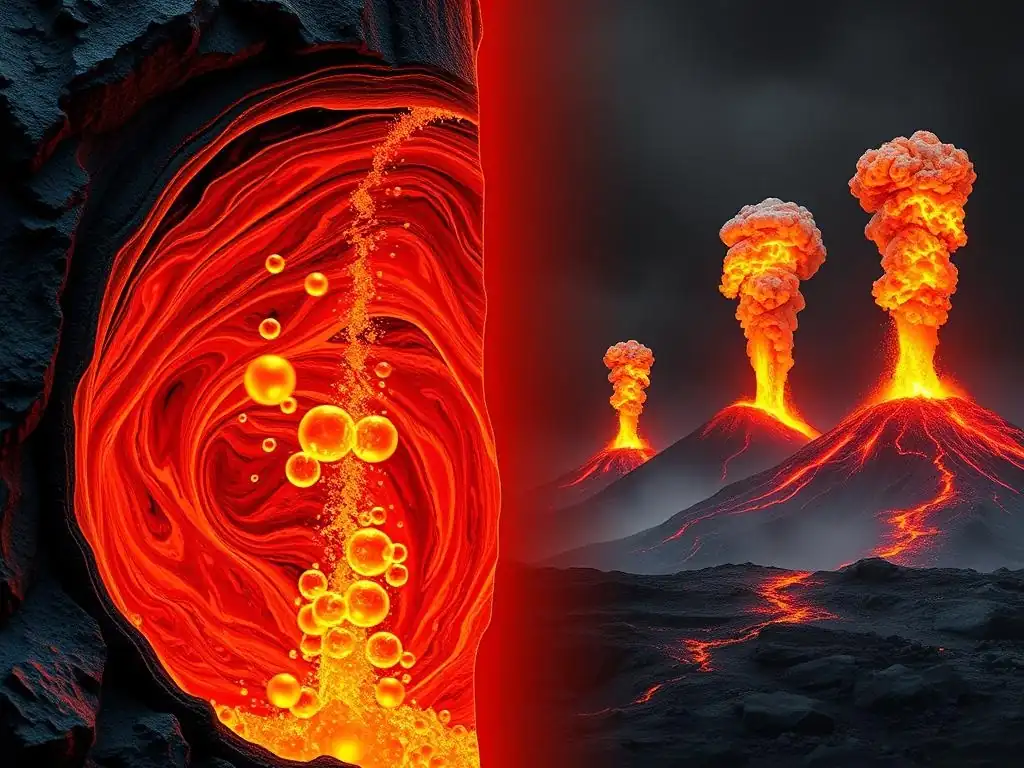
The 1959 eruption of Kīlauea Iki, a satellite vent of Kīlauea volcano in Hawaii, provides a classic case study of an effusive eruption and the role of conduit dynamics in controlling lava lake behavior. This eruption produced a spectacular lava fountain and filled a pre-existing crater, forming a lava lake that persisted for several years. Studying the volcanic eruption fluid dynamics of this event offers valuable insights into the processes governing effusive eruptions and lava lake evolution. The eruption was characterized by relatively low-viscosity basaltic magma and a wide, efficient conduit system, facilitating sustained effusive activity.
The Kīlauea Iki lava lake exhibited complex convective patterns and degassing processes. The lava lake surface was constantly being replenished by fresh lava from below, while cooling and crystallization occurred at the surface and margins. Gas bubbles rose through the lava lake, releasing volatiles into the atmosphere.
Scientists meticulously studied the temperature, composition, and flow patterns within the lava lake, providing a detailed understanding of its volcanic eruption fluid dynamics. The eruption and subsequent lava lake behavior were largely controlled by the low viscosity of the basaltic magma and the relatively unobstructed conduit, allowing for continuous effusive activity and the development of a dynamic lava lake system.
Mount St. Helens (1980): Explosive Eruption and Conduit Fragmentation
The 1980 eruption of Mount St. Helens in Washington State stands as a dramatic example of an explosive eruption driven by conduit fragmentation and rapid decompression of a gas-rich magma. This eruption, triggered by a large landslide that destabilized the volcano's edifice, involved a powerful lateral blast, a Plinian eruption column, and devastating pyroclastic flows.
Analyzing the volcanic eruption fluid dynamics of this event reveals the crucial role of magma composition, gas content, and conduit processes in generating such a catastrophic explosive eruption. The eruption involved a highly viscous, gas-rich dacitic magma that had been stored at shallow depths beneath the volcano.
The landslide removed the overlying pressure, causing rapid decompression of the magma and triggering explosive gas exsolution and fragmentation. The lateral blast, directed sideways due to the landslide, was a result of the sudden expansion of pressurized gas within the magma. The subsequent Plinian eruption column and pyroclastic flows were sustained by the continued fragmentation and ejection of magma from the conduit.
The Mount St. Helens eruption highlighted the importance of understanding conduit fragmentation processes and the role of rapid decompression in driving explosive volcanic eruption fluid dynamics. It also underscored the potential for landslides and edifice instability to trigger or amplify explosive eruptions.
Lessons Learned from Analyzing Eruption Fluid Dynamics
Analyzing case studies like Kīlauea Iki and Mount St. Helens provides valuable lessons about volcanic eruption fluid dynamics and its implications for hazard assessment and volcano monitoring. Comparing effusive and explosive eruptions reveals the fundamental control of magma viscosity, gas content, and conduit dynamics on eruption style. Effusive eruptions, characterized by low viscosity and efficient degassing, are generally less hazardous but can still pose threats from lava flows. Explosive eruptions, driven by high viscosity, trapped gases, and conduit fragmentation, are far more hazardous due to pyroclastic flows, ashfall, and eruption columns.
Understanding the volcanic eruption fluid dynamics of specific volcanoes is crucial for developing effective hazard assessments and monitoring strategies. By studying past eruptions and analyzing the underlying physical processes, scientists can better anticipate future eruptive behavior. This knowledge can inform land-use planning, evacuation procedures, and early warning systems, ultimately reducing the risks posed by volcanic eruptions to human populations and infrastructure. Continued research into volcanic eruption fluid dynamics, combining numerical modeling, experimental studies, and real-time observations, is essential for improving our ability to live safely with volcanoes.
Future Directions in Volcanic Eruption Fluid Dynamics Research
Improving Models of Magma Ascent and Fragmentation
Future research in volcanic eruption fluid dynamics should focus on improving models of magma ascent and fragmentation. Current models, while increasingly sophisticated, still have limitations in fully capturing the complex multiphase flow behavior of magma and the intricate mechanisms of fragmentation. Advancements in computational power and numerical techniques will allow for more detailed and realistic simulations of magma ascent through volcanic conduits, incorporating more complex geometries and magma properties.
Improving fragmentation models requires a better understanding of the physical processes that lead to magma breakup. This includes investigating the roles of gas bubble growth and coalescence, melt rheology, and external factors like pressure changes and shear stresses. Developing more physically based fragmentation models, rather than relying on empirical relationships, will be crucial for accurately predicting eruption explosivity. Furthermore, integrating geochemical data, such as volatile contents and crystal textures, into fluid dynamic models will provide more realistic constraints on magma properties and eruption conditions, leading to more accurate and predictive models of volcanic eruption fluid dynamics.
Integrating Geophysical Data with Fluid Dynamic Simulations
Integrating geophysical data with fluid dynamic simulations represents a promising avenue for advancing volcano research. Geophysical monitoring techniques, such as seismology, geodesy, and gas geochemistry, provide valuable information about the internal state of volcanoes, including magma chamber dynamics, conduit processes, and pre-eruptive signals. Combining these data with fluid dynamic simulations can create more comprehensive and data-constrained models of volcanic eruption fluid dynamics.
For example, seismic data can be used to infer magma ascent rates and conduit geometry, which can then be incorporated into fluid dynamic simulations. Geodetic data, measuring ground deformation, can provide constraints on magma chamber pressure changes and magma volume variations. Gas emission data can offer insights into degassing processes and magma composition. By assimilating these diverse geophysical datasets into numerical models, researchers can develop more realistic and data-driven simulations of volcanic eruption fluid dynamics, improving our ability to monitor volcanic activity and forecast eruptions.
Predicting Volcanic Eruptions: The Role of Fluid Dynamics in Hazard Assessment
Predicting volcanic eruptions remains a major challenge in volcanology, but understanding volcanic eruption fluid dynamics plays a crucial role in improving hazard assessment and eruption forecasting capabilities. By developing more accurate and predictive models of magma ascent, fragmentation, and eruption styles, scientists can better anticipate the timing, magnitude, and style of future eruptions. This knowledge is essential for mitigating volcanic hazards and protecting communities living near active volcanoes.
Fluid dynamic models can be used to simulate various eruption scenarios and assess the potential impacts of different eruption styles. For example, models can predict the extent of lava flows, the dispersal of ash clouds, and the runout distances of pyroclastic flows. These simulations can inform hazard maps and evacuation plans, helping to minimize the risks associated with volcanic eruptions.
Furthermore, real-time monitoring data, combined with fluid dynamic models, can be used to detect pre-eruptive signals and provide early warnings of impending eruptions. Continued research in volcanic eruption fluid dynamics is therefore essential for improving volcano hazard assessment and building more resilient communities in volcanically active regions.
Conclusion: The Significance of Understanding Volcanic Eruption Fluid Dynamics for Volcano Monitoring and Hazard Mitigation
Understanding volcanic eruption fluid dynamics is of paramount significance for effective volcano monitoring and hazard mitigation. The principles of fluid dynamics govern the movement of magma, the styles of eruptions, and the dispersal of volcanic products. By delving into the complexities of magma ascent, conduit flow, gas exsolution, and fragmentation, scientists can unravel the fundamental processes that drive volcanic activity. This knowledge is not merely academic; it has direct and crucial implications for predicting eruptions, assessing volcanic hazards, and ultimately, protecting lives and livelihoods in volcanically active regions.
Continued research and advancements in volcanic eruption fluid dynamics are essential for enhancing our ability to live safely and sustainably in the dynamic and awe-inspiring world of volcanoes.
Frequently Asked Questions
What role does fluid dynamics play in understanding volcanic eruptions?
Fluid dynamics is crucial because it helps us understand how magma flows within the volcano's conduit and how gas bubbles interact, ultimately affecting the explosivity of an eruption. It's about the physics of moving fluids (magma and gas).
How does the viscosity of magma influence the type of volcanic eruption?
Magma viscosity, or its resistance to flow, greatly affects eruption style. High-viscosity magma, like rhyolite, traps gas and leads to explosive eruptions, while low-viscosity magma, like basalt, allows gas to escape more easily, resulting in effusive eruptions.
What is conduit flow, and why is it important in the context of volcanic eruptions?
Conduit flow refers to the movement of magma through the volcano's plumbing system. Understanding conduit flow is vital because it directly influences the rate and style of eruption, determining whether it's a slow lava flow or a violent explosion.
How do gas bubbles within magma contribute to the explosivity of a volcanic eruption?
Gas bubbles within magma, primarily water vapor and carbon dioxide, expand rapidly as magma rises. This expansion creates pressure that, if contained, can lead to powerful explosions when the magma finally reaches the surface. The amount and behavior of gas are key factors.
What are some methods volcanologists use to study the fluid dynamics of eruptions?
Volcanologists use a range of methods, including mathematical modeling, laboratory experiments with simulated magma, and analysis of erupted materials to infer the fluid dynamics within a volcano and predict future behavior.
Final Reflection: Embracing the Volatile Dance
The exploration of volcanic eruption fluid dynamics, as presented in this article, might seem confined to the realm of scientific inquiry. However, understanding the intricate dance of magma within volcanic conduits is profoundly relevant today, as it directly informs our ability to predict and mitigate the devastating impacts of volcanic eruptions on communities worldwide. This knowledge is not just academic; it's a vital tool for safeguarding lives and infrastructure in volcanically active regions.
The study of conduit flow and explosivity has not only reshaped our scientific understanding of volcanic processes but also profoundly influenced the way we approach disaster preparedness and risk assessment. Witnessing the power of fluid dynamics to unlock the secrets of these geological behemoths fills me with a sense of awe and responsibility. The only way to do great work is to love what you do.
– Steve Jobs. This quote resonates deeply, as the dedication to unraveling the complexities of volcanic eruptions stems from a genuine passion for understanding and protecting our planet.
As we conclude this exploration of volcanic eruption fluid dynamics, I invite you to reflect on the power of scientific inquiry to illuminate the forces that shape our world. Consider how a deeper understanding of seemingly abstract concepts can translate into tangible benefits for humanity. Let us embrace the challenge of unraveling the Earth's mysteries, not only for the sake of knowledge but also for the betterment of our shared future.
Ignite Your Inner Volcanologist!
Thank you for exploring the fascinating world of volcanic conduit dynamics! Now that you've learned about the relationship between fluid flow and the explosivity of eruptions, it's time to apply this knowledge.
Here are a few ways to continue your volcanic journey:
- Analyze Volcanic Data: Use publicly available data from a volcano monitoring site to predict the potential style of a future eruption.
- Share Your Passion: Discuss your favorite volcanic eruption with a friend. Which volcano's inner workings most intrigue you?
- Research a Volcanic Event: Investigate a lesser-known eruption, researching its geological record to determine its explosivity.
What new insights have you gained about eruption prediction? Share your thoughts in the comments below!