
Predicting the Unpredictable: Can We Foresee a Supervolcano Eruption?

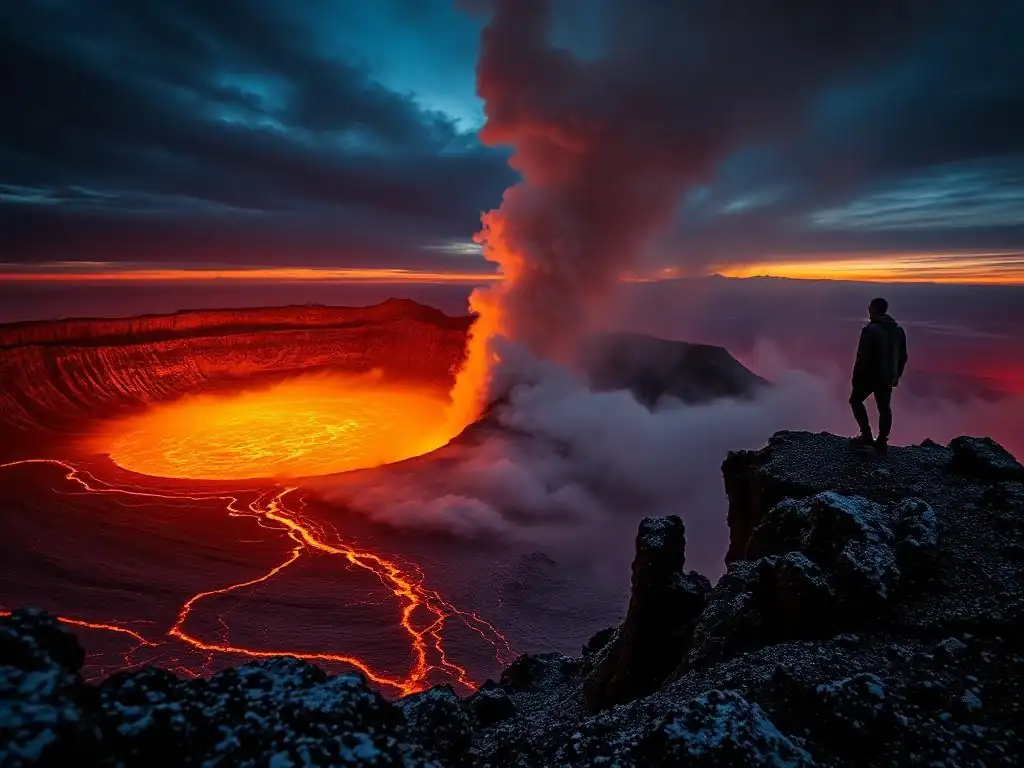
Welcome to Volcano Explorers!
Dare to stare into the abyss? Here, we unravel the mysteries of Earth's fiery giants. But can we really know when a slumbering behemoth will awaken? Join us as we delve into the tantalizing, and potentially lifesaving, question of predicting supervolcano eruptions accurately. The answers might surprise you... and change everything.
Defining Supereruptions: VEI 8 and Beyond
The Volcanic Explosivity Index, or VEI, is a logarithmic scale measuring the explosivity of volcanic eruptions, ranging from 0 to 8. A VEI 8 eruption, also known as a supereruption, represents the largest and most cataclysmic type of volcanic event. These eruptions eject more than 1,000 cubic kilometers (240 cubic miles) of material – ash, pumice, and rock – into the atmosphere, dwarfing even the most powerful historical volcanic events.
For context, the 1980 eruption of Mount St. Helens, a significant event in recent history, was estimated to be a VEI 5, ejecting around 1 cubic kilometer of material. Supereruptions are thus a thousand times larger in magnitude, capable of causing global-scale impacts.
The scale is not linear; each increase in VEI represents a tenfold increase in explosivity. A VEI 7 eruption, like the Tambora eruption of 1815, which caused the "Year Without a Summer," is already devastating, but a VEI 8 supereruption is in a different league entirely. The most recent VEI 8 eruption occurred approximately 26,500 years ago at Taupo Volcano in New Zealand, known as the Oruanui eruption.
Another example, the Yellowstone supereruption approximately 631,000 years ago, ejected over 1,000 cubic kilometers of material and profoundly reshaped the landscape of North America. Understanding the VEI scale, especially the magnitude of VEI 8, is crucial to grasping the immense power and potential impact of supervolcanoes.
Caldera Formation: Collapse and Resurgence
Calderas, vast volcanic depressions, are the hallmark of supervolcanoes, forming through a dramatic process of magma chamber emptying and subsequent ground collapse. Unlike the cone-shaped structure of stratovolcanoes, supervolcanoes often lack a prominent peak. Instead, they are characterized by these broad, basin-like depressions, sometimes tens of kilometers in diameter. Caldera formation begins with the accumulation of a massive volume of magma in a shallow chamber beneath the Earth's surface. As pressure builds within this chamber, driven by the buoyant rise of magma and the accumulation of volcanic gases, the overlying crust begins to bulge and fracture.
When the pressure exceeds the strength of the surrounding rocks, a colossal eruption ensues, rapidly emptying the magma chamber. This sudden evacuation of magma support leads to the catastrophic collapse of the overlying ground into the void, creating the caldera. Following the initial collapse, a phenomenon known as resurgence can occur.
Driven by the remaining magma in the chamber or fresh magma influx, the caldera floor can slowly uplift and dome upwards over time. This resurgence can take centuries or millennia and is often accompanied by renewed volcanic activity, though not necessarily another supereruption. Yellowstone Caldera, for example, exhibits ongoing resurgence, with portions of the caldera floor rising and falling over time, reflecting the dynamic nature of the underlying magma system.
Notable Supervolcanoes: Yellowstone, Taupo, Long Valley
Yellowstone Caldera, located in Wyoming, USA, is perhaps the most well-known supervolcano. It has experienced at least three VEI 8 supereruptions in its history: Huckleberry Ridge (2.1 million years ago), Mesa Falls (1.3 million years ago), and Lava Creek (approximately 631,000 years ago). The Lava Creek eruption, for instance, ejected an estimated 1,000 cubic kilometers of material and formed the current Yellowstone Caldera. Today, Yellowstone is monitored extensively due to its active hydrothermal features, frequent earthquake swarms, and ongoing ground deformation, indicating a still-active magmatic system beneath.
Taupo Volcano, situated in New Zealand's North Island, is another significant supervolcano. It is responsible for the Oruanui eruption around 26,500 years ago, the most recent VEI 8 event globally. Taupo has also produced numerous smaller, but still substantial, eruptions throughout its history, including the VEI 7 Hatepe eruption around 1,800 years ago, which had significant impacts on the Roman world according to some climate proxies.
The Long Valley Caldera in eastern California, USA, is also a noteworthy supervolcano. It formed around 760,000 years ago in the Bishop Tuff eruption, a VEI 7 event, though some estimates suggest it might have reached VEI 8. Long Valley has experienced unrest in recent decades, including earthquake swarms and ground deformation around Mammoth Mountain, reminding us that supervolcanoes, even after long periods of dormancy, can exhibit signs of renewed activity.
- Defining Supereruptions: VEI 8 and Beyond
- Caldera Formation: Collapse and Resurgence
- Notable Supervolcanoes: Yellowstone, Taupo, Long Valley
- How is predicting supervolcano eruptions different from predicting regular volcano eruptions?
- What are some of the challenges in accurately predicting supervolcano eruptions?
- What data do volcanologists use to attempt to predict supervolcano eruptions?
- What is the current state of technology regarding predicting supervolcano eruptions?
- What should people living near a potential supervolcano do to prepare for a possible eruption?
Frequently Asked Questions
How is predicting supervolcano eruptions different from predicting regular volcano eruptions?
Predicting supervolcano eruptions is significantly harder because supervolcanoes erupt far less frequently and exhibit different pre-eruption behaviors than smaller volcanoes. This makes it difficult to gather sufficient data and establish reliable patterns.
What are some of the challenges in accurately predicting supervolcano eruptions?
Key challenges include the vast scale of magma chambers, the long dormancy periods between eruptions, and the complex interplay of geological factors involved. This makes identifying reliable precursors extremely difficult.
What data do volcanologists use to attempt to predict supervolcano eruptions?
Volcanologists monitor ground deformation, gas emissions (like sulfur dioxide), and seismic activity around supervolcanoes. Changes in these indicators can suggest magma movement, but don't guarantee an eruption.
What is the current state of technology regarding predicting supervolcano eruptions?
Current technology allows for better monitoring of supervolcanoes, but cannot definitively predict when an eruption will occur. We can identify potential unrest, but not pinpoint the timing.
What should people living near a potential supervolcano do to prepare for a possible eruption?
Residents should familiarize themselves with evacuation plans, monitor official warnings, and prepare emergency supplies. Staying informed and prepared is crucial in mitigating risks.
Final Reflection: Embracing Uncertainty in the Face of Giants
The quest to understand and predict supervolcano eruptions, as we've explored, is not merely an academic exercise; it's a matter of safeguarding humanity's future. While pinpoint accuracy remains elusive, the advancements in monitoring, modeling, and understanding the underlying geological processes offer a glimmer of hope in mitigating the potential devastation these colossal events could unleash. The urgency of this research is amplified by the increasing global population and the interconnectedness of our world, making the consequences of a supereruption exponentially more severe.
This exploration has underscored the immense power of nature and the humbling reality of our limited understanding. The sheer scale of these events forces us to confront our own vulnerability and the importance of proactive preparedness. The only constant is change,
as Heraclitus famously said. This holds especially true for the Earth's dynamic systems, reminding us that complacency is not an option when dealing with forces capable of reshaping the planet.
As we conclude this journey into the heart of supervolcano research, I invite you to consider your own role in fostering a more informed and resilient society. What steps can you take to support scientific endeavors, advocate for responsible land use planning, and promote awareness of the risks posed by these geological titans? The future is not predetermined, and by embracing knowledge and acting with foresight, we can collectively strive to navigate the unpredictable with greater confidence and resilience.
Dare to Delve Deeper: Unearth the Secrets Beneath Your Feet!
Thank you for exploring the science of supervolcanoes with us! We hope you've gained a new appreciation for the immense power and complexity hidden beneath the Earth's surface. Now, let's turn that knowledge into action and become more informed, proactive citizens.
Here's how you can contribute to understanding and mitigating the risks of these geological giants:
- Become a Citizen Scientist: Explore the USGS Volcano Hazards Program website and learn how to report unusual activity or contribute to volcano monitoring efforts.
- Share this article to raise awareness about supervolcanoes and their potential impact. Help spark crucial conversations about disaster preparedness.
- Research your region's volcanic history. You might be surprised to discover how close you live to a potentially active volcanic area!
What fascinating fact about supervolcanoes surprised you the most, and what steps, if any, have you taken to prepare? Share your thoughts in the comments below!