
The Invisible Killer: How Pyroclastic Flows Annihilated SaintPierre

Welcome to Volcano Explorers!
Prepare to be captivated by the raw power and breathtaking beauty of volcanoes. Ever wondered how a seemingly dormant giant can unleash unimaginable fury? In this article, we unravel the chilling tale of Saint-Pierre and the invisible killer that brought it to its knees. But understanding the danger is the first step to preparedness. Read on for crucial pyroclastic flow safety tips that could save your life. Are you ready to face the heat?
- Introduction: The Catastrophe of Saint-Pierre and Mount Pelée
- Understanding Pyroclastic Flows: Nature's Most Destructive Force
- Mount Pelée's Eruption: A Detailed Account of the Disaster
- Pyroclastic Flow Safety Tips: Minimizing the Risk
- Conclusion: Remembering Saint-Pierre and the Importance of Pyroclastic Flow Awareness
- Frequently Asked Questions
- Final Reflection: Respecting the Fury of the Earth
- Unearth the Secrets: Dare to Understand Volcanoes!
Introduction: The Catastrophe of Saint-Pierre and Mount Pelée
- Setting the stage: Introducing Saint-Pierre, Martinique, and its pre-eruption prosperity.
- The looming threat: Mount Pelée's early warning signs and increasing volcanic activity.
- The devastating pyroclastic flow: Describing the event that destroyed the city on May 8, 1902.
Saint-Pierre, Martinique, in the early 20th century, was a vibrant and prosperous port city, often dubbed the "Paris of the Caribbean." Its cobblestone streets buzzed with commerce, and elegant French colonial architecture lined its bustling harbor. As the cultural and economic heart of Martinique, Saint-Pierre boasted a population of around 30,000 residents. The city was renowned for its sophisticated society, thriving trade, and picturesque setting nestled at the foot of the seemingly dormant Mount Pelée. Little did the inhabitants know, this majestic backdrop concealed a deadly secret, and their vibrant city was on the precipice of unimaginable devastation.
However, the tranquility of Saint-Pierre was deceptive. In the spring of 1902, Mount Pelée, which had been quiet for decades, began to stir. Initially, the signs were subtle – increased fumarole activity, the release of steam and gases from vents near the summit. These early warnings were often dismissed or downplayed by local authorities and even some scientists who, accustomed to Pelée's quiescence, reassured the population.
As days turned into weeks, the volcanic activity intensified. Phreatic explosions, driven by the heating and flashing of groundwater into steam, sent ash and mud raining down on the surrounding areas. Despite these increasingly alarming signs, many residents, influenced by official reassurances and upcoming elections, remained in the city, unaware of the true magnitude of the impending disaster. The stage was set for a catastrophe of unprecedented scale, orchestrated by the invisible killer lurking within Mount Pelée.
The morning of May 8, 1902, dawned like any other in Saint-Pierre, but the deceptive calm was about to shatter. At 7:52 AM, a colossal eruption ripped through the summit of Mount Pelée, unleashing a devastating pyroclastic flow. This superheated avalanche of gas, ash, and volcanic debris surged down the volcano's flanks at speeds exceeding 100 miles per hour. In mere minutes, the pyroclastic flow engulfed Saint-Pierre, transforming the vibrant city into a smoldering ruin.
The intense heat, estimated to reach over 1,000 degrees Celsius (1,832 degrees Fahrenheit), instantly incinerated everything in its path. Buildings crumbled, ships in the harbor were set ablaze, and the vast majority of Saint-Pierre's inhabitants perished. The catastrophe was swift, brutal, and left an indelible mark on history as one of the deadliest volcanic disasters of the 20th century, a stark reminder of the destructive power of pyroclastic flows.
Understanding Pyroclastic Flows: Nature's Most Destructive Force
What is a Pyroclastic Flow? Definition and Composition
- Defining pyroclastic flows: A superheated mix of gas and volcanic debris.
- The components: Ash, rocks, and pumice propelled by volcanic gases.
- Temperature and speed: Extreme heat and rapid movement of pyroclastic flows.
A pyroclastic flow is among the most lethal and destructive phenomena associated with explosive volcanic eruptions. Scientifically defined, a pyroclastic flow is a ground-hugging avalanche of hot ash, pumice, rock fragments, and volcanic gas. These flows are not simply lava flows; they are a far more complex and dangerous mixture. Imagine a scalding cloud of incredibly hot, turbulent material rushing down a volcano's slopes – that is the essence of a pyroclastic flow. Their devastating power stems from a combination of extreme temperature, high speed, and dense composition, making them capable of obliterating everything in their path.
The composition of a pyroclastic flow is a deadly cocktail of volcanic materials. It consists primarily of volcanic gas, which can make up a significant portion of the flow's volume and is responsible for its mobility. This gas is superheated and can include steam, carbon dioxide, sulfur dioxide, and other volcanic gases released from magma.
Mixed within this gas are solid fragments, ranging in size from fine ash particles to large boulders. These solid components are typically made up of volcanic ash (fine particles of pulverized rock and glass), pumice (lightweight, porous volcanic rock), and larger rock fragments torn from the volcano's conduit or surrounding rock. The proportions of gas and solid material can vary, influencing the flow's behavior and destructive potential.
Pyroclastic flows are characterized by their extreme temperature and rapid speed, contributing to their catastrophic impact. Temperatures within a pyroclastic flow can range from 200°C to as high as 1,000°C (approximately 400°F to 1,800°F) or even hotter in some cases. These searing temperatures are enough to instantly ignite combustible materials, melt plastics, and cause severe burns.
Furthermore, pyroclastic flows can travel at astonishing speeds, ranging from relatively slow flows of 20-30 kilometers per hour (12-19 mph) to extremely rapid flows exceeding 700 kilometers per hour (435 mph). The combination of intense heat and high velocity creates an unstoppable force capable of leveling forests, destroying buildings, and causing near-instantaneous death to anything caught within its path, as tragically demonstrated in Saint-Pierre.
The Formation and Mechanics of Pyroclastic Flows
- Collapse of eruption columns: How volcanic explosions can generate pyroclastic flows.
- Boiling over: When a lava dome collapses, creating a flow.
- Density currents: How gravity drives the movement of pyroclastic flows.
One of the primary mechanisms for the formation of pyroclastic flows is the collapse of eruption columns. During explosive volcanic eruptions, massive columns of hot gas and ash are ejected high into the atmosphere. These eruption columns, driven by the force of the eruption, can reach several kilometers in height.
However, if the eruption column becomes too dense, or if the eruption intensity wanes, gravity can overcome the upward momentum. The column then collapses downwards, sending a surge of hot material cascading down the volcano's flanks as a pyroclastic flow. This type of flow is often associated with Plinian or Vulcanian style eruptions, which are characterized by their powerful explosive nature.
Another significant way pyroclastic flows are generated is through the collapse of lava domes. Lava domes are steep-sided mounds of viscous lava that can build up on the summit or flanks of a volcano after an eruption. These domes are often unstable and prone to collapse due to gravity, internal pressure buildup, or external triggers like earthquakes or rainfall.
When a lava dome collapses, the hot, fragmented lava and associated gases are released rapidly, forming a pyroclastic flow. This type of pyroclastic flow, often referred to as a "block-and-ash flow," tends to contain larger rock fragments from the dome itself and can be particularly dangerous due to its unpredictable nature and potential for rapid onset. Mount Pelée's 1902 eruption is believed to have been triggered by a combination of lava dome instability and explosive activity.
The movement of pyroclastic flows is governed by the principles of density currents. Pyroclastic flows are denser than the surrounding air due to their high concentration of solid particles and hot gases. This density difference causes them to behave like a fluid flowing downhill under the influence of gravity.
The denser pyroclastic material seeks lower elevations, following valleys, gullies, and topographic depressions. This channelized flow behavior can make certain areas particularly vulnerable to pyroclastic flows, even if they are relatively far from the volcano's vent. The density current mechanism also explains why pyroclastic flows can travel long distances from their source, sometimes tens of kilometers, and why they can exhibit complex flow patterns, spreading laterally as they encounter obstacles or changes in slope.
Types of Pyroclastic Flows: Variations in Behavior
- Pyroclastic surges: Low-density, highly mobile flows.
- Pyroclastic density currents: High-density flows that follow topography.
- Block-and-ash flows: Flows containing larger rock fragments.
Within the broader category of pyroclastic flows, there are variations in behavior and characteristics that are important to understand for hazard assessment and pyroclastic flow safety tips. One key distinction is between pyroclastic surges and pyroclastic density currents. Pyroclastic surges are characterized by their lower density and higher gas-to-particle ratio compared to other types of pyroclastic flows.
This lower density makes them more mobile and allows them to travel over obstacles and even uphill to some extent. Surges are often described as ground-hugging clouds of hot gas and ash that can expand laterally and affect a wider area than denser flows. They are particularly hazardous because of their ability to penetrate into buildings and other structures, causing widespread damage and casualties even in areas seemingly shielded from direct flow paths.
In contrast to surges, pyroclastic density currents are higher-density flows that are more strongly influenced by topography. These flows are characterized by a higher concentration of solid particles and a lower gas-to-particle ratio. Their greater density causes them to primarily follow valleys and drainage channels, behaving more like avalanches of hot debris.
While they are less likely to travel over obstacles compared to surges, pyroclastic density currents are still incredibly destructive due to their immense mass and force. They can carve out landscapes, demolish structures in their path, and bury areas under thick deposits of ash and rock. The 1902 pyroclastic flow that destroyed Saint-Pierre is considered to have been a type of pyroclastic density current, channeled down a valley towards the city.
Block-and-ash flows represent another significant type of pyroclastic flow, specifically associated with the collapse of lava domes. As the name suggests, these flows are characterized by a significant component of larger rock fragments, or "blocks," mixed within the ash and gas matrix. The blocks are derived from the fragmented lava dome material and can range in size from centimeters to meters.
Block-and-ash flows tend to be relatively short-lived compared to eruption column collapse flows, but they can still be highly dangerous. The presence of large, dense blocks increases their destructive power, capable of inflicting significant impact damage in addition to the thermal hazards. Monitoring lava dome stability and understanding the potential for block-and-ash flows is crucial for effective volcanic hazard mitigation in areas prone to dome-building eruptions.
Mount Pelée's Eruption: A Detailed Account of the Disaster
Early Warning Signs: The Prelude to Destruction
- Increased fumarole activity: Steaming vents and gas emissions.
- Phreatic explosions: Steam-driven eruptions and ashfall.
- Lahars and mudflows: Volcanic debris mixed with water.
Months before the catastrophic pyroclastic flow of May 8, 1902, Mount Pelée provided a series of increasingly alarming warning signs, which, tragically, were largely ignored or misinterpreted. One of the earliest indicators of unrest was a notable increase in fumarole activity. Fumaroles, vents that release steam and volcanic gases, became more numerous and vigorous on Pelée's summit and flanks.
Residents reported stronger sulfurous smells and visible plumes of steam rising from the volcano, signaling that the magmatic system beneath was becoming more active and releasing more volatile components. While fumarole activity itself is not always a direct precursor to a major eruption, a significant change in their intensity and location often indicates increasing volcanic unrest.
As the weeks progressed, Mount Pelée's activity escalated to include phreatic explosions. These explosions occur when magma heats up groundwater, causing it to flash into steam and erupt explosively. Phreatic eruptions are characterized by the ejection of steam, ash, and pre-existing rock fragments, but typically do not involve the direct eruption of magma.
Starting in late April 1902, Saint-Pierre and surrounding areas experienced a series of phreatic explosions, resulting in ashfall that coated the city and nearby villages. These ashfalls, while initially not devastating, should have served as a clear warning of increasing volcanic pressure and the potential for more hazardous events. The phreatic activity demonstrated that the volcanic system was becoming increasingly unstable and primed for a more significant eruption.
Adding to the pre-eruption chaos, lahars and mudflows began to plague the region. Lahars are volcanic mudflows composed of volcanic debris, rock fragments, and water. They can be triggered by heavy rainfall mixing with volcanic ash on the slopes of a volcano, or by the melting of snow and ice during an eruption.
In the days leading up to May 8th, heavy rainfall on Martinique combined with the accumulating volcanic ash to generate lahars that flowed down river valleys and into populated areas. These mudflows damaged infrastructure, destroyed crops, and caused some fatalities in the weeks prior to the major pyroclastic flow. The lahars, combined with the increased fumarole activity and phreatic explosions, constituted a clear and escalating pattern of volcanic unrest, yet tragically, these warnings were not heeded effectively enough to prevent the Saint-Pierre disaster.
The Fateful Day: May 8, 1902, and the Pyroclastic Flow
- The eruption sequence: The events leading up to the devastating flow.
- The destruction of Saint-Pierre: How the city was instantly engulfed.
- Eyewitness accounts: Stories of the few survivors and the horror of the event.
On the morning of May 8, 1902, Ascension Day, the sequence of events leading to the catastrophic pyroclastic flow unfolded rapidly and devastatingly. Mount Pelée had been exhibiting increased activity for weeks, but the eruption on this day was of an entirely different magnitude. Around 7:52 AM local time, a massive explosion occurred at the summit of Mount Pelée.
A dark, dense cloud erupted upwards, followed almost instantaneously by the lateral ejection of a pyroclastic flow from a breach in the volcano's side. This flow was triggered by a combination of factors, possibly including a lava dome collapse and an explosive release of pent-up volcanic gases. The eruption was swift and violent, leaving virtually no time for escape for the inhabitants of Saint-Pierre.
The pyroclastic flow surged down the Rivière des Pères valley directly towards Saint-Pierre. Traveling at speeds estimated to exceed 100 miles per hour, the flow reached the city in less than a minute. The impact was instantaneous and catastrophic. The searing heat, exceeding 1,000 degrees Celsius, ignited everything flammable and incinerated organic matter on contact.
Buildings, many constructed of wood and stone, were either flattened by the force of the flow or consumed by flames. The harbor, filled with ships, became a scene of inferno as vessels were overturned, set ablaze, and their crews perished. The city, once vibrant and bustling, was transformed into a smoldering wasteland in a matter of minutes. The destruction was so complete that little remained standing in the path of the pyroclastic flow.
Eyewitness accounts from the few survivors paint a horrifying picture of the event. Among the most famous survivors were Léon Compère-Léandre, a shoemaker who lived on the outskirts of the city, and Louis-Auguste Cyparis, a prisoner in a poorly ventilated dungeon cell. Compère-Léandre described seeing a colossal wall of fire rushing towards him, feeling an intense heat wave, and then being thrown to the ground amidst falling debris.
He suffered severe burns but managed to survive by seeking refuge in a relatively sturdy building on the city's edge. Cyparis, protected by the thick stone walls of his cell, also survived, albeit with severe burns. Their accounts, along with those of sailors on ships further offshore, are chilling testimonies to the speed, intensity, and utter devastation wrought by the pyroclastic flow, highlighting the near-impossibility of survival for anyone directly in its path.
The Aftermath: Immediate Consequences and Long-Term Impact
- Casualties and devastation: The immense loss of life and property damage.
- Scientific investigation: The study of the eruption and its effects.
- Lessons learned: Improving volcano monitoring and hazard assessment.
The immediate aftermath of the May 8, 1902, pyroclastic flow was a scene of unimaginable devastation in Saint-Pierre. The city was utterly destroyed, reduced to ruins and ash. The human toll was staggering; it is estimated that approximately 30,000 people perished in the disaster, representing nearly the entire population of Saint-Pierre. The catastrophe remains one of the deadliest volcanic eruptions of the 20th century.
Beyond the immense loss of life, the economic and social fabric of Martinique was severely disrupted. Saint-Pierre, once the island's economic and cultural capital, was obliterated, and its recovery was a long and arduous process. The destruction extended beyond the city limits, impacting surrounding agricultural areas and infrastructure.
The Mount Pelée eruption spurred significant scientific investigation into pyroclastic flows and volcanic hazards. Geologists and volcanologists rushed to Martinique to study the eruption deposits, flow dynamics, and the mechanisms that led to such catastrophic destruction. The Saint-Pierre disaster became a pivotal case study in volcanology, leading to a greater understanding of pyroclastic flow behavior and their devastating potential.
Detailed mapping of the flow deposits, analysis of ash and rock fragments, and eyewitness accounts helped scientists reconstruct the sequence of events and refine their understanding of pyroclastic flow formation and propagation. This scientific inquiry was crucial in advancing the field of volcanology and improving hazard assessment techniques for similar volcanoes worldwide.
The tragedy of Saint-Pierre served as a stark and unforgettable lesson in the importance of volcano monitoring, hazard assessment, and effective communication of volcanic risks. Prior to the 1902 eruption, volcano monitoring was in its infancy, and public understanding of volcanic hazards was limited. The disaster highlighted the critical need for robust volcano monitoring networks, including seismic instruments, gas sensors, and deformation measurements, to detect early warning signs of volcanic unrest.
It also underscored the importance of developing volcano hazard maps to identify areas at risk from different volcanic phenomena, including pyroclastic flows. Furthermore, the Saint-Pierre catastrophe emphasized the necessity of clear and timely communication of volcanic warnings to the public and effective evacuation procedures to minimize casualties in future eruptions. The lessons learned from Saint-Pierre have profoundly shaped modern volcanology and pyroclastic flow safety tips protocols around the world.
Pyroclastic Flow Safety Tips: Minimizing the Risk
Understanding Volcanic Hazards: Identifying Pyroclastic Flow Zones
- Volcano hazard maps: Identifying areas at risk from pyroclastic flows.
- Evacuation routes: Planning escape routes in case of an eruption.
- Emergency preparedness: Stocking supplies and creating a family plan.
The first and most crucial step in pyroclastic flow safety tips is understanding the specific volcanic hazards in your area. Volcano hazard maps are invaluable tools for identifying zones at risk from pyroclastic flows and other volcanic dangers. These maps, typically produced by geological surveys and volcano observatories, delineate areas that could be affected by different types of volcanic events, including pyroclastic flows, lava flows, ashfall, and lahars.
Hazard maps are based on past eruption history, volcanic geology, and computer modeling of potential eruption scenarios. By consulting these maps, residents and authorities can understand the specific threats they face and the areas most vulnerable to pyroclastic flow hazards. It is essential to be aware of whether you live, work, or frequently travel within a designated pyroclastic flow hazard zone.
Once you understand the hazard zones, planning evacuation routes becomes a critical component of pyroclastic flow safety tips. Evacuation routes should be pre-determined and clearly marked, leading away from potential pyroclastic flow paths to designated safe zones. These routes should take into account the topography and drainage patterns that pyroclastic flows are likely to follow.
It is crucial to practice evacuation routes with your family or community to ensure everyone knows where to go and what to do in case of an eruption threat. Multiple evacuation routes are preferable in case one route becomes blocked or dangerous. Regularly reviewing and updating evacuation plans is essential, especially as infrastructure and land use patterns change over time.
Emergency preparedness is another fundamental aspect of pyroclastic flow safety tips. Living in a volcanically active area requires proactive preparation for potential eruptions. This includes assembling an emergency kit containing essential supplies such as water, non-perishable food, first-aid supplies, a flashlight, a radio, extra batteries, dust masks, and protective eyewear.
It is also important to have a family emergency plan that outlines communication protocols, meeting points, and evacuation procedures. Regularly check and replenish emergency supplies to ensure they are readily available when needed. Community-level preparedness is equally vital, involving coordination between local authorities, emergency responders, and residents to develop and implement comprehensive volcano emergency plans and drills.
Recognizing Warning Signs: Acting Before It's Too Late
- Monitoring volcanic activity: Staying informed about volcano updates.
- Heeding official warnings: Obeying evacuation orders from authorities.
- Recognizing precursory events: Identifying potential signs of an impending eruption.
Staying informed about volcanic activity is paramount for pyroclastic flow safety tips. Volcano observatories and geological surveys constantly monitor active volcanoes using a variety of instruments, including seismometers, gas sensors, and GPS stations. They provide regular updates on volcanic activity levels, potential hazards, and any changes in volcanic behavior.
It is crucial to identify the official sources of volcano information in your area, such as government websites, emergency management agencies, and volcano observatory social media channels. Regularly check for updates and advisories, especially during periods of heightened volcanic unrest. Understanding the volcano alert level system used in your region is also essential to interpret the level of risk and recommended actions.
Heeding official warnings and evacuation orders is non-negotiable in pyroclastic flow safety tips. When authorities issue evacuation orders, it means the volcanic threat is imminent and serious. Do not hesitate or delay evacuation based on personal assumptions or reassurances. Evacuation orders are based on scientific assessments of volcanic risk and are issued to protect lives.
Follow the designated evacuation routes and procedures outlined in your emergency plan. Assist neighbors and vulnerable individuals in evacuating if possible. Ignoring evacuation orders is extremely dangerous and can have fatal consequences, as tragically demonstrated in Saint-Pierre, where many lives were lost due to delayed evacuation.
Recognizing precursory events can provide crucial early warning signs of an impending eruption and is a vital element of pyroclastic flow safety tips. While official monitoring is essential, being aware of potential precursory signs can help individuals make informed decisions and take proactive safety measures. These signs can include increased frequency or intensity of earthquakes, changes in volcanic gas emissions (e.g., stronger sulfur smells), visible steaming or new fumaroles, ground deformation (swelling or tilting of the volcano), and changes in hot spring activity.
Sudden changes in crater appearance or steam plumes can also be indicative of escalating volcanic activity. If you observe any of these precursory events, report them to local authorities and be prepared to evacuate if necessary. Remember that volcanoes can exhibit a range of precursory signals, and vigilance is key to recognizing potential threats.
Evacuation Procedures: What to Do in Case of a Pyroclastic Flow Threat
- Immediate evacuation: Leaving the danger zone as quickly as possible.
- Seeking shelter: Finding a safe location away from the flow path.
- Protecting yourself: Minimizing exposure to ash and volcanic gases.
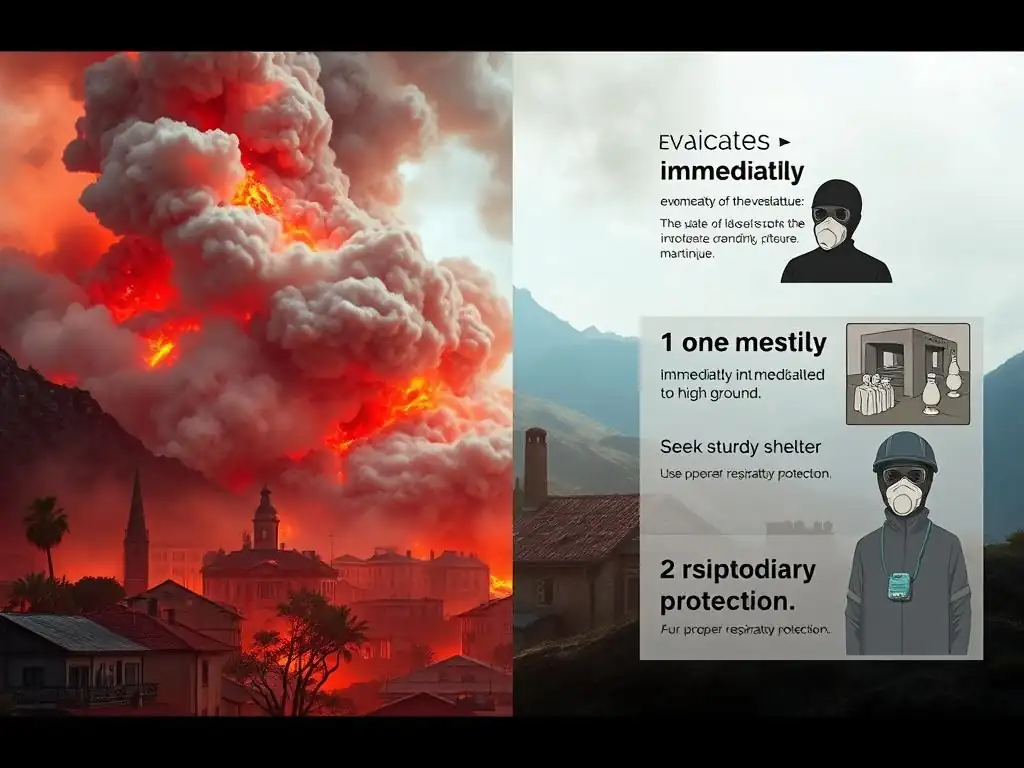
In the event of a pyroclastic flow threat, immediate evacuation is the most critical action for pyroclastic flow safety tips. When an evacuation order is issued or if you observe clear signs of an imminent pyroclastic flow (e.g., a rapidly developing eruption column collapse), leave the danger zone without delay. Do not waste time gathering non-essential belongings; prioritize your safety and the safety of others.
Follow pre-planned evacuation routes and proceed to designated safe zones or areas outside the pyroclastic flow hazard zone. Move as quickly and efficiently as possible, but remain calm and avoid panic. Time is of the essence when a pyroclastic flow is imminent, and swift action can significantly increase your chances of survival.
Seeking appropriate shelter is a crucial aspect of pyroclastic flow safety tips if evacuation is not immediately possible or if you are caught in a pyroclastic flow event. The ideal shelter is a sturdy, reinforced building located outside the direct path of the pyroclastic flow and away from valleys or drainage channels. Basements or underground structures can offer some protection from the heat and impact of a pyroclastic flow, but they are not completely safe.
If outdoors and unable to reach a building, try to find a topographic depression or a location shielded by a substantial natural barrier, such as a dense forest or a steep ridge, although these offer limited protection. Avoid low-lying areas and valleys where pyroclastic flows are most likely to channel.
Protecting yourself from the hazards associated with pyroclastic flows is essential, even during evacuation or while seeking shelter, and is a key element of pyroclastic flow safety tips. Pyroclastic flows carry extreme heat, toxic gases, and ash, all of which pose significant risks. Wear long sleeves, long pants, and closed-toe shoes to minimize skin exposure to heat and ash. Use a dust mask or a damp cloth to cover your mouth and nose to avoid inhaling volcanic ash and gases.
Wear protective eyewear, such as goggles or glasses, to shield your eyes from ash and debris. If caught in an ashfall, seek shelter indoors immediately. Remember that even after a pyroclastic flow has passed, the area may remain hazardous due to lingering heat, unstable ash deposits, and potential for secondary hazards like lahars.
Long-Term Mitigation Strategies: Reducing Vulnerability to Pyroclastic Flows
- Land-use planning: Restricting development in high-risk areas.
- Infrastructure improvements: Building resilient infrastructure to withstand volcanic hazards.
- Community education: Raising awareness about volcano risks and safety measures.
Long-term mitigation strategies are crucial for reducing vulnerability to pyroclastic flows and minimizing future disasters, forming a vital part of comprehensive pyroclastic flow safety tips. Land-use planning plays a significant role in reducing risk by restricting development in high-hazard zones. This involves zoning regulations that limit or prohibit construction of residential areas, critical infrastructure, and essential facilities in areas identified as being at high risk from pyroclastic flows, based on volcano hazard maps.
Land-use planning can also promote the development of less vulnerable areas and guide urban growth away from hazardous zones. Strategic land-use management is a proactive approach to minimizing future losses and ensuring community resilience in volcanically active regions.
Infrastructure improvements are another important long-term mitigation measure for pyroclastic flow safety tips. Building resilient infrastructure that can better withstand volcanic hazards is crucial for protecting communities. This can include constructing buildings with reinforced structures designed to resist ashfall loads and potential pyroclastic surge impacts.
Critical infrastructure, such as hospitals, schools, and emergency response centers, should ideally be located outside high-hazard zones or be hardened to withstand volcanic hazards. Developing robust transportation and communication networks that can function during and after volcanic events is also essential for effective emergency response and recovery. Investing in resilient infrastructure reduces the long-term vulnerability of communities to pyroclastic flow and other volcanic hazards.
Community education and public awareness campaigns are fundamental to long-term pyroclastic flow safety tips and risk reduction. Educating the public about volcanic hazards, warning signs, evacuation procedures, and emergency preparedness is crucial for building a culture of safety and resilience. Community education programs can include workshops, public meetings, school programs, and distribution of informational materials in multiple languages.
Raising awareness about volcano hazard maps, evacuation routes, and emergency kits empowers individuals to take proactive steps to protect themselves and their families. Effective community education fosters a shared understanding of volcanic risks and promotes collective action to minimize vulnerability and enhance community preparedness.
Conclusion: Remembering Saint-Pierre and the Importance of Pyroclastic Flow Awareness
- The legacy of Saint-Pierre: A reminder of the destructive power of volcanoes.
- The ongoing risk: The importance of continued volcano monitoring and research.
- Promoting awareness: Encouraging readers to learn more about volcano safety and preparedness.
The ruins of Saint-Pierre stand as a somber and enduring legacy, a powerful reminder of the terrifying destructive power of pyroclastic flows and volcanoes in general. The 1902 catastrophe serves as a stark lesson in the potential for rapid and complete devastation that these natural forces can unleash. The tragedy underscores the importance of respecting volcanic hazards and taking proactive measures to mitigate risks in volcanically active regions.
Saint-Pierre's story is not just a historical event; it is a continuing cautionary tale that demands our attention and vigilance. Remembering Saint-Pierre compels us to prioritize volcano safety and preparedness to prevent similar tragedies from occurring in the future.
The risk of pyroclastic flows is not confined to the past; it remains an ongoing threat in many volcanic regions around the world. Numerous volcanoes are capable of producing pyroclastic flows, and many communities live in close proximity to these potentially dangerous mountains. Continued volcano monitoring and research are essential to improve our understanding of volcanic processes, predict eruptions more accurately, and enhance our ability to provide timely warnings.
Investing in volcano observatories, advanced monitoring technologies, and scientific research is crucial for mitigating the ongoing risk posed by pyroclastic flows and protecting vulnerable populations. The lessons from Saint-Pierre emphasize that vigilance and scientific advancement are vital for ensuring safer communities in volcanic areas.
Promoting awareness about pyroclastic flow hazards and pyroclastic flow safety tips is a shared responsibility. This article, and resources like VolcanoExplorers.org, aim to educate readers about the nature of pyroclastic flows, the risks they pose, and the essential safety measures that can save lives.
We encourage everyone living in or visiting volcanic areas to learn more about the specific hazards they face, understand volcano warning systems, and develop personal and community preparedness plans. By increasing awareness and promoting a culture of volcano safety, we can collectively reduce vulnerability and build more resilient communities in the face of these powerful and awe-inspiring natural forces.
Frequently Asked Questions
What exactly is a pyroclastic flow?
A pyroclastic flow is a fast-moving current of hot gas and volcanic matter that travels away from a volcano. These flows are extremely dangerous due to their high temperatures and speed.
How fast can a pyroclastic flow travel?
Pyroclastic flows can reach speeds of over 450 miles per hour (720 kilometers per hour). This extreme speed makes it nearly impossible to outrun them.
What makes pyroclastic flows so deadly?
Their extreme heat and speed. Temperatures within a pyroclastic flow can reach up to 1,830°F (1,000°C). The combination of heat and force is devastating.
What are some pyroclastic flow safety tips if I live near a volcano?
Always heed evacuation orders from authorities, as they are based on scientific monitoring and risk assessment. Have an emergency plan and kit ready, including supplies and communication devices.
Why is the Saint-Pierre eruption of 1902 so relevant to understanding pyroclastic flow dangers?
The destruction of Saint-Pierre serves as a stark reminder of the deadly power of pyroclastic flows. It highlights the importance of volcano monitoring and early warning systems to prevent similar tragedies.
Final Reflection: Respecting the Fury of the Earth
The lessons learned from the tragic destruction of Saint-Pierre by a pyroclastic flow are not just historical footnotes; they are urgent warnings for communities living near active volcanoes today. The devastating speed and overwhelming power of these flows serve as a stark reminder that nature's forces demand respect and preparedness.
The story of Saint-Pierre continues to resonate, not just as a cautionary tale, but as a call to action. Understanding the science behind pyroclastic flows and implementing effective safety measures is paramount to protecting vulnerable populations. As volcanologist Maurice Krafft famously said: The duty of volcanologists is to warn people, and if they don't listen, it's not our fault.
This quote underscores the critical role of education and proactive planning in mitigating the risks associated with these deadly phenomena.
Let the memory of Saint-Pierre fuel your commitment to understanding and respecting the power of volcanoes. Take the time to learn about the volcanic hazards in your region, support initiatives that promote pyroclastic flow safety, and advocate for responsible land-use planning. Your awareness and action can help prevent future tragedies and ensure the safety of communities living in the shadow of these magnificent, yet dangerous, giants.
Unearth the Secrets: Dare to Understand Volcanoes!
Thank you for delving into the terrifying tale of Saint-Pierre and the devastating power of pyroclastic flows. Now that you've witnessed the destructive potential of these volcanic phenomena, it's time to deepen your understanding and prepare for responsible exploration.
- Commit to learning essential safety procedures for visiting volcanic regions. Start by researching reputable guides and gear. Your life might depend on it.
- Share this vital story with friends and family to raise awareness about the real dangers of volcanoes and promote informed decision-making.
- Explore the Volcano Explorers archives for more insights into specific volcanoes and geological events. Dive deeper into the world's most active regions!
What specific safety measure do you find most critical when planning a visit to a volcanic area, and why? Let's discuss in the comments below!