
Can You Study Volcanoes From Home? Unveiling Online Volcanology Courses

Welcome to Volcano Explorers, where the Earth's fiery secrets are revealed!
Ever wondered what it takes to unravel the mysteries simmering beneath our feet? Dive into "Can You Study Volcanoes From Home? Unveiling Online Volcanology Courses" and discover how you can ignite your passion for volcanology, no matter where you are. Are you ready to embark on a journey from molten rock to mountain peaks? Explore our selection of online volcanology courses for beginners and unlock the secrets of these awe-inspiring geological forces... what will you uncover?
- Introduction: The Accessibility of Online Volcanology Education
- Choosing the Right Online Volcanology Course
- Recommended Online Volcanology Courses and Programs
- Free Online Resources for Volcanology Enthusiasts
- Essential Tools for Remote Volcanology Studies
- From Online Learning to Volcanology Careers
- Conclusion: Taking Your First Steps in Online Volcanology
-
Frequently Asked Questions
- What kind of online volcanology courses are available for beginners?
- Are online volcanology courses a substitute for in-person learning?
- How much do online volcanology courses for beginners typically cost?
- What skills can I gain from taking online volcanology courses?
- Do I need a science background to take online volcanology courses?
- Final Reflection: Igniting Curiosity, Erupting Knowledge
- Ignite Your Inner Volcanologist!
Introduction: The Accessibility of Online Volcanology Education
The Rise of Remote Learning in Earth Sciences
The digital revolution has profoundly impacted education across all disciplines, and Earth sciences are no exception. Remote learning has emerged as a powerful tool, democratizing access to specialized fields like volcanology. Traditionally, studying volcanoes required physical proximity to volcanic regions and access to university labs equipped for geological analysis.
However, the advent of online platforms and digital resources has broken down geographical barriers, making volcanology education accessible to anyone with an internet connection, regardless of their location or prior academic background. This shift is particularly significant for a field that often relies on fieldwork and hands-on experience, as online courses are now incorporating innovative virtual tools to simulate real-world volcanological scenarios.
The growth of online learning in Earth sciences is also fueled by the increasing availability of high-quality digital resources. Geological surveys and research institutions worldwide are making vast datasets, maps, and scientific publications available online. For instance, organizations like the United States Geological Survey (USGS) and the Smithsonian Institution's Global Volcanism Program offer extensive online databases and educational materials that are invaluable for remote learning. This wealth of open-access information, combined with interactive online platforms, creates a rich learning environment for aspiring volcanologists who can now begin their journey from the comfort of their homes.
Benefits of Studying Volcanoes Online: Flexibility and Affordability
Opting for online volcanology courses presents numerous advantages, most notably flexibility and affordability. Traditional university programs often require fixed schedules and in-person attendance, which can be a significant hurdle for working professionals or individuals with geographical limitations. Online courses, in contrast, typically offer asynchronous learning, allowing students to study at their own pace and schedule their learning around existing commitments. This flexibility is particularly beneficial for those who wish to explore volcanology as a hobby or supplement their existing knowledge without disrupting their current lifestyles.
Furthermore, online courses are often significantly more affordable than traditional on-campus programs. Tuition fees for online courses are generally lower, and students can save on expenses related to commuting, accommodation, and campus resources. Many reputable universities and educational platforms offer introductory online volcanology courses at a fraction of the cost of a full degree program. This cost-effectiveness makes high-quality volcanology education accessible to a broader audience, enabling enthusiasts and career-changers to explore the field without significant financial burden. For beginners interested in online volcanology courses, this accessibility and affordability are key factors driving the popularity of remote learning options.
Choosing the Right Online Volcanology Course
Key Considerations for Beginners: Course Content and Instructor Expertise
For beginners venturing into online volcanology courses, several key considerations should guide their selection. Course content is paramount; introductory courses should provide a solid foundation in fundamental volcanological concepts. Look for courses that cover topics such as plate tectonics, magma generation, volcano types, eruption styles, and volcanic hazards. A well-structured introductory course will systematically build knowledge, starting with the Earth's internal structure and progressing to the dynamic processes that lead to volcanic activity. Checking the course syllabus or module descriptions will offer insights into the depth and breadth of topics covered, ensuring alignment with beginner-level learning objectives.
Instructor expertise is equally crucial. The quality of instruction significantly impacts the learning experience, especially in a complex field like volcanology. Beginners should seek courses taught by experienced volcanologists, geologists, or Earth scientists with a proven track record in research and teaching. Instructor credentials, including their academic background, research publications, and professional affiliations, are indicators of their expertise. Many online course platforms provide instructor biographies or profiles, allowing prospective students to assess the instructor's qualifications and experience in volcanology or related fields. Learning from experienced professionals ensures accurate, up-to-date information and insightful perspectives on the subject matter.
Finding Introductory Online Volcanology Courses
Identifying suitable introductory online volcanology courses requires exploring various educational platforms and university websites. Platforms like Coursera, edX, and FutureLearn host a wide range of Massive Open Online Courses (MOOCs), often including introductory geology or Earth science courses with modules dedicated to volcanology. Searching these platforms using keywords such as "volcanology," "volcanoes," "geology," or "Earth science" will yield relevant course options. University websites, particularly those with strong Earth science departments, are another valuable resource. Many universities now offer online versions of their introductory geology or natural hazards courses, which frequently include substantial volcanology content.
Furthermore, professional organizations and geological surveys sometimes offer online educational resources or short courses. For example, the Geological Society of America (GSA) and similar national geological societies may host online workshops or introductory materials suitable for beginners. Websites of geological surveys, like the USGS in the United States or the British Geological Survey (BGS) in the UK, often feature educational sections with accessible explanations of volcanic processes and related hazards. Exploring these diverse sources will provide beginners with a range of options to find online volcanology courses tailored to their interests and learning goals.
Recommended Online Volcanology Courses and Programs
Oregon State University: Discovering Volcanoes
Course Features: Virtual Field Trips, Interactive Data Analysis, and Expert Instruction
Oregon State University's "Discovering Volcanoes" online course is a highly regarded introductory program designed to immerse students in the fascinating world of volcanology. A standout feature of this course is its innovative use of virtual field trips. Instead of relying solely on textbook descriptions, the course incorporates interactive virtual tours of volcanic landscapes around the world.
These virtual field trips utilize high-resolution imagery and 3D models, allowing students to explore volcanic features, landforms, and geological structures remotely, mimicking the experience of actual fieldwork. This immersive approach enhances understanding and engagement, making complex geological concepts more tangible and relatable for online learners.
Beyond virtual field trips, the course emphasizes interactive data analysis. Students are not just passive recipients of information; they actively engage with real-world volcanological data. The course incorporates exercises that involve analyzing datasets related to volcanic activity, such as seismic readings, gas emissions, and thermal imagery. This hands-on approach to data analysis develops critical thinking and analytical skills essential for volcanology. Furthermore, the course is led by experienced volcanology instructors from Oregon State University, a leading institution in volcanic research. Students benefit from expert instruction, gaining insights from professionals actively involved in studying and monitoring volcanoes.
Pricing and Enrollment Information
"Discovering Volcanoes" at Oregon State University is typically offered as a self-paced online course, allowing students to enroll and begin their studies at any time. Pricing can vary, but generally falls within the range of \$500-\$800 USD. It is advisable to check the Oregon State University Extended Campus website for the most current pricing and enrollment details.
The course often runs on a continuous enrollment basis, meaning there are no fixed start or end dates, providing maximum flexibility for learners. Course materials are usually accessible for a defined period after enrollment, typically several months, allowing ample time to complete the modules and assignments at a comfortable pace.
Enrollment is generally straightforward, requiring online registration through the university's extended campus platform. Prerequisites are minimal, making it accessible to individuals without prior geology background, though a basic understanding of scientific concepts is beneficial. Prospective students should review the course description on the Oregon State University website for specific enrollment instructions and any updated information regarding fees and course access duration. Payment is typically processed online via credit card or other accepted digital payment methods.
Is Oregon State University's Course Right for You?
Oregon State University's "Discovering Volcanoes" is particularly well-suited for individuals seeking a comprehensive and engaging introduction to volcanology with a strong emphasis on practical application. The course's virtual field trips and interactive data analysis components make it ideal for learners who prefer active learning and hands-on experience, even in an online format. It is also a good choice for those seeking expert instruction from a reputable university with a strong volcanology program. The self-paced nature of the course makes it suitable for individuals with busy schedules or those who prefer to learn at their own rhythm.
However, prospective students should consider the course's price point, which may be higher than some other introductory online options. While the course offers excellent value in terms of content and features, budget-conscious learners may want to explore more affordable alternatives if cost is a primary concern. Overall, "Discovering Volcanoes" is an excellent option for serious beginners who are willing to invest in a high-quality, immersive, and practically oriented online volcanology learning experience.
University of Iceland: Living with Volcanoes
Course Features: Focus on Volcanic Hazards and Risk Management
The University of Iceland's online course, often titled "Living with Volcanoes," offers a unique perspective on volcanology, emphasizing volcanic hazards and risk management. Given Iceland's volcanic landscape and extensive experience in managing volcanic crises, this course provides invaluable insights into the practical aspects of living in volcanically active regions. A key feature is its focus on real-world case studies of volcanic eruptions in Iceland and globally.
Students analyze past eruptions, examining the associated hazards, the societal impacts, and the strategies employed for monitoring, mitigation, and emergency response. This case study approach brings theoretical concepts to life, illustrating the direct relevance of volcanology to human safety and community resilience.
The course also delves into the science behind volcanic hazards, including pyroclastic flows, lahars, ashfall, and volcanic gases. It explores the methods used to assess volcanic risk, such as hazard mapping, monitoring techniques, and eruption forecasting. Furthermore, "Living with Volcanoes" often incorporates perspectives from Icelandic experts involved in volcanic monitoring and emergency management.
This may include video interviews or guest lectures from volcanologists at the Icelandic Meteorological Office or civil protection agencies. Learning from professionals on the front lines of volcanic hazard management provides students with a practical and nuanced understanding of the challenges and strategies involved in living with volcanic risk.
Pricing and Enrollment Information
The University of Iceland's "Living with Volcanoes" online course, when offered, typically operates on a semester-based schedule, aligning with the university's academic calendar. Pricing may vary depending on the course format and credit load, but it is generally comparable to other university-level online courses. It is recommended to consult the University of Iceland's website or online course catalog for the most up-to-date pricing and enrollment information. Course fees are usually quoted in Icelandic Króna (ISK), and international students should factor in currency exchange rates.
Enrollment procedures are typically managed through the University of Iceland's online application system. Prospective students may need to create an account and submit an online application form, specifying the course they wish to enroll in. Prerequisites may vary, but introductory courses are often accessible to students with a general science background. The University of Iceland website will provide detailed enrollment instructions, including application deadlines, required documentation, and payment methods. It is advisable to enroll well in advance of the course start date, as enrollment periods may have limitations.
Is the University of Iceland's Course Right for You?
The University of Iceland's "Living with Volcanoes" is an excellent choice for individuals particularly interested in the hazard and risk management aspects of volcanology. Its focus on real-world case studies and practical applications makes it highly relevant for those concerned with community safety and disaster preparedness in volcanic regions. The course's unique Icelandic perspective, drawing on the country's extensive experience with volcanic activity, provides a valuable and geographically specific learning opportunity. It is well-suited for students interested in the societal impacts of volcanoes and the strategies for mitigating volcanic risk.
However, individuals primarily interested in the fundamental geological processes of volcanism might find this course less focused on those aspects compared to courses with a broader volcanology curriculum. While it covers the science behind volcanic hazards, the emphasis is more on the application of volcanology to risk management and societal resilience. Students seeking a deep dive into magma genesis, volcano morphology, or eruption dynamics might prefer courses with a stronger emphasis on these core geological concepts. Nevertheless, "Living with Volcanoes" offers a compelling and practically relevant introduction to volcanology, particularly for those interested in its societal dimensions.
edX: Natural Disasters - Volcanic Eruptions
Course Features: Focus on the Science Behind Volcanic Eruptions and Mitigation Strategies
edX, a prominent online learning platform, offers a range of courses related to Earth sciences, including those focusing on natural disasters. Courses on edX related to "Natural Disasters" or "Volcanic Eruptions" often provide a broad overview of various natural hazards, with dedicated modules specifically addressing volcanology. A key feature of these courses is their emphasis on the scientific principles underlying volcanic eruptions. They delve into the physics and chemistry of magma, the processes leading to eruptions, and the different types of volcanic phenomena. Students gain a foundational understanding of the scientific mechanisms that drive volcanic activity.
These edX courses also typically explore mitigation strategies for volcanic hazards. Beyond simply describing the hazards, they examine the methods used to monitor volcanoes, forecast eruptions, and implement mitigation measures to reduce the impact of volcanic events. This may include topics such as volcano monitoring networks, early warning systems, evacuation planning, and infrastructure design in volcanic areas.
The courses often draw on real-world examples of volcanic eruptions and hazard mitigation efforts from around the globe, illustrating both the challenges and successes in managing volcanic risk. Furthermore, edX courses are often developed and taught by instructors from leading universities worldwide, ensuring high-quality educational content and expert perspectives.
Pricing and Enrollment Information
edX courses generally offer a tiered pricing model. Students can often audit courses for free, gaining access to course materials and lectures but typically without graded assignments or certificates of completion. For those seeking a certificate to document their learning, edX offers verified certificates for a fee. The price for verified certificates varies depending on the course, typically ranging from \$50 to \$200 USD. Payment is usually processed online via credit card or other digital payment methods. It is important to check the specific course page on the edX platform for the most accurate pricing and enrollment options.
Enrollment in edX courses is straightforward and typically open to anyone with an internet connection. Students create an edX account and can then enroll in courses of their choice. Many courses are self-paced, allowing students to begin and progress through the material at their own speed. Course access durations may vary, and it is advisable to review the course details on edX for information regarding course timelines and access periods. edX frequently offers multiple start dates for popular courses, providing flexibility for learners to join at their convenience.
Is edX's Natural Disasters Course Right for You?
An edX course focusing on "Natural Disasters - Volcanic Eruptions" is a suitable option for individuals seeking a broad overview of natural hazards with a specific focus on the science behind volcanic eruptions and mitigation strategies. The tiered pricing model, including the free audit option, makes it particularly accessible to budget-conscious learners who want to explore volcanology without a significant financial commitment. The self-paced format and flexible enrollment options are ideal for individuals with busy schedules or those who prefer to learn at their own pace.
However, students seeking a deeply specialized and immersive volcanology course may find edX courses to be somewhat broader in scope, as they often cover multiple types of natural disasters beyond just volcanoes. While the volcanology modules can be informative, they may not provide the same level of depth and detail as dedicated volcanology courses offered by universities like Oregon State or Iceland.
For beginners seeking a general introduction to natural hazards and basic volcanology concepts, edX offers a valuable and affordable entry point. Those aiming for a more intensive and specialized volcanology education may consider edX courses as a starting point before progressing to more focused programs.
Free Online Resources for Volcanology Enthusiasts
Websites & Databases: USGS Volcano Hazards Program, Smithsonian Global Volcanism Program
For volcanology enthusiasts seeking free resources, several authoritative websites and databases offer a wealth of information. The USGS Volcano Hazards Program website (volcanoes.usgs.gov) is an indispensable resource, providing real-time volcano monitoring data, eruption updates, educational materials, and research publications. The USGS website features interactive maps showing current volcanic activity, detailed descriptions of US volcanoes, and comprehensive information on volcanic hazards and safety. It's an excellent source for staying informed about global volcanic events and understanding the science behind them.
The Smithsonian Institution's Global Volcanism Program (GVP) website (volcano.si.edu) is another invaluable resource. The GVP maintains a comprehensive database of volcanic eruptions from around the world, dating back to the Holocene epoch. This database includes detailed eruption histories, volcano descriptions, and bibliographic references. The GVP website also publishes the Bulletin of the Global Volcanism Network, a weekly report on current volcanic activity worldwide. For anyone researching past or present volcanic eruptions or seeking a global perspective on volcanism, the GVP website is an unparalleled free resource.
Online Lectures and Documentaries: National Geographic, BBC Earth
Platforms like National Geographic (nationalgeographic.com) and BBC Earth (bbcearth.com) offer a rich collection of online lectures and documentaries that can enhance volcanology learning. National Geographic's website and YouTube channel often feature documentaries and short videos exploring volcanic eruptions, geological expeditions, and interviews with volcanologists. These visually engaging resources bring the drama and wonder of volcanoes to life, complementing textbook learning with real-world footage and expert insights. BBC Earth also produces high-quality documentaries on Earth sciences, frequently including segments or entire programs dedicated to volcanoes and volcanic phenomena.
YouTube itself is a treasure trove of educational content. Searching for "volcano documentaries," "volcanology lectures," or specific volcano names will yield numerous videos from universities, science institutions, and independent creators. Many universities and geological organizations now upload lectures and seminars online, making expert knowledge freely accessible. While the quality and accuracy of YouTube content can vary, channels from reputable institutions and well-known science communicators offer valuable supplementary learning materials for volcanology enthusiasts.
Open Educational Resources: MIT OpenCourseWare - Introduction to Geology
Open Educational Resources (OER) provide freely accessible, high-quality educational materials, and MIT OpenCourseWare (ocw.mit.edu) is a prime example. MIT OpenCourseWare makes course materials from nearly all of MIT's subjects available online, including courses in geology and Earth sciences. While not specifically a volcanology course, MIT's "Introduction to Geology" (12.001) OpenCourseWare provides a solid foundation in geological principles, including plate tectonics, mineralogy, and petrology, which are essential for understanding volcanology. The course materials typically include lecture notes, problem sets, exams, and sometimes video lectures.
Other universities also offer OER materials in Earth sciences. Stanford, Yale, and UC Berkeley, among others, have initiatives to make course materials freely available online. Searching university OER repositories or using OER search engines with keywords like "geology," "Earth science," or "volcanoes" can uncover valuable free learning resources. These OER materials are particularly useful for self-directed learners who want to delve deeper into specific volcanology topics or supplement their learning from online courses with additional academic resources.
Essential Tools for Remote Volcanology Studies
Software: QGIS for Volcanic Data Visualization, Google Earth Pro for Remote Observation
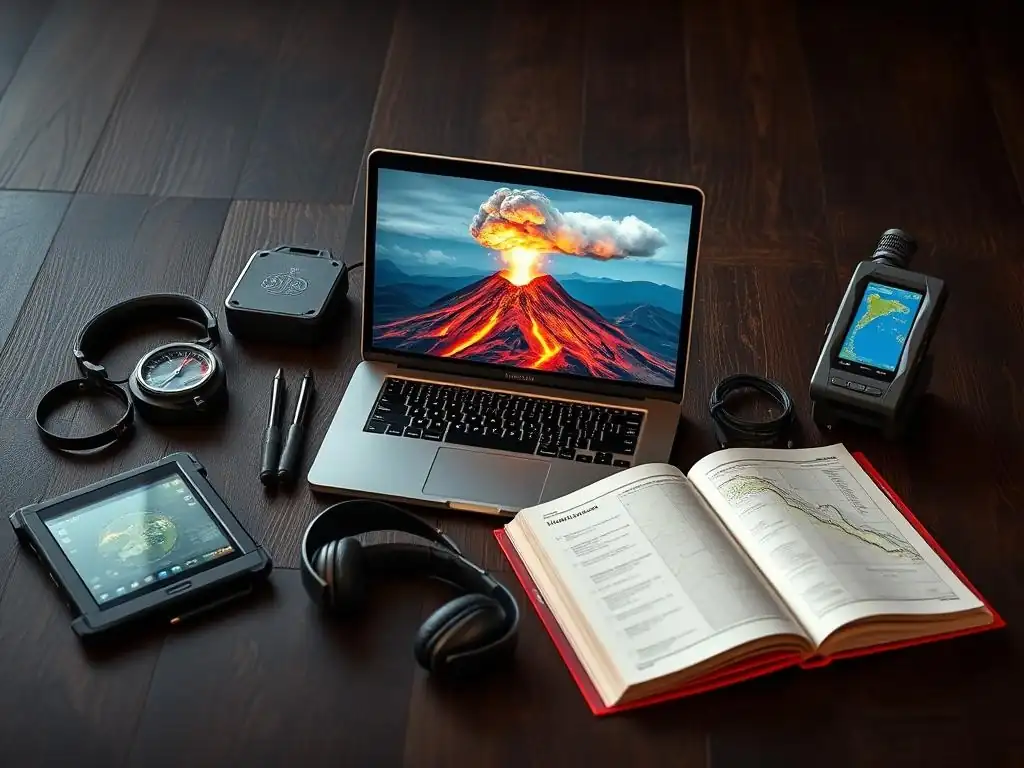
Remote volcanology studies benefit greatly from specialized software tools. QGIS (QGIS.org), a free and open-source Geographic Information System (GIS) software, is invaluable for volcanic data visualization and analysis. QGIS allows users to create maps, analyze spatial data, and visualize various types of volcanological information, such as volcano locations, eruption histories, hazard zones, and monitoring data. Beginners can use QGIS to explore publicly available datasets from geological surveys and research institutions, gaining hands-on experience with spatial data analysis relevant to volcanology. Numerous online tutorials and resources are available to help beginners learn QGIS and apply it to volcanological studies.
Google Earth Pro, a free desktop application, is another essential tool for remote observation of volcanic landscapes. Google Earth Pro provides high-resolution satellite imagery, 3D terrain models, and historical imagery, enabling virtual exploration of volcanoes worldwide. Users can examine volcano morphology, identify geological features, measure distances and areas, and even create virtual field trips. For online volcanology students, Google Earth Pro is a powerful tool for visualizing volcanic landforms and understanding the geological context of volcanic regions without physically being there. Its user-friendly interface and vast global coverage make it accessible and beneficial for beginners and advanced learners alike.
Hardware: Laptop with Adequate Processing Power and Storage
While sophisticated lab equipment is not required for online volcanology studies, a laptop with adequate processing power and storage is essential. For running software like QGIS and Google Earth Pro, a laptop with at least 8GB of RAM and a reasonably fast processor (e.g., Intel Core i5 or equivalent) is recommended.
Sufficient storage space, ideally 256GB or more of solid-state drive (SSD) storage, is needed to accommodate software installations, datasets, and course materials. A dedicated graphics card is not strictly necessary for introductory volcanology studies but can enhance performance, especially when working with 3D visualizations in Google Earth Pro or complex GIS datasets.
Reliable internet connectivity is also crucial for accessing online course materials, streaming lectures, downloading data, and participating in online forums. A stable broadband connection ensures a smooth and uninterrupted learning experience. While a high-end gaming laptop is not required, investing in a mid-range laptop with sufficient processing power, storage, and a reliable internet connection will significantly enhance the effectiveness of online volcanology studies. For beginners starting out, focusing on these fundamental hardware requirements will provide a solid foundation for remote learning.
Books: "Volcanoes" by Peter Francis, "Volcanism" by Hans-Ulrich Schmincke
Complementing online resources, classic textbooks provide in-depth knowledge and structured learning in volcanology. "Volcanoes: A Planetary Perspective" by Peter Francis and Clive Oppenheimer is a widely respected textbook that offers a comprehensive overview of volcanology, covering various aspects from magma generation to eruption dynamics and volcanic hazards. Written in an accessible style, it's suitable for both beginners and those seeking a more advanced understanding. The book is known for its clear explanations, illustrative diagrams, and inclusion of real-world examples. It provides a solid foundation in the fundamental principles of volcanology.
"Volcanism" by Hans-Ulrich Schmincke is another highly regarded textbook, often considered a more advanced and detailed treatment of the subject. It delves deeply into the petrology and geochemistry of volcanic rocks, eruption processes, and the geological context of volcanism. While perhaps more challenging for absolute beginners, "Volcanism" is an invaluable resource for those seeking a rigorous and comprehensive understanding of volcanology at a more advanced level. Both "Volcanoes" by Francis and Oppenheimer, and "Volcanism" by Schmincke are considered essential reading for serious students of volcanology, providing a depth of knowledge that complements online courses and resources.
From Online Learning to Volcanology Careers
Career Opportunities: Volcanic Monitoring, Hazard Assessment, and Research
While online courses offer a fantastic entry point, a career in volcanology typically requires further education and specialized training. However, the knowledge and skills gained from online volcanology courses can be a valuable stepping stone towards various career paths. One prominent career area is volcanic monitoring.
Volcanologists working in monitoring roles analyze data from seismic networks, gas sensors, and satellite imagery to detect changes in volcanic activity and assess eruption potential. This work is crucial for providing early warnings and mitigating volcanic hazards in populated areas near active volcanoes. Organizations like geological surveys and volcano observatories employ volcanologists for monitoring and hazard assessment.
Another career path lies in volcanic hazard assessment. Volcanologists in this field create hazard maps, assess volcanic risk to infrastructure and communities, and develop strategies for risk reduction and emergency preparedness. This often involves fieldwork to study past eruptions and geological deposits, as well as computer modeling to simulate volcanic processes and hazard scenarios. Consulting firms, government agencies, and international organizations involved in disaster risk reduction employ volcanologists for hazard assessment and mitigation projects.
Furthermore, research remains a core career area. Volcanologists in academia and research institutions conduct fundamental research on volcanic processes, magma generation, eruption dynamics, and the Earth's interior. Research careers often involve fieldwork, laboratory analysis, and publishing scientific papers.
Further Education: Pursuing Advanced Degrees in Volcanology
To pursue a professional career in volcanology, further education beyond introductory online courses is generally necessary. A Bachelor's degree in Geology, Earth Science, or Geophysics is typically the first step. These undergraduate programs provide a broad foundation in geological principles, mineralogy, petrology, structural geology, and geophysics, which are essential for volcanology. Following a Bachelor's degree, aspiring volcanologists usually pursue a Master's degree or a Ph.D. in Volcanology, Geophysics, or a related Earth science field. These advanced degrees provide specialized training in volcanology, including coursework, research projects, and fieldwork experiences.
Master's and Ph.D. programs in volcanology are offered by universities with strong Earth science departments and active volcanology research groups. These programs often involve specialized courses in volcanic processes, magma petrology, eruption dynamics, volcanic hazards, and geophysical monitoring techniques. Research is a central component of advanced degrees, with students typically undertaking independent research projects under the supervision of experienced volcanology faculty.
Fieldwork opportunities are often integral to these programs, providing hands-on experience in studying volcanoes in diverse geological settings. Pursuing advanced degrees is essential for gaining the in-depth knowledge, research skills, and professional network necessary for a successful career in volcanology.
Conclusion: Taking Your First Steps in Online Volcanology
Reviewing Top Online Courses and Resources
Exploring the world of volcanoes from home is now remarkably accessible thanks to the wealth of online resources and courses available. For structured learning, Oregon State University's "Discovering Volcanoes" stands out for its immersive virtual field trips and interactive data analysis, offering a comprehensive and engaging beginner experience. The University of Iceland's "Living with Volcanoes" provides a unique perspective on volcanic hazards and risk management, drawing on Iceland's extensive experience. edX's "Natural Disasters - Volcanic Eruptions" courses offer a broader overview of natural hazards, including volcanology, and are particularly accessible due to their tiered pricing and audit options.
Beyond formal courses, free resources like the USGS Volcano Hazards Program and Smithsonian GVP websites offer a treasure trove of data, educational materials, and real-time volcano information. National Geographic and BBC Earth documentaries bring the visual drama of volcanoes to life, while MIT OpenCourseWare and other OER platforms provide free access to university-level geology course materials. Essential tools for remote study include QGIS for data visualization, Google Earth Pro for virtual exploration, and foundational textbooks like "Volcanoes" by Francis and Oppenheimer.
Next Steps: Selecting a Course and Beginning Your Studies.
Taking your first steps in online volcanology is an exciting journey. Start by exploring the recommended online courses and free resources to identify options that align with your interests and learning goals. Consider your budget, time commitment, and preferred learning style when selecting a course. For beginners seeking a comprehensive introduction, Oregon State University's course is an excellent starting point. Those interested in volcanic hazards might find the University of Iceland's course particularly relevant. Budget-conscious learners can begin with free resources and explore edX courses with audit options.
Once you've selected a course or resources, dedicate time each week to engage with the materials, participate in online forums if available, and explore the recommended software and tools. Remember that online learning is a self-directed endeavor, so setting realistic goals and maintaining motivation are key. Embrace the flexibility and accessibility of online volcanology education, and enjoy the process of unraveling the mysteries of these powerful and awe-inspiring geological forces. Your journey into the world of volcanoes can begin today, right from your home.
Frequently Asked Questions
What kind of online volcanology courses are available for beginners?
Beginner courses often cover the basics of volcanology, including plate tectonics, magma formation, and different types of volcanic eruptions. Some might even include virtual field trips.
Are online volcanology courses a substitute for in-person learning?
While online courses offer flexibility, they may not fully replace in-person learning. Hands-on experience and direct interaction with instructors can be limited. However, they are a great starting point.
How much do online volcanology courses for beginners typically cost?
The cost varies widely. Some courses are free or low-cost, while others, particularly those from universities, can be more expensive. Check for scholarships or financial aid options.
What skills can I gain from taking online volcanology courses?
You can develop scientific literacy, learn to interpret volcanic data, and understand volcanic hazards. These skills are useful for both personal enrichment and career prospects.
Do I need a science background to take online volcanology courses?
While a science background can be helpful, it's not always required. Many beginner courses are designed to be accessible to anyone with an interest in volcanology, covering fundamental concepts from scratch.
Final Reflection: Igniting Curiosity, Erupting Knowledge
The exploration of volcanoes, once confined to rugged terrains and specialized laboratories, is now accessible from the comfort of our homes. This democratization of knowledge, fueled by online volcanology courses, represents a significant shift in how we understand and engage with our planet's most dynamic forces. The ability to learn about magma chambers, tectonic plate boundaries, and eruption styles without leaving our desks opens doors for a new generation of volcanologists and enthusiasts alike.
This accessibility has profoundly influenced the cultural landscape, fostering a deeper appreciation for the Earth's processes and the inherent risks and beauty of volcanic activity. My own fascination with volcanoes began with a simple documentary, and I can only imagine the impact these structured online courses will have on inspiring future scientists and informed citizens. The mountains are calling and I must go.
- John Muir. This quote perfectly encapsulates the allure of these geological giants, and online volcanology courses provide the tools to answer that call, even from afar.
Now, I invite you to consider the power of accessible education. What dormant passions can you ignite? What new skills can you acquire? The world of volcanology, and countless other fields, is now at your fingertips. Embrace the opportunity to learn, explore, and contribute to a deeper understanding of the world around you. Let the knowledge you gain from these online courses fuel your curiosity and inspire you to make a positive impact, whether it's through scientific discovery, informed decision-making, or simply a newfound appreciation for the Earth's raw power.
Ignite Your Inner Volcanologist!
Thanks for exploring the fascinating world of volcanoes! You've learned about the exciting opportunity to delve into volcanology from home. Now, it's time to put that knowledge into action.
Ready to continue your volcanic adventure?
- Enroll in our exclusive online course, "Volcanoes From Home," today! Learn from leading experts and gain a deeper understanding of these powerful forces of nature.
- Share this article with fellow science enthusiasts eager to explore volcanology. Let's build a community of volcano lovers!
- Why not create your own model volcano using household materials? Document your eruption and share it online using #VolcanoExplorersOrg.
What excites you most about further exploring the world of volcanology? Let us know in the comments!