
Stratovolcanoes and Aviation: Navigating the Skies Above Volcanic Zones


Welcome to Volcano Explorers, where the Earth breathes fire! Ever wondered how towering stratovolcanoes, those majestic yet volatile peaks, can unexpectedly ground even the most seasoned pilots? Delve into the hidden dangers lurking beneath the ash clouds in our latest article, " Stratovolcanoes and Aviation: Navigating the Skies Above Volcanic Zones," and uncover the critical impact these geological giants have on aviation safety. But that's just the beginning; explore the depths of Volcano Types & Features and prepare to be amazed by the raw power and breathtaking beauty of the volcanic world. What secrets will you unearth next?
- Introduction: The Threat of Stratovolcanoes to Air Travel
- Understanding Stratovolcano Hazards: Ash Clouds and Their Impact
- Specific Risks Posed by Stratovolcanoes to Aviation
- Monitoring and Prediction: Minimizing the Risk to Aviation
- Case Studies: Aviation Incidents Involving Stratovolcanoes
- The Future of Aviation Safety in Volcanic Regions
- Conclusion: Mitigating the Risks of Stratovolcanoes to Aviation
-
Frequently Asked Questions
- What are the primary hazards Stratovolcanoes pose to aviation?
- How does volcanic ash affect aircraft engines?
- What measures are in place to mitigate the risks of Stratovolcanoes to aviation?
- How do volcanologists contribute to aviation safety near Stratovolcanoes?
- What should pilots do if they inadvertently enter a volcanic ash cloud?
- Final Reflection: The Unseen Threat Above
- Take Flight: Safeguarding Our Skies!
Introduction: The Threat of Stratovolcanoes to Air Travel
Stratovolcanoes, majestic yet perilous mountains of fire, pose a significant and often underestimated threat to modern aviation. These towering geological structures, known for their explosive eruptions and far-reaching ash plumes, are strategically located along major air traffic routes around the globe. The intersection of these natural hazards with increasingly busy skies creates a complex challenge for air safety.
Understanding the specific dangers stratovolcanoes present and implementing effective mitigation strategies are paramount to ensuring the continued safety of air travel in volcanically active regions. The very nature of stratovolcano eruptions, characterized by their sudden onset and widespread ash dispersal, demands constant vigilance and preparedness from both the aviation industry and volcanological monitoring agencies.
The impact of stratovolcanoes on aviation safety is not merely a theoretical concern; it is a tangible risk that has materialized in numerous incidents throughout aviation history. Encounters with volcanic ash clouds, even seemingly minor ones, can have catastrophic consequences for aircraft, leading to engine damage, reduced visibility, and critical system failures.
Therefore, a comprehensive understanding of stratovolcano hazards, coupled with advanced detection and avoidance technologies, is crucial for navigating the skies above volcanic zones and minimizing the potential for disastrous encounters. This article delves into the specific threats posed by stratovolcanoes to aviation, exploring the science behind the hazards, the systems in place to mitigate risks, and the ongoing efforts to enhance aviation safety in these dynamic environments.
Understanding Stratovolcano Hazards: Ash Clouds and Their Impact
What are Stratovolcanoes and How Do They Erupt?
Stratovolcanoes, also known as composite volcanoes, are characterized by their steep conical shape, built up from many layers of hardened lava, tephra, pumice, and volcanic ash. They are typically found at subduction zones, where one tectonic plate slides beneath another. This process leads to the formation of magma, rich in silica and dissolved gases, which fuels the explosive eruptions characteristic of stratovolcanoes.
Unlike shield volcanoes, which are known for effusive eruptions of fluid basaltic lava, stratovolcanoes are prone to violent, explosive eruptions. These eruptions are driven by the build-up of pressure from trapped gases within the viscous magma. When this pressure overcomes the strength of the overlying rock, a powerful eruption occurs, often ejecting ash, gas, and pyroclastic flows at high speeds.
The eruption style of stratovolcanoes is highly variable, ranging from relatively small ash plumes to colossal Plinian eruptions that can inject ash tens of kilometers into the atmosphere. The explosivity is largely determined by the magma's composition and gas content. Magmas with high silica content are more viscous, trapping gases and leading to greater pressure build-up.
Water vapor, carbon dioxide, and sulfur dioxide are the primary volcanic gases released during eruptions. These gases not only contribute to the explosive force but also play a critical role in the formation and dispersal of volcanic ash clouds, which are the primary hazard to aviation posed by stratovolcanoes. The unpredictable nature of stratovolcano eruptions, coupled with their potential for producing vast quantities of ash, makes them a persistent threat to air traffic.
Volcanic Ash: A Major Hazard to Aircraft
Volcanic ash, despite its seemingly innocuous name, is not the soft, fluffy material associated with burning wood. It is composed of tiny fragments of pulverized rock, minerals, and volcanic glass, often less than 2 millimeters in diameter. Critically, these particles are extremely abrasive and hard, with a hardness similar to that of sand or even glass shards.
When ingested into jet engines, volcanic ash melts in the high temperatures of the combustion chamber and then resolidifies onto turbine blades and other engine components. This process, known as vitrification, can lead to engine surge, stall, or even complete engine failure. Furthermore, the abrasive nature of the ash can erode engine compressor blades, reducing engine efficiency and thrust.
Beyond engine damage, volcanic ash poses numerous other hazards to aircraft. The fine particles can scratch and pit windshields, severely reducing visibility for pilots, especially during critical phases of flight like takeoff and landing. Ash can also contaminate aircraft systems, including pitot tubes and static ports, which are essential for measuring airspeed and altitude.
Blockage of these systems can lead to unreliable instrument readings and potentially dangerous flight control issues. Additionally, volcanic ash clouds are often associated with reduced visibility in general, creating hazardous flying conditions even without direct engine ingestion. The combination of engine damage, reduced visibility, and potential system malfunctions makes volcanic ash a significant and multifaceted threat to aviation safety, demanding careful avoidance and mitigation strategies.
Specific Risks Posed by Stratovolcanoes to Aviation
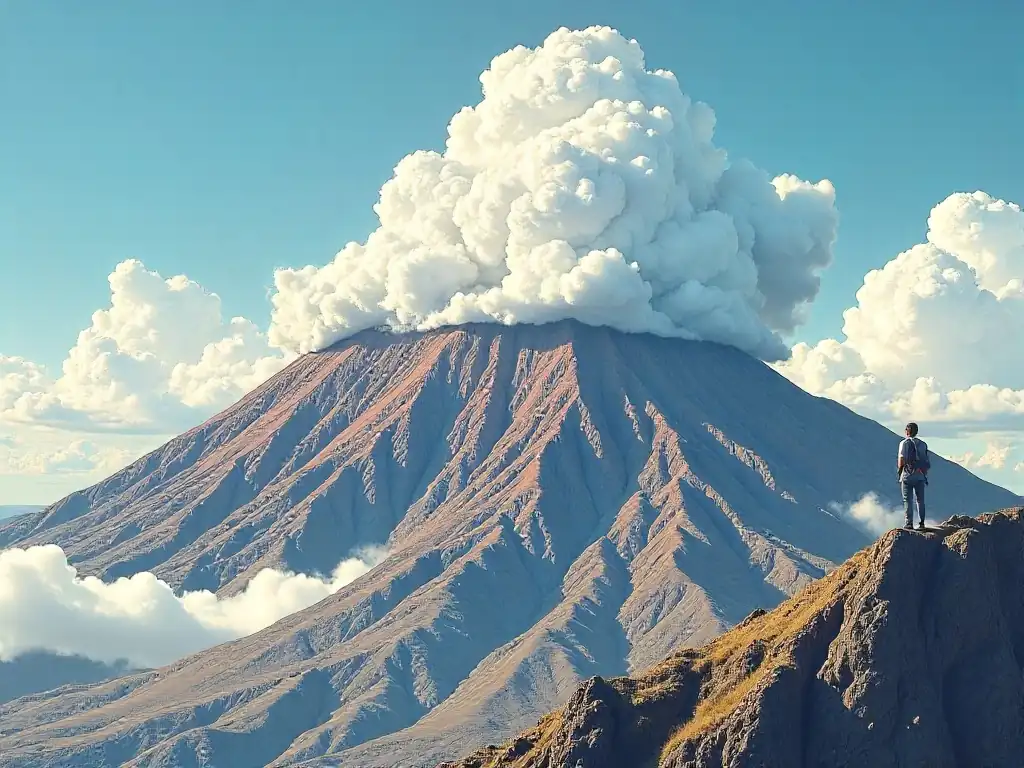
High-Altitude Ash Plumes from Stratovolcano Eruptions
Stratovolcanoes are particularly hazardous to aviation due to their capacity to generate high-altitude ash plumes that can reach cruising altitudes of commercial airliners. Plinian eruptions, the most explosive type of stratovolcano eruption, can inject ash columns well into the stratosphere, sometimes exceeding 30 kilometers (approximately 100,000 feet) in altitude.
These plumes can then be dispersed over vast areas by prevailing winds, creating extensive ash clouds that pose a risk to aircraft hundreds or even thousands of kilometers downwind from the erupting volcano. For instance, the 2010 eruption of Eyjafjallajökull, a stratovolcano in Iceland, although not exceptionally large in volcanic terms, injected ash up to 9 kilometers (30,000 feet) into the atmosphere, disrupting air travel across Europe for several days due to its location beneath a major air traffic corridor and the fine-grained nature of the ash.
The altitude reached by ash plumes is influenced by several factors, including the eruption intensity, the height of the volcano itself, and atmospheric conditions. Stratovolcanoes located in regions with strong prevailing winds, such as the Pacific Ring of Fire, are particularly concerning as ash plumes can be rapidly transported across major air routes.
The density of ash within these plumes can vary significantly, but even relatively low concentrations can be damaging to aircraft engines. The unpredictable nature of stratovolcano eruptions, both in terms of timing and intensity, necessitates continuous monitoring and real-time information dissemination to the aviation industry to effectively mitigate the risks associated with high-altitude ash plumes.
The Importance of Ash Cloud Detection and Avoidance
The primary strategy for mitigating the risk of stratovolcanoes impact on aviation safety is the detection and avoidance of volcanic ash clouds. Given the serious hazards posed by ash ingestion, it is crucial for aircraft to remain clear of these plumes. This requires a multi-faceted approach involving ground-based and space-based monitoring, effective communication channels, and robust air traffic management procedures. Early detection of volcanic eruptions and the subsequent tracking of ash cloud dispersal are paramount. Without timely and accurate information about ash cloud location and movement, pilots and air traffic controllers cannot make informed decisions to avoid hazardous areas.
Effective ash cloud avoidance relies on a collaborative effort between volcanologists, meteorologists, air traffic control, and airline operators. Volcanologists monitor volcanic activity and provide eruption alerts, while meteorologists model ash cloud dispersal based on eruption parameters and weather patterns. Volcanic Ash Advisory Centers (VAACs) play a central role in synthesizing this information and disseminating it to the aviation community.
Air traffic control uses this information to reroute aircraft around ash-affected areas, and airlines adjust flight plans and schedules accordingly. Pilot training also plays a crucial role, equipping pilots with the knowledge and procedures to recognize and respond to potential ash encounters. The success of ash cloud avoidance strategies hinges on the seamless integration of these various components and the timely flow of accurate information to all stakeholders.
Monitoring and Prediction: Minimizing the Risk to Aviation
Volcanic Ash Advisory Centers (VAACs): Providing Crucial Information
Volcanic Ash Advisory Centers (VAACs) are a critical component of the global aviation safety framework, specifically designed to mitigate the risks posed by volcanic ash. Established by the International Civil Aviation Organization (ICAO), there are nine VAACs strategically located around the world, each responsible for monitoring volcanic activity and issuing ash advisories for a defined geographical region.
These centers operate 24/7, utilizing a combination of satellite data, ground-based observations, pilot reports, and meteorological models to detect volcanic eruptions and track the movement of ash clouds. VAACs are the primary source of information for the aviation industry regarding volcanic ash hazards.
VAACs issue Volcanic Ash Advisories (VAAs) which provide crucial information to air traffic control, airlines, and pilots. These advisories detail the location, altitude, and forecast movement of volcanic ash clouds. VAAs are disseminated in both textual and graphical formats, allowing for easy interpretation and integration into flight planning systems.
The information provided by VAACs enables air traffic controllers to reroute flights around ash-affected areas, minimizing the risk of encounters. Furthermore, VAAs assist airlines in making informed decisions about flight operations, including potential delays, cancellations, or route adjustments. The timely and accurate information provided by VAACs is essential for maintaining aviation safety in regions prone to volcanic eruptions.
Technological Advancements in Ash Cloud Detection
Technological advancements have significantly enhanced the ability to detect and track volcanic ash clouds, improving aviation safety. Satellite-based remote sensing is a cornerstone of modern ash cloud detection. Geostationary and polar-orbiting satellites equipped with infrared and visible light sensors can detect ash plumes in near real-time, even in remote or poorly monitored volcanic regions.
These satellites can provide information on the spatial extent, altitude, and movement of ash clouds, which is crucial for VAACs in issuing timely advisories. For example, the Advanced Very High Resolution Radiometer (AVHRR) and the Spinning Enhanced Visible and Infrared Imager (SEVIRI) are widely used for ash cloud detection.
Ground-based radar systems are also increasingly utilized, particularly for monitoring volcanoes in closer proximity to airports and air routes. Weather radar can detect larger ash particles, while specialized volcanic ash radar systems are being developed to detect finer ash particles more effectively. Lidar (Light Detection and Ranging) technology, which uses laser pulses to measure atmospheric particles, offers another promising avenue for ash cloud detection and characterization.
Furthermore, advancements in atmospheric modeling and computational power have improved the accuracy of ash dispersal forecasts. These models integrate meteorological data with eruption source parameters to predict the trajectory and concentration of ash clouds, aiding in risk assessment and flight planning. Continued investment in and refinement of these technologies are vital for further enhancing ash cloud detection capabilities and minimizing the impact of stratovolcanoes on aviation safety.
Pilot Training and Procedures for Volcanic Ash Encounters
Pilot training and standardized procedures are essential components of aviation safety in volcanic regions, equipping flight crews to effectively respond to potential volcanic ash encounters. Pilot training programs now incorporate comprehensive modules on volcanic ash hazards, including the risks of engine damage, reduced visibility, and system malfunctions.
Pilots are trained to recognize the signs of volcanic ash encounters, such as unusual smells in the cockpit (often described as sulfurous or acrid), haze or discoloration of the atmosphere, and St. Elmo's fire (a luminous electrical discharge) on the windshield. They are also instructed on the appropriate procedures to follow if an ash cloud is encountered.
Standard procedures for volcanic ash encounters emphasize avoidance as the primary strategy. Pilots are trained to consult VAAC advisories and weather information before and during flights to identify potential ash hazards. If an ash cloud is encountered inadvertently, recommended procedures include immediately turning away from the ash cloud, reducing engine thrust to minimize ash ingestion, and activating engine and airframe anti-icing systems if available. Maintaining a constant airspeed and avoiding rapid changes in altitude are also advised.
Post-encounter procedures include a thorough inspection of the aircraft for ash contamination and potential damage. Regular simulator training scenarios that simulate volcanic ash encounters are crucial for reinforcing these procedures and ensuring pilots are prepared to react effectively in a real-world situation. Continuous improvement in pilot training, based on lessons learned from past incidents and advancements in understanding volcanic ash hazards, is vital for maintaining a high level of aviation safety.
Case Studies: Aviation Incidents Involving Stratovolcanoes

British Airways Flight 9, Galunggung, Indonesia, 1982: The "Jakarta Incident"
British Airways Flight 9, a Boeing 747-200 en route from Kuala Lumpur to Perth in June 1982, encountered a dramatic and near-catastrophic volcanic ash cloud from the erupting Mount Galunggung stratovolcano in Indonesia. Flying at night at approximately 37,000 feet, the aircraft unexpectedly flew into a dense cloud of volcanic ash. Within minutes, all four engines began to fail.
Pilots initially believed they were experiencing engine surge or stall, but soon realized the severity of the situation as all engines eventually flamed out completely, leaving the 747 gliding silently over the Indian Ocean. The cockpit windshield was abraded to opacity by the ash, and the cabin filled with a sulfurous smell.
Despite the extreme emergency, the flight crew, led by Captain Eric Moody, skillfully managed to restart three of the four engines after descending to a lower altitude. The aircraft, with severely damaged engines, managed to divert to Jakarta and land safely. Subsequent inspection revealed extensive damage to the engines caused by volcanic ash ingestion, including solidified ash deposits on turbine blades and compressor erosion.
The "Jakarta Incident" became a landmark case, highlighting the previously underestimated danger of volcanic ash to jet aircraft and prompting significant changes in aviation procedures and volcanic ash monitoring. It underscored the potential for stratovolcanoes to impact aviation safety far beyond the immediate vicinity of an eruption.
KLM Flight 867, Redoubt Volcano, Alaska, 1989: Four Engine Flameout
KLM Flight 867, another Boeing 747-400, experienced a similar harrowing encounter with volcanic ash in December 1989, this time from the Redoubt Volcano stratovolcano in Alaska. While flying at 25,000 feet near Anchorage, the aircraft entered an unpredicted volcanic ash cloud. Like British Airways Flight 9, KLM 867 suffered complete failure of all four engines due to ash ingestion. The windshield was also severely abraded, and the aircraft experienced significant airframe damage from the abrasive ash particles.
The crew of KLM Flight 867, under immense pressure, managed to restart two engines after descending approximately 13,000 feet. They successfully landed at Anchorage International Airport, though the aircraft sustained substantial engine damage and required extensive repairs. The Redoubt Volcano incident further reinforced the lessons learned from the Galunggung eruption, emphasizing the critical need for improved volcanic ash detection, forecasting, and avoidance procedures.
These case studies demonstrate the real and present danger stratovolcanoes pose to aviation, even with modern aircraft and flight management systems. They underscore the importance of continuous vigilance and proactive measures to mitigate the risks associated with stratovolcanoes impact on aviation safety.
The Future of Aviation Safety in Volcanic Regions
Improving Volcanic Ash Forecasting Models
Continued improvement in volcanic ash forecasting models is crucial for enhancing aviation safety in volcanic regions. Current models rely on a combination of meteorological data, eruption source parameters (such as eruption column height and ash emission rate), and atmospheric dispersion algorithms. However, uncertainties remain in accurately predicting ash cloud dispersal, particularly due to the complex dynamics of volcanic eruptions and atmospheric conditions. Future advancements in forecasting will likely focus on incorporating more sophisticated eruption source models, utilizing higher-resolution meteorological data, and improving the representation of ash particle physics in dispersion models.
Research efforts are underway to develop ensemble forecasting techniques, which combine the outputs of multiple models to provide probabilistic forecasts of ash cloud location and concentration. This approach can better quantify the uncertainties associated with ash cloud predictions and provide more robust information for decision-making. Furthermore, integrating real-time data from satellite and ground-based observations into forecasting models through data assimilation techniques can improve forecast accuracy and timeliness.
Advances in computational power and data analysis techniques, such as machine learning, also hold promise for enhancing volcanic ash forecasting capabilities. By continuously refining and validating these models, we can improve the accuracy and reliability of ash cloud predictions, leading to more effective mitigation strategies and safer air travel in volcanic regions.
International Collaboration and Regulatory Frameworks
International collaboration and robust regulatory frameworks are essential for ensuring consistent and effective aviation safety practices in volcanic regions worldwide. Volcanic ash is a transboundary hazard, and eruptions in one country can impact air traffic across multiple nations. Therefore, international cooperation is vital for sharing information, coordinating responses, and establishing standardized procedures. Organizations like ICAO play a crucial role in setting international standards and guidelines for volcanic ash management, including the establishment and operation of VAACs.
Further strengthening international collaboration involves enhancing data sharing between volcanological observatories, meteorological agencies, and VAACs across different countries. Joint research initiatives and technology transfer programs can facilitate the development and implementation of best practices in volcanic ash monitoring and forecasting. Regulatory frameworks need to be continually updated to reflect advancements in scientific understanding and technological capabilities.
This includes regulations related to flight planning in volcanic regions, pilot training requirements, and aircraft certification standards for volcanic ash tolerance. Harmonized international regulations and collaborative efforts are crucial for creating a globally consistent and effective system for managing the risks posed by stratovolcanoes to aviation safety.
The Use of Remote Sensing Technologies in Volcanic Hazard Assessment
The future of volcanic hazard assessment and aviation safety is increasingly reliant on remote sensing technologies. Beyond ash cloud detection, remote sensing plays a vital role in monitoring volcanic activity, assessing volcanic deformation, and characterizing volcanic gas emissions. Satellite-based instruments can detect subtle changes in ground deformation, thermal anomalies, and gas plumes, providing early warning signs of potential eruptions. For example, Interferometric Synthetic Aperture Radar (InSAR) can measure ground deformation with millimeter-level precision, while thermal infrared sensors can detect changes in volcanic heat output.
Hyperspectral and multispectral imagers can be used to map volcanic gas plumes, such as sulfur dioxide (SO2), which is a key indicator of volcanic activity. Unmanned Aerial Vehicles (UAVs) or drones are also emerging as valuable tools for volcanic monitoring, allowing for closer-range observations and sampling in hazardous areas.
Data from these remote sensing platforms can be integrated with ground-based monitoring networks to provide a comprehensive picture of volcanic activity and improve eruption forecasting capabilities. The continued development and application of remote sensing technologies will be instrumental in enhancing volcanic hazard assessment and mitigating the risks posed by stratovolcanoes to aviation, ultimately contributing to safer skies above volcanic zones.
Conclusion: Mitigating the Risks of Stratovolcanoes to Aviation
Mitigating the risks of stratovolcanoes to aviation requires a multi-faceted and continuously evolving approach. Understanding the specific hazards posed by volcanic ash, particularly from explosive stratovolcano eruptions, is paramount. Effective mitigation relies on robust systems for ash cloud detection and avoidance, with Volcanic Ash Advisory Centers playing a central role in providing crucial information to the aviation industry.
Technological advancements in satellite and ground-based monitoring, coupled with improved volcanic ash forecasting models, are continually enhancing our ability to predict and track ash clouds. Pilot training and standardized procedures equip flight crews to respond effectively to potential ash encounters, while international collaboration and regulatory frameworks ensure a globally consistent approach to aviation safety in volcanic regions.
Case studies of past aviation incidents involving stratovolcanoes, such as British Airways Flight 9 and KLM Flight 867, serve as stark reminders of the real and present danger. Looking to the future, continued investment in research and development, focusing on improved forecasting models, enhanced remote sensing technologies, and strengthened international cooperation, is essential.
By proactively addressing the challenges posed by stratovolcanoes, the aviation industry can continue to navigate the skies above volcanic zones safely and efficiently, minimizing the impact of these powerful natural forces on global air travel. The ongoing commitment to innovation and vigilance remains crucial for ensuring the safety of passengers and crew in the face of the persistent threat from stratovolcanoes impact on aviation safety.
Frequently Asked Questions
What are the primary hazards Stratovolcanoes pose to aviation?
Stratovolcanoes present several dangers, including ash clouds that can damage aircraft engines and reduce visibility. These clouds can drift for hundreds of miles, impacting air routes far from the volcano itself. Sulfur dioxide emissions can also corrode aircraft materials.
How does volcanic ash affect aircraft engines?
Volcanic ash is extremely abrasive and can cause engine stall by melting and solidifying on turbine blades, disrupting airflow. The tiny glass particles within the ash can also erode engine components, leading to significant damage.
What measures are in place to mitigate the risks of Stratovolcanoes to aviation?
Air traffic control relies on volcanic ash advisories and satellite monitoring to reroute flights around affected areas. Pilots are trained to recognize the signs of volcanic ash and to follow specific procedures, such as reducing engine power, to minimize damage.
How do volcanologists contribute to aviation safety near Stratovolcanoes?
Volcanologists monitor volcanic activity and provide early warnings of potential eruptions. They also create ash dispersion models to predict the movement of ash clouds, enabling air traffic controllers to make informed decisions about flight paths.
What should pilots do if they inadvertently enter a volcanic ash cloud?
Pilots should immediately turn away from the ash cloud, increase the distance from the volcano, and activate anti-ice systems. It's crucial to report the encounter to air traffic control and follow emergency procedures to prevent engine failure.
Final Reflection: The Unseen Threat Above
The preceding analysis has illuminated the complex and often underestimated relationship between stratovolcanoes and aviation safety. The persistent threat of volcanic ash clouds to aircraft, even in seemingly dormant volcanic zones, remains a critical concern for pilots, air traffic controllers, and the aviation industry as a whole. Complacency is not an option when dealing with the unpredictable nature of these geological giants and their potential to disrupt global air travel.
This topic has profoundly shaped our understanding of risk management in aviation, forcing us to confront the invisible dangers lurking in the atmosphere. The ongoing need for improved detection, forecasting, and communication systems is undeniable, and the lives of countless passengers and crew depend on our collective commitment to vigilance. The sky is no longer the limit when there are footprints on the moon.
This quote, while originally about space exploration, resonates deeply here, reminding us that even in seemingly familiar environments, new challenges and unseen dangers constantly emerge, demanding innovative solutions and unwavering dedication to safety.
As we conclude this exploration of stratovolcanoes and their impact on aviation, I urge you to consider the broader implications of this knowledge. How can you, in your own sphere of influence, advocate for greater awareness and investment in volcanic ash detection and mitigation strategies? Let us all strive to ensure that the skies remain safe for travel, not just today, but for generations to come. Reflect on the lessons learned here and commit to playing your part in safeguarding the future of aviation.
Take Flight: Safeguarding Our Skies!
Thank you for exploring the critical relationship between stratovolcanoes and aviation safety. Now that you understand the risks and challenges, it's time to act. Let's work together to ensure safer skies for everyone.
Here's how you can help:
- Urge your elected officials to support improved volcanic ash monitoring and forecasting. This is crucial for preventing aviation disasters.
- Explore our interactive map on VolcanoExplorers.org to identify potential volcanic hazards near major flight paths and share your findings with fellow aviation enthusiasts.
- Pilots can provide invaluable real-time observations of volcanic activity. Learn about reporting procedures and encourage pilots you know to report any encounters.
What innovative solutions can further mitigate the risks of volcanic ash to aircraft? Share your ideas in the comments below!