
The Science of Scoria and Steam: Geological CrossSections in 19th Century Volcano Prints

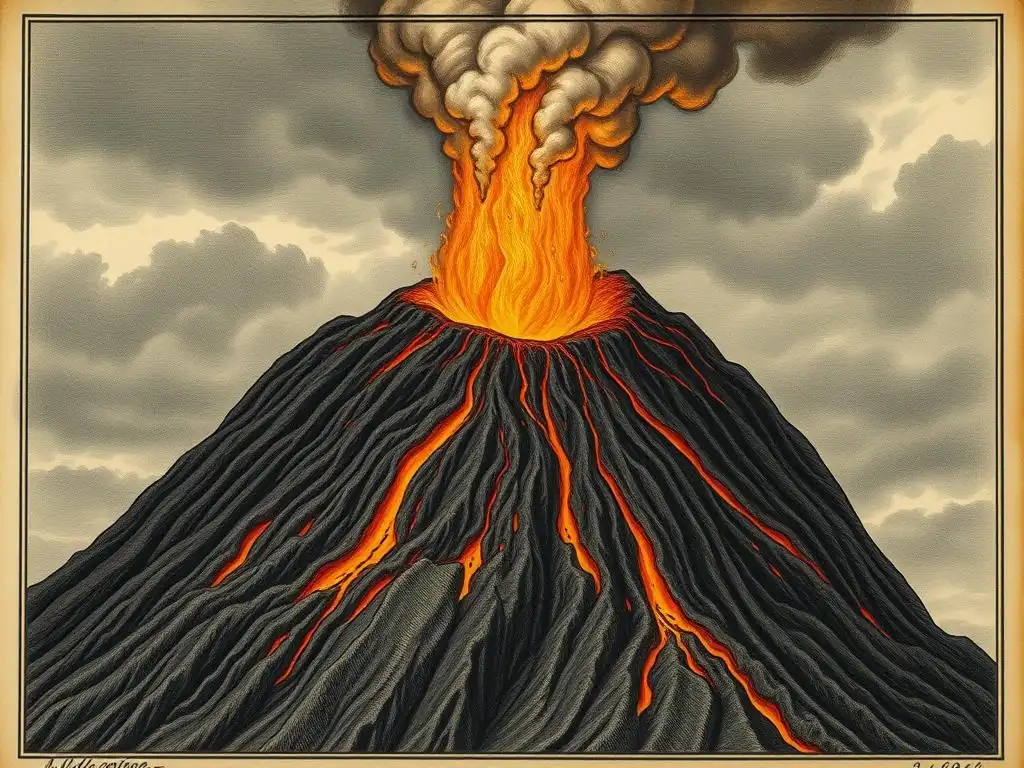
Welcome to Volcano Explorers!
Prepare to be transported back in time as we uncover a hidden world within 19th century volcano prints. More than just pretty pictures, these historical artifacts offer a fascinating glimpse into the geological understanding of volcanoes at the time. What secrets do these cross-sections reveal about the science of scoria and steam? Join us as we delve into the artistry and scientific insight captured within each fiery brushstroke, and discover how these prints shaped our understanding of these magnificent, and often deadly, natural wonders.
- Unveiling the Earth's Fury: Exploring 19th Century Volcano Prints
- Decoding the Cross-Sections: Geological Accuracy in 19th Century Prints
- Notable Artists and Publishers of 19th Century Volcano Prints
- The Art of Lithography and Engraving: Techniques Behind 19th Century Volcano Prints
- Collecting and Preserving 19th Century Volcano Prints: A Guide for Enthusiasts
- The Enduring Legacy of 19th Century Volcano Prints: A Bridge Between Art and Science
-
Frequently Asked Questions
- What makes 19th century volcano prints valuable from a scientific perspective?
- Why were lithographs a popular medium for 19th century volcano prints?
- Do 19th century volcano prints accurately depict volcanic activity according to modern science?
- Where can I find high-quality reproductions of 19th century volcano prints?
- How do 19th century volcano prints contribute to our understanding of volcanology today?
- Final Reflection: Unearthing Insights from Volcanic Visions
- Unearth Your Inner Geologist!
Unveiling the Earth's Fury: Exploring 19th Century Volcano Prints
A Window into Volcanic Science: Why These Prints Matter
In the 19th century, a burgeoning interest in natural sciences coincided with advancements in printmaking, creating a fascinating intersection in the form of geological cross-sections of volcanoes. These weren't merely artistic renderings; they were crucial visual tools for disseminating scientific knowledge about the Earth's internal structure and volcanic processes. Before widespread photography and easily accessible geological surveys, detailed prints offered a tangible and reproducible way to understand the complex anatomy of volcanoes. For scientists and the public alike, 19th century volcano prints served as vital educational resources, illustrating concepts that were otherwise abstract and inaccessible.
These prints often incorporated the latest geological theories, such as Neptunism and Plutonism, and evolving understandings of volcanic activity. They visually represented the internal layers of volcanoes – from solidified lava flows and ash deposits to the potential magma chambers deep below. By studying these meticulously crafted images, one could begin to grasp the scale and structure of these geological giants, fostering a broader scientific literacy about volcanism beyond the immediate experience of eruptions. They acted as portable geological field guides, allowing armchair travelers and scientists distant from volcanic regions to engage with the science of vulcanology.
The Allure of Vintage Volcano Art & Geological Understanding
Beyond their scientific utility, 19th century volcano prints possess a distinct artistic charm. Created during a period when exploration and scientific discovery were romanticized, these prints often blend scientific accuracy with artistic expression. The dramatic subject matter – erupting volcanoes, plumes of steam, and rugged landscapes – lent itself to visually compelling compositions. Artists and engravers skillfully used techniques like lithography and etching to capture the textures of volcanic rock, the dynamism of eruptions, and the sublime power of nature.
The appeal of 19th century volcano prints also lies in their historical context. They offer a glimpse into the scientific understanding and artistic sensibilities of the era. Collecting these prints today is not just about acquiring decorative art; it's about owning a piece of scientific and cultural history.
These vintage depictions of volcanoes reflect a time when the Earth's mysteries were being actively unravelled, and visual representations played a crucial role in this process. The combination of aesthetic beauty and scientific insight makes 19th century volcano prints highly sought after by collectors and those fascinated by the history of both art and science.
Decoding the Cross-Sections: Geological Accuracy in 19th Century Prints
Layering the Landscape: Interpreting Strata in Early Volcano Illustrations
A key feature of 19th century volcano prints is their emphasis on geological cross-sections. These illustrations meticulously depicted the layered structure of volcanoes, reflecting the prevailing geological understanding of stratification and formation processes. Artists, often working closely with geologists, would represent distinct layers of volcanic rock – strata – with varying textures, colors, and sometimes even annotations indicating the types of materials. These layers, visible in cross-section, were crucial for understanding the history of a volcano's eruptions and its overall construction over time.
Interpreting these strata in 19th century volcano prints requires understanding basic geological principles. For instance, darker layers might represent solidified lava flows rich in basaltic minerals, while lighter layers could indicate ash and pumice deposits from explosive eruptions. The thickness and sequence of these layers provided clues about the frequency and intensity of past volcanic events.
Furthermore, the prints often illustrated the angles and inclinations of these strata, reflecting the tectonic forces and eruptive dynamics that shaped the volcano. By carefully examining the layering depicted in these prints, we gain insight into how 19th-century scientists visualized and interpreted volcanic stratigraphy, laying the groundwork for modern volcanology.
From Scoria to Steam: Identifying Volcanic Materials and Processes
Beyond just layers, 19th century volcano prints often aimed to depict specific volcanic materials and processes. Terms like "scoria," "lava," "ash," and "steam" frequently appeared in the accompanying texts and sometimes even within the prints themselves as labels. Artists attempted to visually differentiate these materials, often using shading and texture to distinguish between coarse, vesicular scoria and smooth, solidified lava flows. The representation of steam and gas plumes was also a common feature, capturing the dynamic and often violent nature of volcanic eruptions.
These prints served as visual dictionaries of volcanic phenomena. For example, an illustration might clearly differentiate between a pyroclastic flow – depicted as a dense, ground-hugging cloud of hot gas and debris – and a lava flow, shown as a molten river of rock descending the volcano's flanks.
The depiction of steam vents, fumaroles, and solfataras offered insights into degassing processes and the hydrothermal activity associated with volcanoes. By studying these visual representations of volcanic materials and processes, we can appreciate how 19th-century scientists and artists collaborated to educate the public about the diverse and complex world of volcanism, using the medium of print to bring these phenomena to life.
Notable Artists and Publishers of 19th Century Volcano Prints
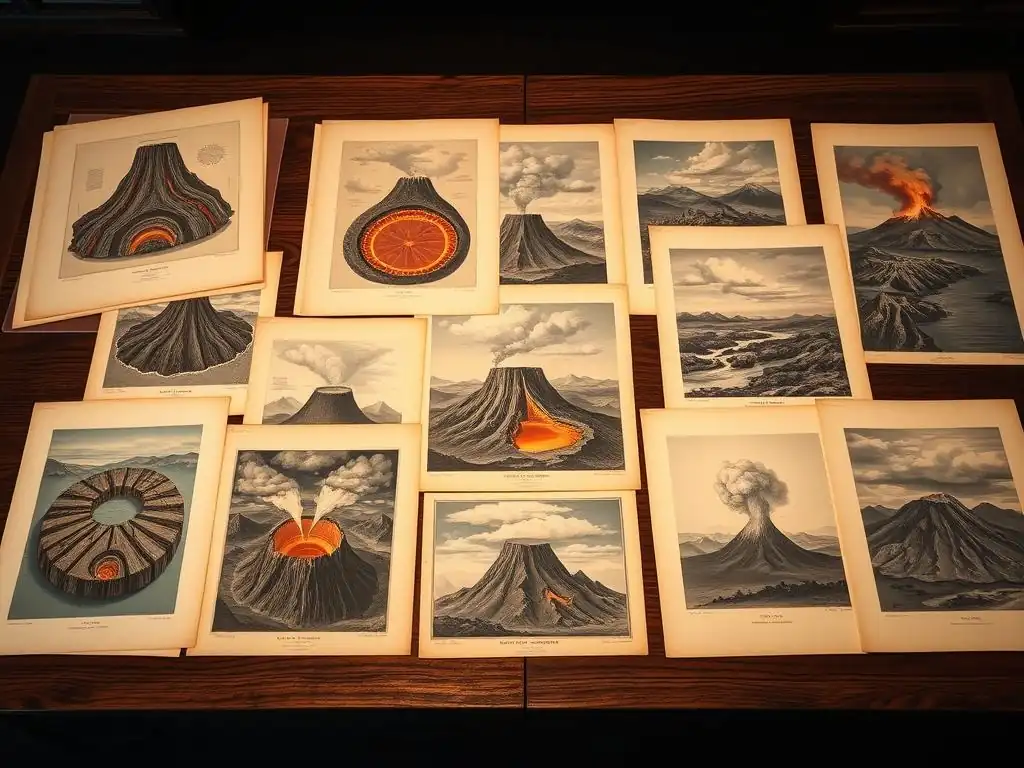
William Hamilton: Capturing the Power and Geology of Mount Vesuvius
Sir William Hamilton, a British diplomat and amateur volcanologist stationed in Naples during the late 18th and early 19th centuries, was a pivotal figure in the documentation of Mount Vesuvius and its eruptions. While technically predating the 19th century in his most active period, his influence extended well into it, and his publications set a precedent for the style and scientific approach of later 19th century volcano prints. Hamilton meticulously observed and documented numerous eruptions of Vesuvius, producing detailed accounts and commissioning artists to create illustrations of the volcanic activity and surrounding landscapes.
Hamilton's publications, such as "Campi Phlegraei" (1776) and "Supplement to the Campi Phlegraei" (1779), featured hand-colored engravings that were groundbreaking for their time. These illustrations not only captured the dramatic spectacle of Vesuvian eruptions but also attempted to depict the geological formations and volcanic products.
While not strictly cross-sections in the modern sense, Hamilton's prints often showed layered volcanic deposits and attempted to convey the structure of Vesuvius. His work popularized the study of volcanology in Europe and inspired a generation of scientists and artists to further explore and document volcanic phenomena, establishing a strong foundation for the 19th century tradition of volcano prints.
Geological Society of London: Disseminating Volcanic Knowledge Through Prints
The Geological Society of London, founded in 1807, played a crucial role in the advancement and dissemination of geological knowledge throughout the 19th century. Recognizing the power of visual communication, the Society actively utilized prints and illustrations in its publications, including its Transactions and Geological Maps. Volcanic regions, being areas of intense geological interest, were frequently depicted in these publications, often featuring geological cross-sections and detailed representations of volcanic landscapes.
The Geological Society's publications were highly influential in shaping the scientific understanding of volcanoes during the 19th century. They provided a platform for geologists to share their research findings, often accompanied by meticulously prepared illustrations and maps.
These prints, disseminated to members and subscribers across Europe and beyond, helped to standardize the visual language of volcanology and promote a more systematic approach to the study of volcanoes. The Society's commitment to visual accuracy and detail ensured that 19th century volcano prints produced under its auspices were not only aesthetically pleasing but also scientifically valuable, contributing significantly to the growth of volcanology as a rigorous scientific discipline.
The Art of Lithography and Engraving: Techniques Behind 19th Century Volcano Prints
The Craft of Stone: Lithographic Prints of Volcanoes
Lithography, invented in the late 18th century, became a dominant printmaking technique in the 19th century, and it was widely adopted for creating 19th century volcano prints. This method, based on the principle that oil and water repel each other, allowed for the reproduction of drawings made with greasy crayons or inks directly onto a porous limestone or metal plate.
The image area, rendered oleophilic, would attract油墨, while the non-image areas, treated to be hydrophilic, would repel it. This process enabled artists to create prints with a wide range of tonal values and a drawing-like quality, making it ideal for capturing the textures and details of volcanic landscapes and geological formations.
Lithographic 19th century volcano prints often exhibit a characteristic softness and subtlety of line, distinct from the sharper lines of engravings. The process allowed for relatively large editions to be produced, making these prints more accessible to a wider audience. Furthermore, lithography facilitated the use of color, often through hand-coloring or chromolithography, enhancing the visual impact and realism of volcano depictions. The efficiency and versatility of lithography contributed significantly to the proliferation of 19th century volcano prints, playing a key role in popularizing volcanic science and imagery.
Engraving the Eruption: Detailed Volcano Representations
Engraving, a more traditional printmaking technique, also played a significant role in the creation of 19th century volcano prints, particularly for works requiring fine detail and sharp lines. Engraving involves cutting lines directly into a metal plate, typically copper, using a tool called a burin. Ink is then applied to the plate and wiped away from the surface, remaining only in the incised lines.
When paper is pressed against the plate, the ink is transferred, creating a print. This process, while more laborious than lithography, yielded prints with exceptional clarity and precision, ideal for depicting the intricate geological details and dramatic intensity of volcanic eruptions.
Engraved 19th century volcano prints often showcase a high level of detail, allowing for the accurate representation of geological strata, volcanic textures, and the dynamic movement of lava and ash. The sharp, precise lines of engraving lent themselves well to cross-sectional diagrams and scientific illustrations, emphasizing clarity and accuracy. While perhaps less painterly than lithographs, engraved volcano prints possessed a distinct graphic power and scientific authority. Both engraving and lithography contributed to the rich visual landscape of 19th century volcano prints, each technique offering unique aesthetic and technical advantages for representing the science and spectacle of volcanoes.
Collecting and Preserving 19th Century Volcano Prints: A Guide for Enthusiasts
Identifying Authentic Prints: Recognizing Key Features and Marks
For enthusiasts looking to collect authentic 19th century volcano prints, several key features and marks can aid in identification. Paper type is a crucial indicator; 19th-century prints are typically on laid paper or wove paper, often exhibiting a distinct texture or watermark when held to the light. Printmaking techniques are also revealing. Lithographs will often show a subtle graininess and softer lines, while engravings will exhibit sharp, precise lines and sometimes a plate mark – an indentation around the image area left by the printing press.
Examining the print's subject matter, style, and accompanying text can also help determine its authenticity and origin. Look for details consistent with 19th-century scientific understanding and artistic conventions. Signatures of artists or engravers, publisher imprints, and dates (though dates are not always present) can provide valuable clues. Consulting reference books on printmaking techniques and 19th-century artists and publishers specializing in scientific illustrations can further assist in verifying the authenticity and provenance of 19th century volcano prints.
Caring for Your Collection: Best Practices for Preservation
Preserving 19th century volcano prints requires careful attention to environmental conditions and handling. Paper is a delicate material susceptible to damage from light, humidity, and acidity. Framing prints with UV-protective glass or acrylic is essential to prevent fading and paper degradation caused by light exposure. Maintaining a stable relative humidity between 40% and 50% and a moderate temperature is crucial to prevent mold growth and paper embrittlement.
Avoid storing prints in direct sunlight, damp basements, or hot attics. Use acid-free mats and backing boards when framing or storing prints to prevent acid migration from damaging materials. Handle prints with clean, dry hands or cotton gloves to avoid transferring oils and dirt. Store unframed prints flat in archival-quality folders or boxes, interleaved with acid-free tissue paper. Regularly inspect your collection for signs of damage, such as foxing (brown spots), tears, or pest infestations, and consult a professional paper conservator for any necessary repairs or conservation treatments to ensure the longevity of your 19th century volcano prints.
The Enduring Legacy of 19th Century Volcano Prints: A Bridge Between Art and Science
Inspiring Future Generations of Volcanologists and Artists
The legacy of 19th century volcano prints extends far beyond their historical context. These prints continue to inspire both volcanologists and artists today. For scientists, they offer a valuable historical record of how volcanic phenomena were observed, interpreted, and visualized in an era before modern technology. Studying these prints provides insights into the evolution of volcanological understanding and the development of visual communication in science. The meticulous detail and geological accuracy of many 19th century volcano prints still hold scientific merit and can be used to compare historical depictions with modern data and observations.
For artists, 19th century volcano prints serve as a rich source of inspiration in terms of subject matter, composition, and technique. The dramatic power of volcanic eruptions, the beauty of volcanic landscapes, and the blend of scientific observation with artistic expression continue to resonate with contemporary artists. The technical skill and artistry evident in these historical prints demonstrate the enduring power of visual representation to communicate complex ideas and evoke a sense of awe and wonder at the natural world, bridging the gap between scientific inquiry and artistic creativity for future generations.
Where to Find and Purchase Authentic 19th Century Volcano Prints
Authentic 19th century volcano prints can be found in various places, requiring a combination of online research and visits to specialized venues. Online auction sites and marketplaces specializing in antique prints and maps are a primary source. Search terms like "19th century volcano prints," "antique volcano engravings," or "vintage lithographs Vesuvius" can yield relevant results. However, it is crucial to carefully examine descriptions and images to assess authenticity and condition, and to purchase from reputable dealers.
Antique print shops and galleries, particularly those specializing in scientific prints or geological art, are another valuable resource. These establishments often have curated collections and knowledgeable staff who can assist in identifying and evaluating prints. Specialized book fairs and antique shows may also feature dealers offering 19th century volcano prints. Museums and libraries with print collections sometimes hold exhibitions or have prints available for viewing by appointment, providing opportunities to study these historical artifacts firsthand. Patience and diligent research are key to building a collection of authentic and historically significant 19th century volcano prints.
Further Reading: Exploring the World of Volcanic Art and Geology
For those wishing to delve deeper into the world of volcanic art and geology, several avenues for further reading exist. Books on the history of volcanology often feature 19th century volcano prints as illustrations and discuss their scientific context. Biographies of key figures like Sir William Hamilton provide insights into the early study of volcanoes and the role of visual documentation. Publications focusing on the history of printmaking techniques, particularly lithography and engraving, offer a deeper understanding of the artistic processes behind these prints.
Museum and library websites often have online collections and resources related to scientific illustration and historical prints. Academic journals specializing in the history of science, art history, and volcanology can provide scholarly articles and research on 19th century volcano prints and their cultural and scientific significance. Exploring online databases of historical prints and maps, such as those offered by major libraries and archives, can uncover a wealth of visual material and related information. Engaging with these resources will enrich your appreciation for the fascinating intersection of art, science, and history embodied in 19th century volcano prints.
Frequently Asked Questions
What makes 19th century volcano prints valuable from a scientific perspective?
These prints often showcase detailed geological cross-sections, offering valuable insights into volcano internal structures as understood at the time. They provide a historical record of geological interpretations.
Why were lithographs a popular medium for 19th century volcano prints?
Lithography allowed for the mass reproduction of detailed images. It was a more accessible and affordable technique for sharing scientific observations than earlier printing methods.
Do 19th century volcano prints accurately depict volcanic activity according to modern science?
While visually striking, some depictions may reflect the scientific understanding of the time, which differs from current models. They are historical artifacts.
Where can I find high-quality reproductions of 19th century volcano prints?
Many museums and libraries with geological collections offer digital reproductions. Online archives dedicated to historical prints also provide access.
How do 19th century volcano prints contribute to our understanding of volcanology today?
They offer a glimpse into the evolution of volcanological thought and provide a visual record of past eruptions. They show historical interpretations of volcanic processes.
Okay, here's a final reflection tailored for your article "The Science of Scoria and Steam: Geological Cross-Sections in 19th Century Volcano Prints," designed to resonate with readers and reinforce the importance of the topic, while also incorporating your specified structure and keyword focus:
Final Reflection: Unearthing Insights from Volcanic Visions
The enduring allure of 19th-century volcano prints lies not just in their aesthetic beauty, but in their remarkable blend of art and scientific observation. These prints serve as tangible links to a time when the world was being actively explored and understood through both artistic expression and rigorous geological inquiry. They remind us that scientific understanding and artistic representation can be powerful allies in shaping our perception of the natural world.
The impact of these prints extends beyond their historical significance; they continue to influence our understanding of volcanology and the history of science. Personally, I find the dedication and meticulous detail captured in these prints deeply inspiring, a testament to the human desire to comprehend the forces that shape our planet. > As John Ruskin eloquently stated, "The greatest thing a human soul ever does in this world is to see something, and tell what it saw in a plain way." These prints embody that spirit, offering a clear and compelling vision of the Earth's fiery heart.
Now, as you reflect on the intricate details and scientific insights revealed in these 19th-century volcano prints, consider how they challenge you to look beyond the surface. Let these images inspire you to appreciate the power of observation, the beauty of scientific inquiry, and the enduring legacy of those who sought to understand the dynamic forces that shape our world. Seek out the hidden stories within the landscapes around you, and embrace the spirit of exploration that fueled the creation of these remarkable works of art and science.
Unearth Your Inner Geologist!
Thanks for exploring the fascinating science behind 19th-century volcano prints! You've gained a deeper appreciation for the artistic and geological insights these cross-sections offer. Let's put that knowledge to work and further ignite your volcanic curiosity.
- Begin your own geological sketch of a local geological feature (even a road cut will work!) Don't worry about perfection; focus on observation and representation.
- Explore our online gallery at volcanoexplorers.org to find more prints and compare artistic representations of different volcanic formations.
- Share your newfound appreciation by discussing your favorite aspect of 19th-century volcanic prints with a friend or fellow enthusiast.
What details in historical volcanic prints now grab your attention that you hadn't noticed before? Share your observations in the comments below!