
The Art of Volcanic Illustration: From Da Vinci's Sketches to 19th Century Lithographs

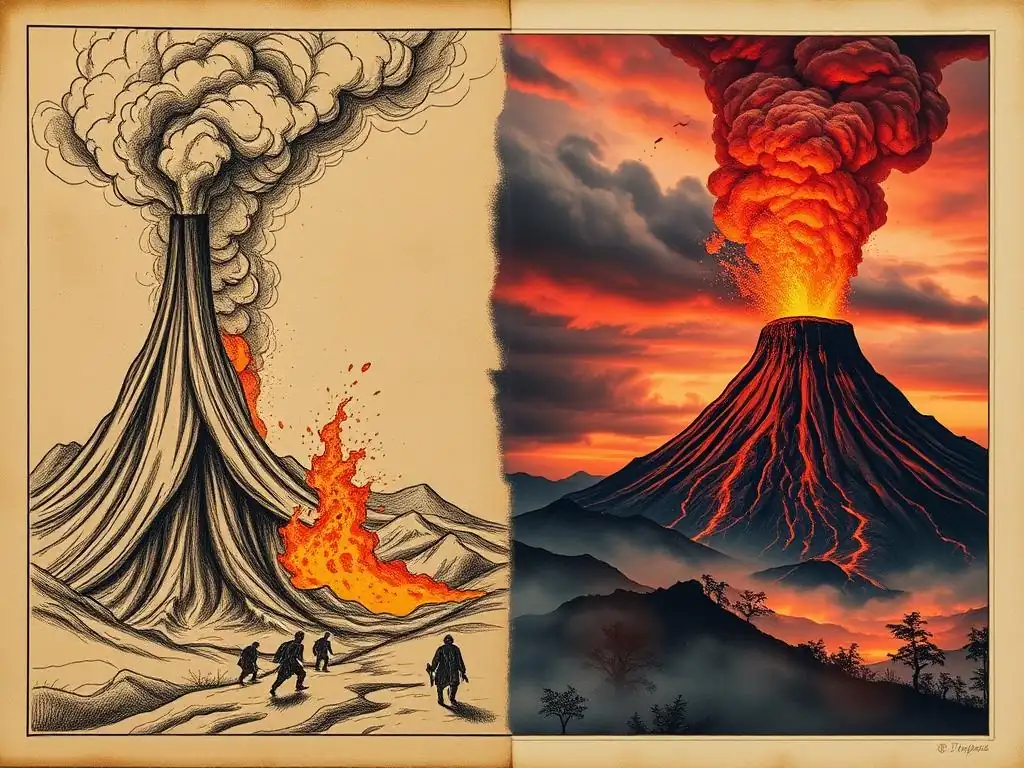
Welcome to Volcano Explorers, where the Earth breathes fire! Ever wondered how artists captured the raw power and sublime beauty of volcanoes before the age of photography? Prepare to be amazed as we uncover the fascinating history of volcanic illustration techniques, from the pioneering sketches of Leonardo da Vinci to the stunning lithographs of the 19th century. Join us on a visual journey that reveals how artists braved danger and pushed the boundaries of their craft to document these fiery giants. What secrets do these historic depictions hold? Let's find out!
- Early Volcanic Depictions: Da Vinci and the Dawn of Scientific Illustration
- 18th Century: An Era of Exploration and Volcanic Documentation
- The Golden Age of Volcanic Illustration: 19th Century Lithographs and Beyond
- Volcanic Illustration Techniques: A Detailed Look
- Preserving the Legacy: Caring for Vintage Volcanic Prints
- The Enduring Power of Volcanic Illustration: Inspiring Wonder and Understanding
-
Frequently Asked Questions
- What is the article "The Art of Volcanic Illustration: From Da Vinci's Sketches to 19th Century Lithographs" about?
- Why is the history of volcanic illustration important?
- What techniques were commonly used in early volcanic illustrations?
- How did Leonardo da Vinci contribute to the field of volcanic illustration?
- What role did 19th-century lithographs play in popularizing volcanoes?
- Final Reflection: The Enduring Power of Volcanic Illustration
- Unearth Your Inner Volcanic Artist!
Early Volcanic Depictions: Da Vinci and the Dawn of Scientific Illustration
Leonardo Da Vinci's Volcanic Sketches: A Renaissance Perspective on Earth's Power
Leonardo Da Vinci, the quintessential Renaissance polymath, was not only an artist and inventor but also a keen observer of the natural world. While primarily known for his anatomical drawings and engineering marvels, Da Vinci's notebooks reveal a fascination with geological phenomena, including volcanoes. Although he never witnessed an eruption firsthand in the dramatic style of later artists, his sketches and notes demonstrate an understanding of geological processes that was remarkable for his time.
His depictions, though not explicitly labeled as volcanoes in the modern sense, often feature mountainous landscapes with fissures and smoke emanating from peaks, suggesting an awareness of volcanic activity as a powerful force shaping the Earth. These early sketches, scattered throughout his codices, offer a glimpse into the nascent stages of scientific volcanic illustration, driven by curiosity and a desire to understand the planet's inner workings.
Da Vinci’s approach to volcanic illustration was deeply rooted in his scientific method of observation and detailed recording. He emphasized direct study from nature, urging artists to "learn how to see." This principle is evident in his geological drawings, where he meticulously rendered rock formations, strata, and the effects of erosion.
While lacking the detailed geological cross-sections that would become common in later centuries, Da Vinci's sketches can be seen as precursors to these more technical illustrations. They represent an early attempt to visually document and interpret geological processes, laying a foundation for future generations of artists and scientists who sought to capture the dynamic and often violent beauty of volcanoes. His focus was less on romanticizing eruptions and more on understanding the underlying natural processes, a truly Renaissance perspective on Earth's power.
The Influence of Early Scientific Observation on Volcanic Illustration Techniques
The Renaissance emphasis on empirical observation and scientific inquiry profoundly influenced the development of volcanic illustration techniques. Before the 16th century, depictions of volcanoes were largely symbolic or mythological, often integrated into religious or allegorical artwork. However, as scientific thinking gained prominence, there was a shift towards more realistic and accurate representations. Early scientific observers, often natural philosophers and physicians, began to document volcanic phenomena with increasing precision. Travel accounts and geographical treatises started including sketches and descriptions of volcanic landscapes, moving away from purely fantastical portrayals.
This era saw the emergence of techniques focused on conveying factual information alongside aesthetic appeal. Artists started to employ methods that could effectively communicate the scale and structure of volcanoes. Linear perspective, a technique mastered during the Renaissance, became crucial for rendering depth and spatial relationships in volcanic landscapes.
Hatching and cross-hatching, used extensively in engravings and woodcuts, allowed for the depiction of textures and shading, essential for representing the rugged terrain of volcanic mountains and the dramatic contrast between light and shadow during eruptions. These early techniques, although rudimentary compared to later advancements, marked a crucial step in the evolution of volcanic illustration, moving it from the realm of myth and legend towards a more scientifically grounded approach.
18th Century: An Era of Exploration and Volcanic Documentation
The Grand Tour and the Rise of Volcanic Tourism: A Catalyst for Illustration
The 18th century witnessed a surge in European travel, particularly the "Grand Tour," a traditional trip undertaken by young men of the upper classes for educational and cultural enrichment. Italy, with its active Mount Vesuvius and other volcanic regions, became a prominent destination on this circuit. The allure of witnessing a live volcano, considered both awe-inspiring and scientifically fascinating, drew a growing number of tourists, including artists and naturalists eager to document these natural spectacles. This burgeoning volcanic tourism created a demand for visual representations of volcanic landscapes and eruptions, fueling the development of volcanic illustration.
The Grand Tour era fostered a market for souvenirs and visual records of these exotic experiences. Prints, watercolors, and drawings of volcanoes became highly sought-after mementos, allowing travelers to relive their encounters with these powerful natural forces and share them with others. Artists accompanying wealthy travelers or independently visiting volcanic regions found a ready audience for their work.
This increased demand acted as a significant catalyst, encouraging artistic experimentation and refinement in volcanic illustration techniques. The rise of volcanic tourism not only popularized the subject but also provided crucial economic incentives for artists to specialize in and improve their depictions of volcanoes, moving beyond simple sketches to more elaborate and detailed compositions.
Early Volcanic Illustration Styles: From Romanticism to Scientific Accuracy
The 18th century saw a fascinating interplay between Romanticism and scientific accuracy in early volcanic illustration styles. Initially, many depictions leaned towards the Romantic aesthetic, emphasizing the sublime and awe-inspiring aspects of volcanic eruptions. Artists sought to capture the dramatic power and terrifying beauty of nature, often employing exaggerated scales and fiery color palettes to evoke strong emotional responses in viewers. These romanticized portrayals resonated with the prevailing artistic sensibilities of the time, which valued emotional impact and the expression of grand, untamed nature.
However, alongside this Romantic trend, there was a growing demand for more scientifically accurate volcanic illustrations. As geological understanding advanced, particularly with the rise of volcanology as a distinct field, the need for precise visual documentation became increasingly important. This led to the development of styles that prioritized detail, topographical accuracy, and the clear representation of geological features.
Artists began to incorporate cross-sections, detailed renderings of lava flows, and careful observations of eruption plumes. This shift towards scientific accuracy did not entirely eclipse Romanticism, but rather co-existed and often intertwined with it, resulting in a diverse range of volcanic illustration styles that reflected both the emotional and intellectual engagement with these natural phenomena during the 18th century.
William Hamilton: Capturing the Essence of Mount Vesuvius in the 1700s
Sir William Hamilton, the British Ambassador to the Kingdom of Naples during the latter half of the 18th century, played a pivotal role in popularizing and documenting Mount Vesuvius. Living in close proximity to the volcano, Hamilton witnessed numerous eruptions and became deeply fascinated by its activity. He was not just a passive observer; Hamilton actively studied Vesuvius, collecting lava specimens, recording eruption details, and, crucially for volcanic illustration history, commissioning artists to document the volcanic phenomena he witnessed. His patronage and personal interest significantly contributed to the artistic record of Vesuvius during this period.
Hamilton’s influence is evident in the numerous illustrations of Vesuvius produced under his guidance and often included in his publications. He employed artists like Pietro Fabris, whose detailed and often dramatic watercolors captured the various phases of Vesuvian eruptions. These illustrations were not merely aesthetic representations; they served as valuable scientific records, depicting eruption plumes, lava flows, and the changing landscape around the volcano.
Hamilton's publications, such as "Campi Phlegraei," which featured numerous hand-colored engravings based on Fabris's artwork, became highly influential in disseminating knowledge about Vesuvius and establishing a visual standard for volcanic illustration that balanced artistic appeal with scientific observation. His dedication to documenting Vesuvius ensured that the volcano became one of the most visually represented natural phenomena of the 18th century, shaping the future direction of volcanic illustration techniques.
The Golden Age of Volcanic Illustration: 19th Century Lithographs and Beyond
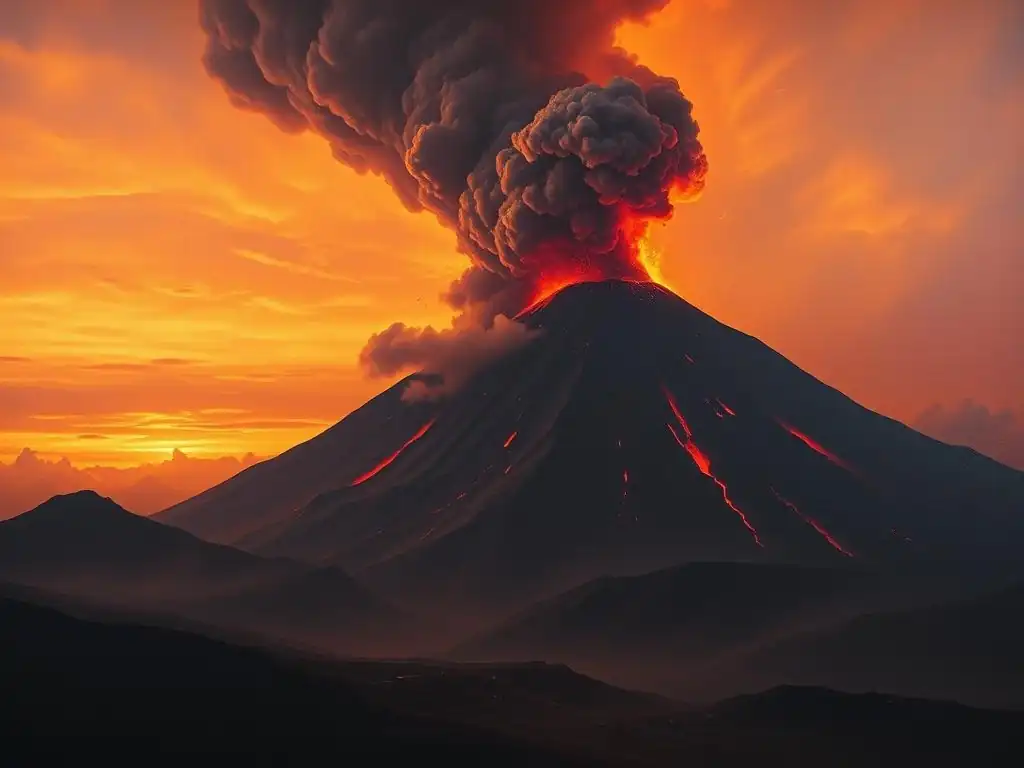
Lithography and the Mass Production of Volcanic Images: Democratizing Access to Volcanic Art
The 19th century marked the golden age of volcanic illustration, largely due to the advent of lithography. Invented in the late 18th century, lithography became widely adopted in the 1800s. This printing technique, which utilizes a flat stone or metal plate, revolutionized image reproduction. Unlike earlier methods like engraving, lithography allowed artists to draw directly onto the printing surface with greasy crayons or inks, resulting in images with greater tonal range and a more painterly quality. More importantly, lithography was significantly more efficient and cost-effective for mass production than previous printing techniques.
The accessibility and affordability of lithographic printing democratized access to volcanic images. Suddenly, detailed and visually stunning depictions of volcanoes, previously limited to expensive engravings or hand-painted works, could be reproduced in large quantities and distributed widely. Books, journals, and even individual prints featuring volcanic illustrations became more readily available to a broader public.
This wider dissemination of volcanic imagery fueled public interest in volcanoes, contributing to both scientific understanding and popular fascination with these geological wonders. Lithography transformed volcanic illustration from a niche art form into a more mainstream visual medium, significantly expanding its reach and influence during the 19th century.
Key Figures in 19th Century Volcanic Illustration: Giorgio Sommer and Friedrich Simony
The 19th century boasted a number of talented artists who significantly contributed to the field of volcanic illustration, two notable figures being Giorgio Sommer and Friedrich Simony. Giorgio Sommer, a German photographer and artist based in Naples, became renowned for his photographic and hand-colored prints of Mount Vesuvius.
Working during a period of intense Vesuvian activity, Sommer captured dramatic scenes of eruptions, lava flows, and the volcano's imposing presence. His works, often produced as albumen prints and then meticulously hand-colored, combined the realism of photography with the artistic enhancement of color, creating visually striking and scientifically informative depictions of Vesuvius.
Friedrich Simony, an Austrian topographer and artist, focused on the volcanic landscapes of Iceland. In the mid-1180s, Simony undertook extensive expeditions to Iceland, meticulously documenting the island's unique volcanic terrain through detailed drawings and watercolors. His work emphasized topographical accuracy and geological detail, capturing the stark beauty and ruggedness of Icelandic volcanic landscapes.
Simony's illustrations, often published in travelogues and scientific publications, provided invaluable visual records of Iceland's volcanic regions, contributing significantly to the geographical and geological understanding of these remote and often inaccessible areas. Both Sommer and Simony, through their distinct approaches and geographical focuses, exemplify the high standards and diverse styles that characterized 19th-century volcanic illustration.
The Enduring Appeal of Hand-Colored Volcanic Lithographs: A Collector's Perspective
Hand-colored volcanic lithographs from the 19th century hold a particular appeal for collectors and enthusiasts today. These prints represent a unique intersection of art, science, and history. The lithographic process itself allowed for detailed and nuanced imagery, capturing the textures of volcanic rock, the dynamism of eruptions, and the atmospheric effects of volcanic plumes. The subsequent hand-coloring, often executed with watercolors or gouache, added another layer of artistry and vibrancy to these prints. While mass-produced, each hand-colored lithograph possesses slight variations, making them unique and sought-after artifacts.
From a collector's perspective, these prints offer a tangible connection to a specific era of scientific exploration and artistic expression. They represent a time when the wonders of the natural world, particularly volcanoes, were being actively investigated and visually documented using emerging technologies. The subject matter itself – volcanoes – holds inherent drama and fascination. The combination of historical significance, artistic merit, and captivating subject matter contributes to the enduring appeal of hand-colored volcanic lithographs, making them prized pieces for collectors interested in art, science history, and the powerful beauty of volcanic landscapes.
Volcanic Illustration Techniques: A Detailed Look
Capturing Eruptions: Depicting Explosive Power and Lava Flows
Depicting volcanic eruptions effectively in illustration requires mastering techniques that convey both explosive power and the fluid nature of lava flows. To capture the sheer force of an eruption, artists often employ dynamic compositions with upward-sweeping lines and dramatic contrasts between light and shadow. Explosion plumes are frequently rendered with swirling, energetic strokes, suggesting the rapid expansion of gases and ash.
The use of vibrant, fiery colors like reds, oranges, and yellows is crucial for conveying the intense heat and energy associated with volcanic explosions. Artists might also use techniques like impasto in painting or thick crayon strokes in lithography to create texture and volume, further emphasizing the three-dimensional and forceful nature of the eruption.
Illustrating lava flows requires a different but equally important set of techniques. The key is to convey the molten, fluid nature of lava while also suggesting its immense heat and destructive power. Artists often use flowing, curvilinear lines to depict the movement of lava, varying the line weight to indicate depth and volume.
Color gradients, transitioning from bright yellows and oranges at the center of the flow to darker reds and browns at the cooling edges, effectively represent the temperature variations within the lava. Texture is also important; rendering the rough, solidified crust of older lava flows alongside the smooth, molten surface of active flows adds realism and depth to the illustration. Techniques like hatching and stippling can be used to create these textural differences, further enhancing the visual impact of the lava flow depiction.
Illustrating Volcanic Landscapes: Showcasing Topography and Geological Features
Illustrating volcanic landscapes effectively hinges on accurately showcasing topography and key geological features. To convey the three-dimensional nature of volcanic terrain, artists rely heavily on techniques like perspective and shading. Employing aerial perspective, where distant features are rendered with less detail and lighter tones, creates a sense of depth and vastness. Accurate topographical rendering is essential, often requiring artists to study geological maps or conduct on-site observations to understand the shapes and relationships of volcanic cones, craters, calderas, and lava fields. Cross-sections, while not always aesthetically driven, are invaluable for scientifically accurate depictions of volcanic structure and subsurface features.
Representing geological features requires careful attention to detail and an understanding of volcanic processes. Illustrators need to accurately depict different types of volcanic rock formations, such as basalt columns, lava tubes, and ash layers. Textural variations are crucial; smooth, glassy obsidian should be rendered differently from rough, porous pumice or jagged, solidified lava flows.
Color palettes should reflect the geological composition of the landscape, ranging from the dark grays and blacks of basalt to the reddish-brown hues of oxidized volcanic ash. By meticulously rendering these topographical and geological details, artists can create volcanic landscape illustrations that are not only visually compelling but also informative and scientifically accurate representations of these dynamic environments.
The Use of Color in Volcanic Illustration: From Earth Tones to Fiery Hues
Color plays a vital role in volcanic illustration, ranging from earthy tones that depict the geological landscape to fiery hues that capture the drama of eruptions. Earth tones – browns, grays, ochres, and muted greens – are essential for representing the base volcanic landscape. These colors effectively convey the mineral composition of volcanic rocks, the textures of ash deposits, and the often sparse vegetation found in volcanic regions.
Variations in these earth tones, from light beiges to dark charcoal grays, can be used to differentiate between different rock types and geological formations, adding depth and realism to the landscape depiction. Subtle washes and blending techniques can further enhance the naturalistic appearance of these earth-toned areas.
In contrast, fiery hues – vibrant reds, oranges, yellows, and even intense whites – are indispensable for illustrating volcanic eruptions and molten lava. These colors convey the extreme heat, energy, and dramatic spectacle of volcanic activity. Bold, saturated colors are often used to depict eruption plumes, lava fountains, and flowing lava streams, immediately drawing the viewer's eye to the focal point of volcanic action.
The juxtaposition of these fiery hues against the cooler earth tones of the surrounding landscape creates a powerful visual contrast, enhancing the dramatic impact of the illustration. Skillful use of color gradients and blending techniques can further amplify the sense of heat and luminosity emanating from volcanic eruptions and lava flows, making them appear both visually stunning and scientifically plausible.
Preserving the Legacy: Caring for Vintage Volcanic Prints
Identifying Authentic Volcanic Lithographs: A Guide for Collectors
Identifying authentic vintage volcanic lithographs requires a combination of careful observation and knowledge of historical printing techniques. Firstly, examine the paper. 19th-century lithographs were typically printed on handmade or early machine-made paper, which often has a different texture and feel compared to modern paper. Look for signs of age, such as slight yellowing or foxing (brown spots).
Watermarks, if present, can also provide clues to the paper's origin and age, though their absence doesn't necessarily indicate inauthenticity. Carefully inspect the printing technique. Lithographs, unlike engravings or etchings, have a very fine, almost grainless texture under magnification. Look for the characteristic greasy crayon or ink appearance of lithographic lines rather than the incised lines of intaglio prints.
Another key aspect is to research the artist and publisher. Authentic vintage lithographs often bear the names of the artist, lithographer, and publisher within the print itself. Cross-referencing these names with historical records, auction catalogs, and print databases can help verify the print's authenticity and provenance. Pay attention to the subject matter and style.
Volcanic lithographs should depict volcanoes and related geological features in a style consistent with 19th-century artistic conventions. Unusual or anachronistic subject matter or artistic styles might raise red flags. Finally, consider consulting with experts. If you are uncertain about the authenticity of a volcanic lithograph, seeking advice from reputable print dealers, appraisers, or museum curators specializing in historical prints can provide valuable insights and expert opinions.
Conservation and Preservation Techniques: Protecting Your Volcanic Art Collection
Proper conservation and preservation techniques are crucial for protecting your vintage volcanic art collection and ensuring its longevity. Framing is a primary concern. Always use archival-quality, acid-free mats and backboards to prevent chemical damage to the print. UV-protective glazing, such as museum glass or acrylic, is essential to shield the print from harmful ultraviolet radiation, which can cause fading and paper degradation.
Avoid direct sunlight and excessive humidity when displaying or storing volcanic lithographs. Fluctuations in temperature and humidity can cause paper to expand and contract, leading to cracking and other forms of damage. Ideally, store prints in a cool, dry, and stable environment.
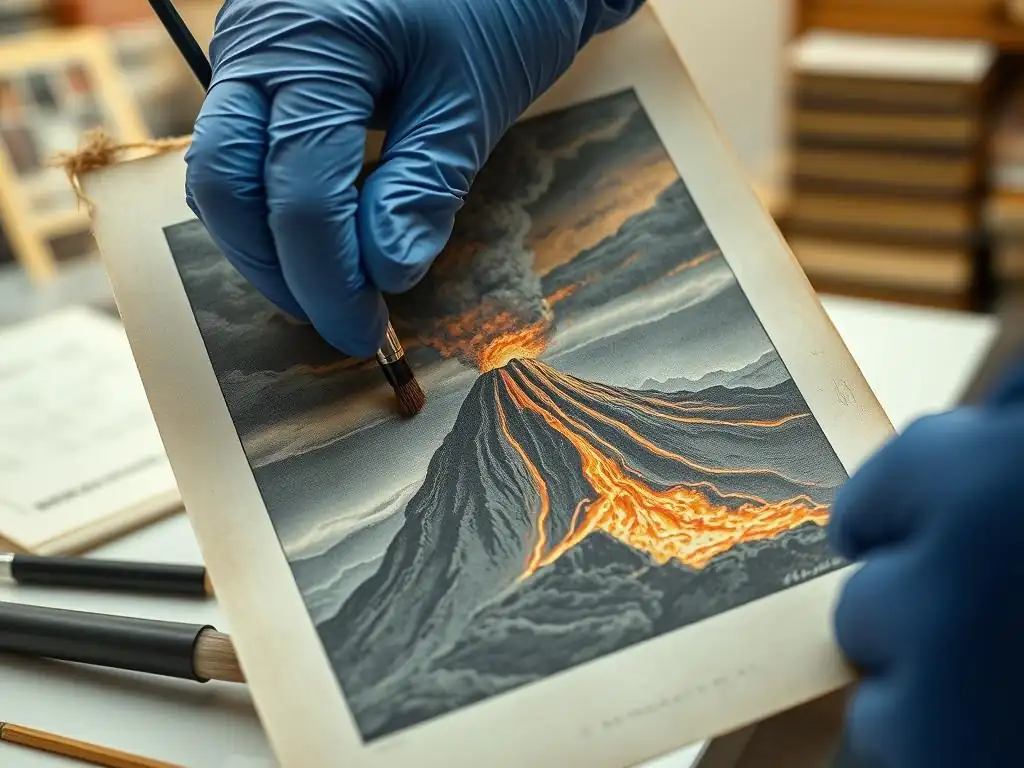
Handling vintage prints with care is paramount. Always wash and dry your hands thoroughly before handling prints, or wear cotton gloves to prevent transferring oils and dirt. Support prints fully when moving or examining them, and avoid bending or folding them. For long-term storage, consider using archival-quality sleeves or folders made of acid-free paper or inert plastic. Store prints flat whenever possible, as rolling can cause creases and distortions.
Regularly inspect your volcanic art collection for signs of damage, such as tears, foxing, or pest infestations. If you notice any damage, consult with a professional paper conservator for appropriate treatment. Attempting to repair damaged prints yourself can often cause further harm. Professional conservation can help stabilize and restore vintage volcanic prints, ensuring their preservation for future generations.
The Enduring Power of Volcanic Illustration: Inspiring Wonder and Understanding
Frequently Asked Questions
What is the article "The Art of Volcanic Illustration: From Da Vinci's Sketches to 19th Century Lithographs" about?
The article explores the history of volcanic illustrations, focusing on techniques used from Leonardo da Vinci's sketches to the lithographs of the 19th century. It examines how artists depicted volcanic activity and landscapes over time.
Why is the history of volcanic illustration important?
Understanding the history of volcanic illustration provides insight into how scientific knowledge and artistic interpretations of volcanoes evolved. It highlights the techniques used to visually communicate complex geological phenomena.
What techniques were commonly used in early volcanic illustrations?
Early volcanic illustrations often employed techniques like hand-drawn sketches, engravings, and woodcuts. Later, lithography allowed for more detailed and accurate depictions of volcanic landscapes and eruptions.
How did Leonardo da Vinci contribute to the field of volcanic illustration?
While not solely focused on volcanoes, Leonardo da Vinci's sketches demonstrated an acute understanding of natural processes, including geological formations. His observational skills influenced the development of scientific illustration and, indirectly, volcanic illustration.
What role did 19th-century lithographs play in popularizing volcanoes?
19th-century lithographs allowed for the mass production and distribution of volcanic images, making them accessible to a wider audience. This helped to raise awareness and fascination with volcanoes, contributing to their cultural significance.
Final Reflection: The Enduring Power of Volcanic Illustration
The journey through the history of volcanic illustration, from Da Vinci's initial sketches to the detailed lithographs of the 19th century, reveals more than just artistic evolution; it underscores the unwavering human desire to understand and document the raw power of nature. These illustrations, born from a blend of scientific curiosity and artistic skill, continue to resonate today, reminding us of the earth's dynamic forces and our place within its grand narrative.
This exploration of volcanic illustration not only highlights the techniques used but also reveals how these images have shaped our perception of volcanoes. The meticulous detail captured in these historical artworks fostered both awe and a healthy respect for these geological giants, influencing scientific understanding and inspiring countless artists and writers. The greatest tragedy is not that men are poor, but that they use the forces which could make them rich so badly.
- Henry George. This quote, while not directly about volcanoes, speaks to the human potential for both creation and destruction, a duality perfectly embodied by these fiery mountains and their artistic representations.
As we close this chapter on volcanic illustration, let us not simply admire the beauty and skill of these past masters. Instead, consider how their dedication to observation and documentation can inspire us to engage more deeply with the world around us. What natural wonders stir your curiosity? How can you use your own skills, be they artistic, scientific, or otherwise, to capture and share the essence of these wonders with others? The legacy of volcanic illustration is a call to action, urging us to become active participants in understanding and appreciating the powerful forces that shape our planet.
Unearth Your Inner Volcanic Artist!
Thanks for exploring the fascinating history of volcanic illustration! You've now seen how artists throughout history have captured the raw power and beauty of volcanoes. Ready to create your own volcanic masterpiece?
Here are a few ways to continue your artistic journey:
- Grab your pencils and sketch your favorite volcano! Don't worry about perfection – focus on capturing its unique form and power.
- Explore your local library or online archives for historical illustrations of volcanoes in your region. You might be surprised by the artistic interpretations you discover!
- Share your volcanic sketches or favorite historical illustrations with the Volcano Explorers community on social media using #VolcanoArt. Let's inspire each other!
What's the most inspiring volcanic image you've ever seen, and what made it so captivating?