
What Makes Basalt Columns So Perfectly Hexagonal? The Scientific Enigma


Welcome to Volcano Explorers, where we unravel the Earth's fiery secrets! Ever been mesmerized by the seemingly impossible geometry of basalt columns? Prepare to have your mind blown as we delve into the scientific enigma behind their perfectly hexagonal forms. This isn't just about pretty rocks; it's about the fundamental forces shaping our planet. Discover the fascinating process of Basalt columns formation and unlock the geological wonders hidden beneath your feet. Are you ready to explore?
- Introduction: The Allure of Hexagonal Basalt Columns
- Understanding Basalt Rock Composition and Formation
- The Science Behind Basalt Columns Formation Process
- Factors Influencing Basalt Column Shape and Size
- Notable Examples of Basalt Column Formations Around the World
- The Enigmatic Imperfections: When Basalt Columns Deviate from Hexagonal Perfection
- Studying Basalt Columns: Research Methods and Ongoing Discoveries
- Preserving Basalt Column Formations: Conservation Efforts and Responsible Tourism
- Conclusion: The Enduring Fascination with Basalt Columns and Their Formation
-
Frequently Asked Questions
- What is the main process behind the formation of basalt columns?
- Why are basalt columns often found in hexagonal shapes?
- Does the cooling rate of lava affect the size or shape of basalt columns?
- Are basalt columns only found near volcanoes?
- Can all types of lava form basalt columns, or is it specific to basalt?
- Final Reflection: The Enduring Beauty of Natural Geometry
- Unravel the Mystery: Explore More Volcanic Wonders
Introduction: The Allure of Hexagonal Basalt Columns
- [Introduce basalt columns as a natural phenomenon resulting from volcanic activity, known for their striking geometric shapes, primarily hexagons.]
Basalt columns stand as nature's testament to the fascinating interplay of physics and geology. These towering structures, often found in regions marked by past volcanic activity, captivate observers with their remarkably geometric forms. Predominantly hexagonal, these columns are not the work of human hands but rather the product of natural cooling processes within basalt lava flows.
From the Giant's Causeway in Northern Ireland to Devils Postpile in California, these formations showcase the inherent order that can emerge from seemingly chaotic volcanic events. Their near-perfect polygonal shapes invite curiosity and scientific inquiry, prompting us to explore the underlying mechanisms of their creation.
The allure of basalt columns lies not only in their visual appeal but also in the scientific puzzle they present. Why hexagons? This question has intrigued geologists and physicists for centuries. The seemingly deliberate precision of these natural structures contrasts sharply with the often-perceived randomness of geological processes. Exploring the basalt columns formation process is therefore an exploration into the fundamental principles that govern material behavior under thermal stress, revealing how simple physical laws can give rise to complex and beautiful patterns in the natural world.
Understanding Basalt Rock Composition and Formation
The Composition of Basalt Lava Flows
- [Explain that basalt lava is primarily composed of plagioclase feldspar and pyroxene minerals, with smaller amounts of olivine and iron oxides. The silica content is typically between 45-55%.]
Basalt, the rock from which these impressive columns are formed, originates as magma deep within the Earth's mantle. When this molten rock erupts onto the surface as lava, it possesses a characteristic chemical composition that is crucial to the basalt columns formation process. Primarily, basaltic lava is composed of silicate minerals, with plagioclase feldspar and pyroxene taking center stage.
Plagioclase feldspar in basalt is typically labradorite or bytownite, rich in calcium and sodium. Pyroxenes are usually augite or pigeonite, magnesium and iron-rich minerals. These minerals, along with lesser amounts of olivine, another magnesium and iron silicate, and iron oxides like magnetite and ilmenite, give basalt its dark color and dense nature.
The silica content in basalt lava typically ranges between 45% and 55% by weight. This relatively low silica content is a key factor differentiating basalt from other volcanic rocks like rhyolite or andesite. The lower silica level contributes to basalt's lower viscosity, meaning it flows more readily than more silica-rich lavas. This fluidity allows basalt lava to spread out in extensive flows, cool more uniformly, and ultimately, facilitate the formation of the characteristic columnar jointing. The specific mineral assemblage and silica content are thus fundamental in understanding the initial conditions that lead to the spectacular geometry of basalt columns.
From Molten Rock to Solid Basalt: The Cooling Process
- [Describe the cooling process of basalt lava, emphasizing the importance of relatively slow and uniform cooling for columnar jointing to occur. Rapid cooling can lead to fracturing and prevent column formation.]
The transformation from fiery, molten lava to solid basalt rock is a gradual process driven by heat dissipation. For basalt columns formation process to occur effectively, a relatively slow and uniform cooling rate is paramount. When a thick basalt lava flow is emplaced, the heat escapes primarily from the top surface exposed to the air and the bottom surface in contact with the ground.
This creates a temperature gradient within the flow, with the surfaces cooling faster than the interior. However, if the overall cooling is sufficiently slow and consistent across the horizontal plane of the flow, it allows for the development of tensile stresses in a relatively uniform manner, which is crucial for the orderly cracking that leads to columns.
Conversely, rapid cooling disrupts the organized stress patterns necessary for columnar jointing. If lava cools too quickly, perhaps due to contact with water or very cold air, it tends to fracture irregularly and form shattered masses rather than well-defined columns.
Think of throwing hot glass into cold water – it shatters into numerous fragments because the rapid temperature change induces stresses too quickly and unevenly for organized cracking. Therefore, the ideal scenario for basalt columns formation process is a lava flow that is thick enough to retain heat and cools at a rate that allows for the gradual and uniform buildup of tensile stress, eventually leading to the formation of those iconic polygonal columns.
How Basalt Rock Differs From Other Volcanic Rocks
- [Explain that basalt is mafic (rich in magnesium and iron), whereas rhyolite is felsic (rich in feldspar and silica). Basalt's lower viscosity allows for more uniform cooling compared to rhyolite, which tends to cool unevenly and form obsidian or pumice.]
Basalt is categorized as a mafic volcanic rock, a term derived from "magnesium" and "ferric" (iron), highlighting its rich composition in these elements. This mafic nature contrasts sharply with felsic volcanic rocks like rhyolite, which are rich in feldspar and silica. Rhyolite, with its high silica content, is significantly more viscous than basalt. Imagine honey versus water; rhyolitic lava is like honey, thick and sticky, while basaltic lava is more like water, flowing easily. This fundamental difference in viscosity profoundly affects the cooling and solidification behavior, and thus, the basalt columns formation process.
The lower viscosity of basalt lava facilitates a more uniform cooling process throughout the lava flow. Because it flows readily, basalt can spread out into thin, extensive sheets, allowing heat to dissipate more evenly. In contrast, rhyolitic lava's high viscosity causes it to pile up into thick, dome-like structures.
The uneven heat distribution within these thicker, less fluid rhyolitic flows often leads to rapid and irregular cooling, preventing the formation of columnar joints. Instead of columns, rapidly cooled rhyolite can solidify into volcanic glass known as obsidian, or, if gas is trapped within during cooling, it can form porous pumice. Therefore, the mafic composition and resulting low viscosity of basalt are critical factors that predispose it to the unique basalt columns formation process, a phenomenon rarely observed in felsic volcanic rocks.
The Science Behind Basalt Columns Formation Process
Thermal Stress and Contraction: The Key to Columnar Jointing
- [Explain that as basalt lava cools, it contracts, creating tensile stress within the rock. When the stress exceeds the rock's tensile strength, cracks initiate.]
The driving force behind the mesmerizing geometry of basalt columns is thermal stress, arising from the contraction of the cooling lava. As molten basalt transitions from a liquid to a solid state, it undergoes a decrease in volume, much like water turning into ice.
This contraction is a direct consequence of the reduction in thermal energy and the closer packing of atoms as the temperature drops. However, because different parts of the lava flow cool at slightly different rates, and the solidified outer layers resist the contraction of the still-cooling interior, tensile stresses—stresses that pull apart—build up within the rock mass.
Imagine stretching a rubber band; tensile stress is the force trying to pull it apart. In the case of cooling basalt, this tensile stress is distributed throughout the rock. Basalt, like any rock, has a certain tensile strength, which is the maximum tensile stress it can withstand before fracturing. When the thermally induced tensile stress within the cooling basalt exceeds its tensile strength, cracks begin to initiate. These cracks are the precursors to the beautiful columnar joints we observe, and their formation is the direct result of the basalt columns formation process driven by thermal contraction and stress.
The Formation of Cracks: Nucleation Points and Propagation
- [Describe how cracks form at evenly spaced nucleation points on the cooling surface and propagate downwards as the lava continues to cool and contract.]
The initiation of cracks in cooling basalt is not random; they tend to form at evenly spaced nucleation points on the cooling surface. These nucleation points can be thought of as weak spots or areas of slightly higher stress concentration on the surface of the lava flow. Once the tensile stress reaches the rock's tensile strength at these points, small cracks begin to develop. The spacing between these initial cracks is determined by the properties of the cooling basalt, such as its thermal conductivity and tensile strength, and the rate of cooling.
As the lava continues to cool and contract, these initial cracks do not just stay on the surface; they propagate downwards into the body of the lava flow. This downward propagation is driven by the ongoing thermal contraction and the release of stress at the crack tip.
The cracks tend to grow in a direction perpendicular to the cooling surface, which is usually vertical for a horizontal lava flow. This downward and inward propagation of cracks, originating from evenly spaced nucleation points, is a crucial step in the basalt columns formation process, setting the stage for the development of the characteristic polygonal patterns we observe in basalt columns.
Why Hexagons? The Physics of Crack Formation
- [Explain that hexagonal patterns are the most energy-efficient way to relieve stress in a cooling material because they minimize surface area for a given volume, and thus minimize the energy required for crack propagation.]
The prevalence of hexagonal shapes in basalt columns is not a geological coincidence; it's a manifestation of fundamental physics principles, specifically the principle of energy minimization. When a material like cooling basalt contracts and cracks due to tensile stress, the cracks will naturally propagate in a way that minimizes the total energy of the system. This energy includes the strain energy stored in the stressed rock and the surface energy associated with the newly formed crack surfaces.
Hexagonal patterns are the most efficient way to relieve stress in a two-dimensional plane because they minimize the surface area for a given area. Imagine tiling a floor; hexagons fit together perfectly without gaps, and for a given area, a hexagonal tiling uses the least amount of perimeter (or "crack length" in our basalt analogy) compared to other regular polygons like squares or triangles.
Minimizing the crack surface area minimizes the energy required to create these cracks. Therefore, in the basalt columns formation process, as cracks propagate downwards, they naturally tend to intersect and organize themselves into a hexagonal pattern because this configuration is the most energy-efficient way to relieve the tensile stress and minimize the total crack surface energy within the cooling basalt flow.
While perfect hexagons are ideal, variations do occur, leading to columns with five, seven, or even more sides, still reflecting the underlying principle of efficient stress relief.
Basalt Columns Formation Process: The Role of Cooling Rate
- [Discuss that a slower cooling rate generally leads to larger and more well-defined columns, while a faster cooling rate can result in smaller, less regular columns.]
The rate at which basalt lava cools plays a significant role in determining the size and regularity of the resulting columns. A slower cooling rate generally fosters the development of larger and more well-defined basalt columns. When cooling is slow, the tensile stresses build up gradually and uniformly over a larger area.
This allows cracks to propagate further and more consistently before new cracks initiate. The result is the formation of fewer, but larger, crack centers, leading to wider and taller columns with more distinct polygonal shapes. Iconic formations like the Giant's Causeway are thought to have formed from lava flows that cooled relatively slowly, allowing for the development of their impressive, large-diameter columns.
Conversely, a faster cooling rate tends to produce smaller and less regular basalt columns. Rapid cooling causes tensile stresses to develop quickly and potentially unevenly. This can lead to the formation of numerous crack nucleation points in closer proximity, resulting in a higher density of cracks that are shorter and less well-organized.
The resulting columns are often narrower, shorter, and may exhibit less perfect polygonal shapes. In essence, the basalt columns formation process is highly sensitive to the cooling rate; slower cooling allows for a more ordered and large-scale development of columnar joints, while faster cooling leads to smaller and less geometrically perfect structures.
Factors Influencing Basalt Column Shape and Size
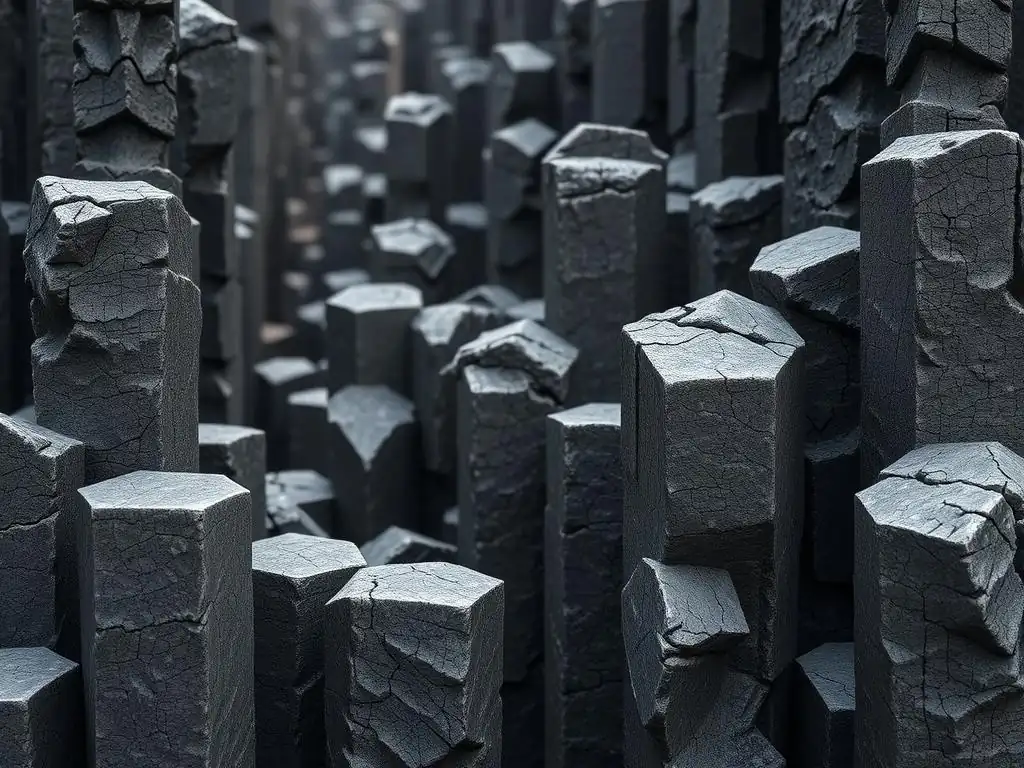
The Impact of Lava Flow Thickness on Column Dimensions
- [Explain that thicker lava flows tend to produce larger diameter columns because the slower cooling allows for more extensive crack propagation.]
The thickness of a basalt lava flow is a primary factor influencing the dimensions of the basalt columns it forms. Thicker lava flows generally result in columns with larger diameters. This relationship stems from the fact that thicker flows cool more slowly than thinner flows.
As discussed earlier, slower cooling is conducive to the formation of larger and more well-defined columns. In a thick lava flow, the interior is insulated by the surrounding rock, slowing down the rate at which heat can escape. This prolonged cooling period allows tensile stresses to build up and be relieved over a larger area before solidification is complete.
The extended period of stress accumulation in thicker flows enables cracks to propagate more extensively both horizontally and vertically. Cracks can grow wider apart before new cracks are initiated, leading to larger column diameters.
Furthermore, the slower cooling in thicker flows often promotes more uniform crack propagation, resulting in columns that are not only wider but also longer and more regular in shape. Therefore, when observing basalt column formations, the sheer size and diameter of the columns can often be a visual indicator of the original thickness of the lava flow from which they formed, highlighting the direct impact of lava flow thickness on the basalt columns formation process.
Influence of Impurities and Inclusions on Column Structure
- [Describe how impurities or inclusions can act as stress concentrators, disrupting the regular crack patterns and leading to irregularities in column shape and size.]
While basalt is generally homogeneous, the presence of impurities or inclusions within the lava flow can significantly influence the basalt columns formation process, leading to irregularities in column shape and size. Impurities can be minerals that crystallized early in the cooling process, or xenoliths—fragments of pre-existing rock incorporated into the lava. Inclusions are foreign materials trapped within the lava. These features act as stress concentrators, meaning they can alter the distribution of tensile stress within the cooling basalt.
Areas around impurities or inclusions may experience higher or more unevenly distributed stress compared to the surrounding homogenous basalt. This disruption in the stress field can interfere with the regular crack propagation patterns that typically lead to hexagonal columns. Cracks may be diverted, terminated prematurely, or new cracks may initiate in unexpected locations due to the stress concentration.
As a result, the presence of impurities and inclusions can lead to columns that are less perfectly polygonal, exhibit variations in diameter along their length, or even display branching or curved joint patterns. The degree of irregularity depends on the size, distribution, and properties of the impurities or inclusions, demonstrating how even minor heterogeneities in the lava can impact the final geometry of basalt columns.
Environmental Conditions and Their Effects on Basalt Column Formation
- [Discuss that exposure to air or water during cooling can affect the cooling rate and uniformity, leading to variations in column size and shape. Water contact, in particular, can cause more rapid cooling and smaller, less regular columns.]
The environmental conditions surrounding a basalt lava flow during its cooling phase exert a considerable influence on the basalt columns formation process, particularly affecting the cooling rate and uniformity. Exposure to air or water, the two most common cooling environments for lava flows, can lead to significant variations in column size and shape. Air cooling is generally slower and more uniform compared to water cooling. Lava flows cooling in air typically develop larger and more regular columns because the heat dissipation is gradual and consistent from the exposed surfaces.
In contrast, if a lava flow comes into contact with water, either from rainfall, rivers, or the sea, the cooling rate dramatically increases. Water is a much more efficient heat conductor than air, leading to rapid heat extraction from the lava. This rapid cooling, especially if uneven across the flow, can result in smaller, less regular, and often more curved or distorted columns.
In extreme cases of rapid water quenching, such as lava flows entering the sea, the cooling can be so fast and uneven that it inhibits the formation of well-defined columns altogether, leading to pillow basalts or fragmented volcanic glass. Therefore, the environment in which basalt lava cools, particularly the presence and nature of cooling media like air or water, is a crucial factor determining the final morphology of basalt column formations.
Notable Examples of Basalt Column Formations Around the World
Giant's Causeway, Northern Ireland: A UNESCO World Heritage Site
- [Describe the Giant's Causeway as an area of approximately 40,000 interlocking basalt columns, the result of an ancient volcanic eruption. Many of the columns are hexagonal, though there are also some with four, five, seven, or eight sides.]
The Giant's Causeway, located on the coast of Northern Ireland, is perhaps the most iconic and globally recognized example of basalt column formation. This UNESCO World Heritage Site is comprised of approximately 40,000 interlocking basalt columns, a breathtaking testament to the power and artistry of volcanic processes. These columns are the result of a Paleocene epoch volcanic eruption, around 50 to 60 million years years ago, where molten basalt lava flowed into the sea and subsequently cooled and solidified. The vast majority of the columns are hexagonal, showcasing the efficiency of this shape in the basalt columns formation process.
However, the Giant's Causeway isn't solely composed of hexagons. A closer examination reveals columns with a variety of sides, including four, five, seven, and even eight. While hexagons are statistically dominant due to their energy efficiency, the presence of these variations highlights that the basalt columns formation process is not perfectly uniform in nature and can be influenced by slight local variations in cooling rates or stress distribution. The sheer scale and geometric perfection of the Giant's Causeway continue to inspire awe and scientific curiosity, drawing visitors and researchers from around the world to marvel at this natural wonder.
Devils Postpile National Monument, California, USA
- [Highlight the unique features of Devils Postpile, where the columns are exceptionally symmetrical and display a distinctive glacial polish on their upper surfaces.]
Devils Postpile National Monument in California offers another spectacular example of basalt column formation, distinct from the Giant's Causeway in several key aspects. The columns at Devils Postpile are renowned for their exceptional symmetry and regularity. They are notably more uniform in size and shape compared to those at the Giant's Causeway, exhibiting a remarkable consistency in their hexagonal cross-sections. This uniformity suggests a highly consistent and controlled basalt columns formation process at this location, potentially due to a very stable and slow cooling environment within a thick lava flow.
A unique feature of Devils Postpile is the distinctive glacial polish on the upper surfaces of the columns. During past ice ages, glaciers flowed over the solidified basalt columns, effectively grinding and polishing the tops to a smooth, almost artificial-looking surface. This glacial polish provides a striking contrast with the rough, fractured sides of the columns, further accentuating their geometric forms. The combination of exceptionally symmetrical columns and the glacial polish makes Devils Postpile a particularly visually stunning and geologically significant site for studying and appreciating the basalt columns formation process.
Fingal's Cave, Scotland: A Symphony in Stone
- [Showcase Fingal's Cave, a sea cave formed entirely from hexagonal basalt columns, known for its natural acoustics and inspiring musical compositions like Mendelssohn's "The Hebrides" overture.]
Fingal's Cave, located on the uninhabited island of Staffa in Scotland, presents a truly unique and acoustically remarkable example of basalt column formation. This sea cave is formed entirely within hexagonal basalt columns, creating a natural architectural wonder. The cave's entrance is a high, arched opening into a cavernous interior lined with perfectly formed hexagonal columns. The rhythmic patterns of the columns, combined with the echoing sounds of the sea within the cave, create an almost cathedral-like atmosphere.
Fingal's Cave is famed not only for its visual beauty but also for its exceptional natural acoustics. The regular geometry of the hexagonal columns and the cave's dimensions create unique reverberation and resonance effects. These acoustic properties have inspired artists and musicians for centuries.
Perhaps most famously, Felix Mendelssohn visited Fingal's Cave in 1829 and was so captivated by its atmosphere that it inspired him to compose his overture "The Hebrides," also known as "Fingal's Cave Overture." Fingal's Cave beautifully illustrates how the basalt columns formation process can create not only geological wonders but also spaces of profound natural beauty and inspiration.
Other Significant Basalt Column Formations Globally
- [Mention other notable examples, such as Svartifoss in Iceland, noted for its dark basalt columns contrasting with the white water, and the Columbia River Basalt Group in the US, a vast flood basalt province with extensive columnar jointing.]
Beyond these iconic examples, basalt column formations are found in numerous locations around the globe, each with its own unique characteristics. Svartifoss waterfall in Iceland offers a dramatic visual contrast, where dark, almost black basalt columns provide a striking backdrop to the cascading white glacial meltwater. The columns here are slightly less regular than at the Giant's Causeway or Devils Postpile, but their dark color and setting within a waterfall gorge make them exceptionally picturesque.
The Columbia River Basalt Group in the northwestern United States represents a vast flood basalt province, covering an area of approximately 163,700 square kilometers. This massive basalt deposit exhibits extensive columnar jointing across many of its flows, showcasing the basalt columns formation process on a truly continental scale. Other notable locations include Organ Pipes National Park in Australia, with its organ pipe-like columns, and the basalt columns of Garni Gorge in Armenia. These diverse examples underscore the global distribution of basalt column formations and the varied expressions of this fascinating geological phenomenon across different landscapes and geological settings.
The Enigmatic Imperfections: When Basalt Columns Deviate from Hexagonal Perfection
Variations in Column Shape: Pentagons, Heptagons, and Beyond
- [Discuss that variations from perfect hexagons occur due to slight variations in cooling rates or stress distribution during the formation process. These variations represent adjustments to optimize stress relief.]
While hexagons are overwhelmingly dominant in basalt column formations, deviations from perfect hexagonal shapes are common and scientifically significant. Columns with pentagonal, heptagonal, and even octagonal cross-sections are frequently observed alongside hexagonal columns. These variations are not imperfections but rather natural adjustments within the basalt columns formation process to optimize stress relief under slightly varying conditions. Perfect hexagonal packing is the most energy-efficient in a perfectly uniform stress field, but real-world cooling and stress distributions are rarely perfectly uniform.
Slight local variations in cooling rates, minor heterogeneities in the basalt composition, or subtle changes in the direction of heat flow can all lead to deviations from the ideal hexagonal pattern. When these variations occur, the crack network adapts to maintain the most efficient stress relief possible under the given circumstances.
For example, if a crack encounters a slight obstacle or a region of slightly different cooling rate, it might branch or curve, resulting in a column with a different number of sides. These variations, therefore, are not flaws but rather evidence of the dynamic and adaptive nature of the basalt columns formation process, demonstrating how natural systems respond to and optimize under slightly non-ideal conditions.
Imperfect Jointing: Fractures and Irregularities in Basalt Columns
- [Explain that fractures and irregularities can arise from non-uniform cooling, pre-existing weaknesses in the rock, or later tectonic activity.]
Beyond variations in the number of sides, basalt columns often exhibit other forms of "imperfections" in their jointing patterns, such as fractures and irregularities along the column length. These deviations from perfect columnar structures can arise from several factors, including non-uniform cooling, pre-existing weaknesses within the basalt flow, or later tectonic activity that affects the solidified rock.
Non-uniform cooling, even on a small scale, can lead to variations in stress distribution and crack propagation. If some areas cool faster than others, it can result in uneven crack growth and the formation of curved or stepped joint surfaces rather than perfectly planar ones.
Pre-existing weaknesses in the basalt, such as minor fractures or variations in mineral composition, can also influence the basalt columns formation process. Cracks may preferentially propagate along these weaknesses, leading to irregular joint patterns.
Furthermore, after the columns have formed and solidified, tectonic activity, such as earthquakes or faulting, can introduce new fractures or displace existing joints, further contributing to irregularities in the column structure. These "imperfections" are important geological clues, providing insights into the complex cooling history and post-formation modifications of basalt column formations, reminding us that nature's artistry is often imbued with subtle complexities and deviations from perfect ideals.
Studying Basalt Columns: Research Methods and Ongoing Discoveries

Geological Surveys and Mapping of Basalt Formations
- [Describe the methods used to study and map basalt column formations, including field observations, drone imagery, and GPS mapping to document the extent and characteristics of the formations.]
Understanding basalt column formations requires a multi-faceted approach, starting with thorough geological surveys and mapping. Field observations remain a cornerstone of basalt column research. Geologists meticulously examine basalt outcrops, recording the dimensions, shapes, and orientations of columns, as well as the overall geological context of the formation. Detailed field notes, photographs, and sketches are essential for documenting the characteristics of the basalt columns formation process in various locations.
Modern technology has significantly enhanced geological mapping capabilities. Drone imagery provides a bird's-eye view of basalt column formations, allowing for large-scale mapping and analysis of joint patterns that would be difficult or impossible from ground level alone.
High-resolution aerial photographs and 3D models generated from drone surveys enable geologists to study the spatial extent of columnar jointing, identify variations in column morphology across the formation, and analyze the relationship between column patterns and surrounding geological features. GPS mapping is used to accurately locate and georeference field observations and drone imagery, creating precise maps of basalt column formations that are crucial for further research and conservation efforts.
Analyzing Basalt Samples: Composition and Cooling History
- [Explain how analyzing basalt samples through techniques like X-ray diffraction and geochemical analysis helps determine the mineral composition and reconstruct the cooling history of the lava flow.]
Analyzing basalt samples in the laboratory is crucial for deciphering the composition and cooling history of basalt column formations. X-ray diffraction (XRD) is a powerful technique used to identify the mineralogical composition of basalt samples. XRD analysis reveals the types and proportions of minerals present, such as plagioclase feldspar, pyroxene, olivine, and iron oxides, providing fundamental data about the lava's original chemistry. This mineralogical information is essential for understanding the physical properties of the basalt and how they influenced the basalt columns formation process.
Geochemical analysis, including techniques like inductively coupled plasma mass spectrometry (ICP-MS), provides detailed information about the elemental composition of basalt. Analyzing the concentrations of major and trace elements helps geologists to determine the magma source, magmatic evolution processes, and the cooling conditions of the lava flow.
Furthermore, radiometric dating techniques, such as argon-argon dating, can be used to determine the age of the basalt formation, providing a chronological framework for understanding the volcanic events that led to the basalt columns formation process. By combining mineralogical, geochemical, and geochronological data, researchers can reconstruct a comprehensive picture of the origin and evolution of basalt column formations.
Modeling Basalt Column Formation: Simulations and Experiments
- [Discuss the use of computer simulations based on finite element analysis and laboratory experiments using materials that mimic basalt to model the thermal stress and crack propagation during column formation.]
To further understand the complex physics of the basalt columns formation process, scientists employ computer simulations and laboratory experiments. Computer simulations, often based on finite element analysis (FEA), are used to model the thermal stress and crack propagation in cooling basalt. FEA allows researchers to simulate the temperature distribution within a lava flow, calculate the resulting tensile stresses, and model the initiation and growth of cracks. By varying parameters such as cooling rate, lava flow thickness, and material properties, simulations can test different hypotheses about the factors controlling column formation and predict the resulting column geometries.
Laboratory experiments complement computer simulations by providing physical analogs of the basalt columns formation process. Researchers use materials that mimic the thermal and mechanical properties of basalt, such as starch solutions or wax mixtures, to conduct controlled cooling experiments. These experiments allow for the direct observation of crack initiation and propagation in a simplified and controlled setting.
By varying cooling conditions and material properties in laboratory experiments, scientists can gain valuable insights into the fundamental mechanisms driving columnar jointing and validate the results of computer simulations. The combination of numerical modeling and physical experiments provides a powerful approach to unraveling the scientific enigma of basalt column formation.
Preserving Basalt Column Formations: Conservation Efforts and Responsible Tourism
Protecting Basalt Column Sites: UNESCO and National Park Designations
- [Highlight the importance of preserving basalt column formations through UNESCO World Heritage Site designations and national park status, which provide legal protection against development and destructive activities.]
Basalt column formations are not only scientifically fascinating but also represent unique and irreplaceable natural heritage. Preserving these geological wonders is crucial for future generations, and formal designations like UNESCO World Heritage Sites and national park status play a vital role in their protection. UNESCO World Heritage Site designation recognizes sites of outstanding universal value, providing international recognition and often attracting resources for conservation. The Giant's Causeway, for example, benefits from UNESCO status, which helps ensure its long-term protection from development and destructive activities.
National park or national monument status, as in the case of Devils Postpile National Monument, provides legal protection within a country's borders. These designations typically restrict development, mining, quarrying, and other activities that could damage or destroy basalt column formations. Furthermore, national park status often includes provisions for visitor management, education, and scientific research, promoting both conservation and public appreciation of these geological treasures. Securing these protective designations is a critical step in safeguarding basalt column sites and ensuring the continued study and enjoyment of the basalt columns formation process for years to come.
Responsible Tourism and Minimizing Environmental Impact
- [Promote responsible tourism practices such as staying on designated trails, avoiding the removal of rocks, and supporting local conservation efforts to minimize the impact on these delicate geological wonders.]
While tourism can bring economic benefits and raise awareness about basalt column formations, it's essential to practice responsible tourism to minimize environmental impact and ensure the long-term preservation of these delicate geological wonders. Visitors to basalt column sites should adhere to responsible tourism practices, such as staying on designated trails and walkways. Wandering off trails can damage fragile vegetation, accelerate erosion, and disturb the natural environment surrounding the columns.
It is crucial to avoid removing or damaging rocks, including basalt columns themselves. Even seemingly small actions, like taking a "souvenir" rock, can cumulatively degrade the site over time. Supporting local conservation efforts is another important aspect of responsible tourism.
This can include donating to park conservation funds, participating in volunteer cleanup activities, or patronizing local businesses that are committed to sustainable practices. By practicing responsible tourism, visitors can enjoy the beauty and scientific intrigue of basalt column formations while contributing to their long-term protection and minimizing their environmental footprint, ensuring these sites remain pristine examples of the basalt columns formation process for future visitors.
Conclusion: The Enduring Fascination with Basalt Columns and Their Formation
- [Summarize the key aspects of basalt column formation process and their enduring appeal.]
Basalt columns, with their striking hexagonal geometry, stand as a testament to the elegant order that can emerge from natural processes. The basalt columns formation process, driven by the physics of thermal stress and contraction in cooling lava, reveals a fascinating interplay between material properties, cooling rates, and environmental conditions.
From the mineral composition of basalt lava to the propagation of cracks in a cooling flow, each step in the formation process contributes to the final shape and size of these natural wonders. Notable examples around the world, like the Giant's Causeway, Devils Postpile, and Fingal's Cave, showcase the diverse and breathtaking expressions of columnar jointing.
Despite their seemingly perfect geometry, the imperfections and variations observed in basalt columns provide valuable insights into the complexities of the basalt columns formation process. These deviations from ideal hexagons, along with fractures and irregularities, reflect the dynamic and adaptive nature of geological systems.
Ongoing research, utilizing geological surveys, laboratory analyses, and computer modeling, continues to deepen our understanding of these formations. Preserving these sites through conservation efforts and responsible tourism is crucial to ensure that the enduring fascination with basalt columns and their formation process continues to inspire and educate future generations, allowing us to marvel at these scientific enigmas etched in stone.
Frequently Asked Questions
What is the main process behind the formation of basalt columns?
The formation involves cooling and contraction of basalt lava flows. As the lava cools, it shrinks, creating tension cracks that propagate through the rock. These cracks typically form a hexagonal pattern due to the most efficient way to relieve the stress.
Why are basalt columns often found in hexagonal shapes?
Hexagons are the most stable and efficient geometric shape for distributing stress during cooling. The hexagonal shape minimizes the overall surface energy and allows for the most uniform contraction, reducing the risk of fracturing in other ways.
Does the cooling rate of lava affect the size or shape of basalt columns?
Yes, the cooling rate plays a significant role. Slower cooling tends to produce larger, more well-defined columns. Faster cooling can result in smaller, less organized columns or even amorphous structures.
Are basalt columns only found near volcanoes?
While often associated with volcanic activity, basalt columns can also form in other geological settings where basaltic lava flows occur, such as large igneous provinces. The key ingredient is the presence of basalt lava that cools and contracts.
Can all types of lava form basalt columns, or is it specific to basalt?
The phenomenon is primarily associated with basaltic lava due to its specific composition and viscosity. Other types of lava may crack upon cooling, but they rarely form the distinct, regular columnar jointing characteristic of basalt columns.
Final Reflection: The Enduring Beauty of Natural Geometry
The exploration of basalt column formation, as we've seen, is far more than just a geological curiosity; it's a testament to the underlying mathematical elegance of the natural world. From the Giant's Causeway to Devil's Postpile, these hexagonal structures continue to captivate and inspire, reminding us that even seemingly random processes can give rise to breathtaking order.
The enduring fascination with basalt columns speaks to our innate desire to understand the patterns that govern our universe. This quest for understanding, this drive to decipher the secrets held within the Earth's crust, is what truly connects us to the landscape. Look deep into nature, and then you will understand everything better.
- Albert Einstein. This quote encapsulates the ongoing journey of scientific discovery, where each answer only leads to more profound questions and a deeper appreciation for the intricate beauty of the natural world.
Now, consider the lessons learned from the basalt columns' formation process. How can the principles of cooling, contraction, and stress relief be applied to your own life? Embrace the idea that even under pressure, order and beauty can emerge. Let the perfect hexagons of basalt columns inspire you to find equilibrium amidst chaos, to seek out the underlying patterns that shape your own experiences, and to appreciate the inherent beauty in the processes of change and transformation.
Unravel the Mystery: Explore More Volcanic Wonders
Thanks for exploring the fascinating world of basalt columns with Volcano Explorers! We hope you enjoyed uncovering the secrets behind their incredible hexagonal shapes. Ready to delve deeper?
Here are a few ways to continue your exploration:
- Embark on a virtual expedition! Research different basalt column formations around the globe, comparing their shapes, sizes, and geological settings. Share your findings on our community forum!
- Share the wonder: Inspire friends and fellow enthusiasts by sharing this article and letting them marvel at the beauty and scientific enigma of basalt columns.
- Delve deeper: Explore the science behind the formation of these structures, considering the roles of thermal stress and material properties. Discover other natural wonders formed by similar processes.
Ready to plan a real-world trip to witness this beauty firsthand?