
Basalt Columns: Nature's Skyscrapers or Geological Curiosities? You Decide

Welcome to Volcano Explorers!
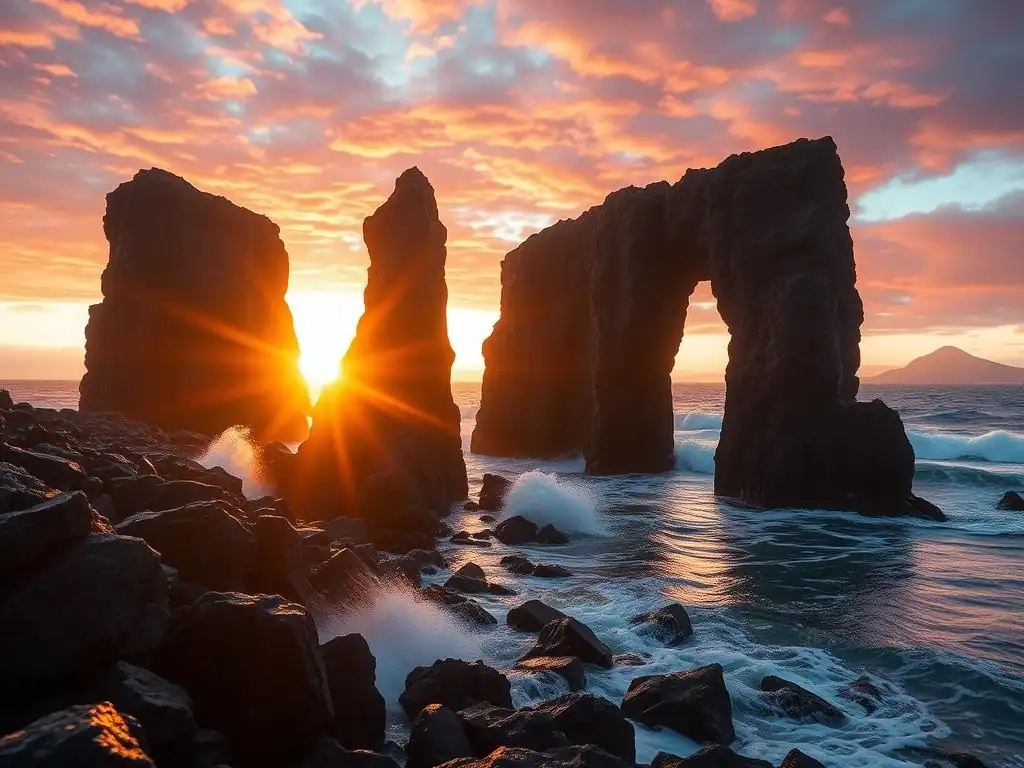
Ever wondered how nature sculpts its own skyscrapers? Prepare to be mesmerized as we delve into the fascinating world of Basalt Columns Formation and Significance. Uncover the secrets behind these geological marvels and decide for yourself: are they simply curiosities, or nature's grandest architectural achievements? Journey with us, and let the story of molten rock and cooling forces unfold...
- Introduction to Basalt Columns: Marvels of Volcanic Geology
- The Geological Genesis of Basalt Columns
- Where Can You Find Basalt Columns? Global Locations and Volcanic Hotspots
- The Significance of Basalt Columns: Beyond Aesthetics
- Basalt Columns: Nature's Skyscrapers? Architectural Inspiration and Cultural Impact
- Basalt Columns: Geological Curiosities? Unique Features and Unusual Formations
- Comparing Basalt Columns to Other Volcanic Rock Formations
- Preserving Basalt Columns: Conservation Efforts and Geological Heritage
- Conclusion: Appreciating the Majesty of Basalt Column Formations
- Frequently Asked Questions
- Final Reflection: Echoes of Ancient Fire
- Unearth Your Inner Geologist!
Introduction to Basalt Columns: Marvels of Volcanic Geology
Unveiling the Beauty and Mystery of Basalt Column Formations
Basalt columns are among the most striking and geometrically perfect natural formations on Earth. These remarkable structures, resembling colossal stacks of polygonal pillars, are found in various volcanic landscapes worldwide, captivating scientists and sightseers alike. Their precise shapes and imposing scale evoke a sense of wonder, prompting questions about their origins and the geological processes that sculpted them. From the Giant's Causeway in Northern Ireland to the Devil's Postpile in California, these formations stand as testaments to the powerful forces of nature and the intricate beauty that can arise from volcanic activity.
The allure of basalt columns lies not only in their visual appeal but also in the scientific intrigue they represent. For geologists, these formations are invaluable clues to understanding the cooling and contraction processes of lava flows. Each column tells a story of molten rock solidifying over time, revealing details about the temperature gradients, cooling rates, and the physical properties of basalt itself. Studying basalt columns provides insights into the broader context of volcanic landscapes and the planet's dynamic geological history.
VolcanoExplorers.org: Your Guide to Volcanic Landscapes
VolcanoExplorers.org serves as your premier online destination for uncovering the secrets and wonders of volcanic phenomena, and basalt columns are a prime example of the geological marvels we explore. Our website is dedicated to providing comprehensive information about all aspects of volcanology, from the fundamental science of magma generation to the breathtaking landscapes shaped by eruptions. We aim to educate and inspire, offering detailed explanations, engaging narratives, and stunning visuals that bring the world of volcanoes to life.
Whether you are a seasoned geologist, a curious student, or simply an admirer of natural beauty, VolcanoExplorers.org offers a wealth of resources to deepen your understanding and appreciation of volcanic landscapes. Through articles, guides, and explorations of specific volcanic regions, we invite you to join us in discovering the dynamic and often dramatic world of volcanoes, including the captivating formations of basalt columns that stand as both geological curiosities and nature's own skyscrapers.
The Geological Genesis of Basalt Columns
Understanding Basalt Rock Formation: From Lava Flow to Columnar Jointing
Basalt columns are born from basalt, a fine-grained, dark-colored volcanic rock that is the most common type of lava on Earth. Basalt originates from the rapid cooling of mafic lava, which is relatively low in silica content and therefore less viscous than other types of lava. When basaltic lava erupts, it flows across the landscape, often covering vast areas before it begins to cool and solidify. The process of cooling is crucial in the formation of basalt columns, as it leads to a phenomenon known as columnar jointing.
Columnar jointing is a geological term describing the natural fracturing of rock into columns. This process is primarily driven by thermal stress as the lava cools and contracts. Imagine a thick layer of molten basalt gradually losing heat to the surrounding environment. As the temperature decreases, the lava shrinks in volume. Because the cooling process typically starts from the surface and progresses inwards, differential cooling occurs, leading to tensile stresses within the solidifying rock. These stresses eventually overcome the rock's tensile strength, causing it to fracture.
The Role of Cooling and Contraction in Basalt Column Development
The distinctive hexagonal shape of most basalt columns is a direct consequence of the uniform contraction forces acting within the cooling lava flow. As the lava cools and contracts, it does so approximately equally in all horizontal directions. This even contraction pattern naturally leads to the formation of centers of contraction that are equidistant from each other. The most efficient way to fill a plane with equidistant points is to arrange them in a hexagonal grid. Consequently, the fractures that develop to relieve the tensile stress tend to propagate in a hexagonal pattern, creating the familiar polygonal columns.
The rate of cooling also plays a significant role in the size and regularity of basalt columns. Slower cooling generally results in larger, more well-defined columns, while faster cooling may lead to smaller and less regular formations. For instance, thick lava flows that cool slowly from both the top and bottom surfaces tend to develop prominent, large-diameter columns.
Conversely, thinner flows or flows that cool rapidly might exhibit less distinct columnar jointing or even irregular fracturing. The specific cooling environment, including factors like the initial lava temperature, the surrounding rock temperature, and the presence of water, all contribute to the final characteristics of basalt columns.
The Physics of Polygonal Fractures in Cooling Lava
The formation of polygonal fractures in cooling lava is governed by fundamental principles of physics, specifically related to stress, strain, and fracture mechanics. As basalt lava solidifies, it undergoes volumetric contraction due to the decrease in temperature. This contraction generates tensile stress within the solidifying rock mass. When the tensile stress exceeds the rock's tensile strength, fractures initiate. The key to the polygonal pattern lies in the way these fractures propagate and interact.
Studies have shown that the most energy-efficient way for a material under uniform tension to fracture is in a hexagonal pattern. This is because a hexagonal fracture network minimizes the total surface energy associated with the fractures, while effectively relieving the stress. Think of it like bubbles forming on the surface of a liquid; they tend to arrange themselves in a hexagonal pattern to minimize surface tension.
Similarly, in cooling lava, the hexagonal arrangement of fractures is a natural consequence of the system seeking the lowest energy state. Mathematical models and physical experiments, including laboratory simulations of lava cooling, further support the role of uniform contraction and stress relief in the formation of hexagonal basalt columns.
Where Can You Find Basalt Columns? Global Locations and Volcanic Hotspots
Famous Basalt Column Sites Around the World
Basalt columns are not confined to a single region; they are a global phenomenon, found in diverse volcanic landscapes across the continents. Perhaps the most iconic example is the Giant's Causeway in Northern Ireland, a UNESCO World Heritage Site famed for its approximately 40,000 interlocking basalt columns. Another well-known location is the Devil's Postpile National Monument in California, USA, showcasing a remarkably symmetrical array of dark basalt columns. In Asia, the columnar basalts of Jeju Island in South Korea are a significant geological attraction and UNESCO World Heritage Site, known for their coastal cliffs and unique volcanic features.
Further examples abound, including Fingal's Cave on the Scottish island of Staffa, famous for its sea cave formed in hexagonal basalt columns, inspiring music and literature for centuries. In India, the Gilbert Hill in Mumbai is a monolithic column of basalt rock exhibiting columnar jointing, offering a unique geological feature within a bustling urban environment. These are just a few examples, with basalt columns also found in countries like Australia (Organ Pipes National Park), Spain (Los Órganos de La Gomera), and many others, each site possessing its own unique geological context and scenic beauty.
Exploring Basalt Columns in Iceland
Iceland, often called the "Land of Fire and Ice," is a volcanic paradise and a prime location to witness basalt column formations. The island's geology is dominated by basaltic volcanism, a result of its location on the Mid-Atlantic Ridge and a mantle plume. Numerous sites across Iceland display spectacular basalt columns, often in dramatic settings alongside waterfalls, glaciers, and black sand beaches. Reynisfjara black sand beach, near Vík í Mýrdal, is famous for its towering basalt columns and sea stacks, creating a breathtaking and otherworldly landscape.
Another notable location is Svartifoss waterfall in Vatnajökull National Park, where a cascade of water plunges over a cliff framed by dark hexagonal basalt columns, exemplifying the harmonious blend of water and volcanic rock. Gerðuberg cliffs in West Iceland feature a long, remarkably uniform wall of basalt columns, showcasing nature's architectural precision. These Icelandic examples highlight the diversity of basalt column formations, from coastal settings to inland cliffs, all contributing to the island's unique geological character and attracting visitors from around the world.
Discovering Basalt Columns in the Columbia River Plateau
The Columbia River Plateau in the northwestern United States is one of the largest basalt flood provinces on Earth and a treasure trove for basalt column enthusiasts. This vast region, covering parts of Washington, Oregon, and Idaho, was formed by massive basalt lava flows during the Miocene epoch, approximately 17 to 6 million years ago. These immense lava flows, known as the Columbia River Basalt Group, created extensive layers of basalt rock, within which impressive columnar jointing developed.
The Columbia River Gorge, cutting through the Cascade Mountains, offers stunning views of basalt cliffs displaying prominent columnar structures. Specifically, areas around the Palouse Falls State Park in Washington and the Leslie Gulch-Succor Creek State Natural Area in Oregon showcase dramatic basalt columns in canyon landscapes.
These formations within the Columbia River Plateau provide valuable insights into the scale and intensity of past volcanic events and the geological processes that shaped this vast region. The sheer scale of the basalt flows and the resulting columnar formations in this area are truly awe-inspiring, representing one of the planet's most significant examples of basalt volcanism.
The Significance of Basalt Columns: Beyond Aesthetics
Basalt Columns as Indicators of Past Volcanic Activity
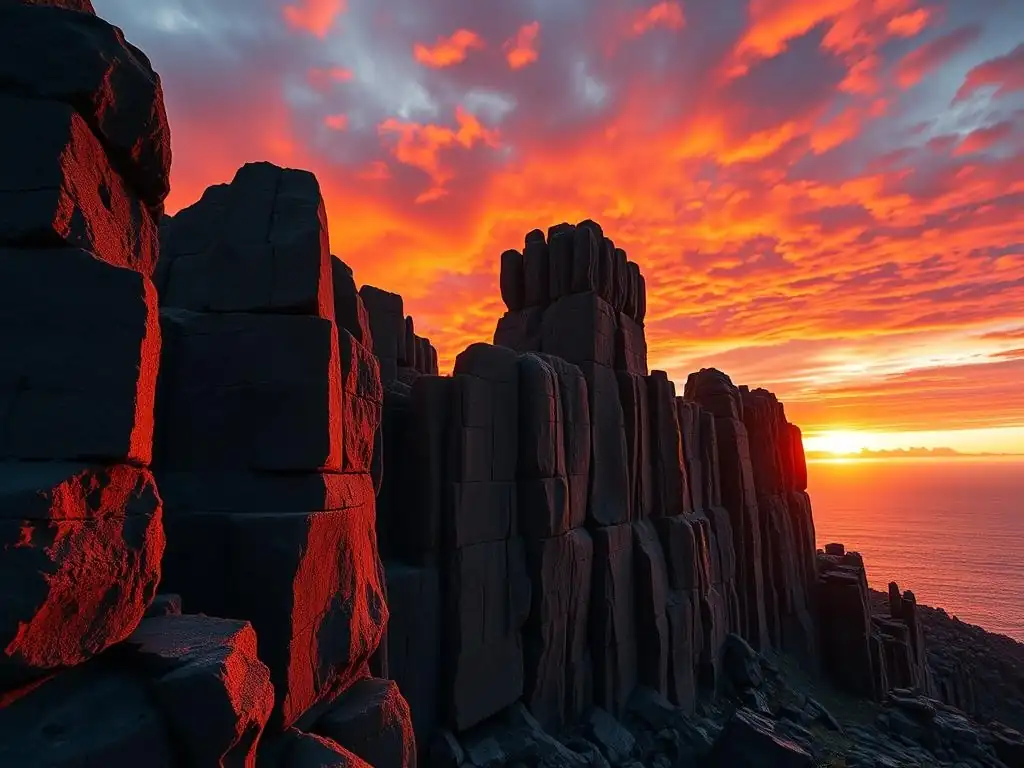
Beyond their striking appearance, basalt columns serve as important geological indicators of past volcanic activity and the conditions surrounding lava flows. The presence of columnar jointing unequivocally points to basaltic lava flows as the source rock. The size, shape, and orientation of the columns can further reveal details about the lava flow itself, such as its thickness, cooling rate, and flow direction. For example, well-developed, large-diameter columns often suggest a thick, slow-cooling lava flow, while smaller, less regular columns might indicate a thinner, faster-cooling flow.
Moreover, the spatial distribution of basalt column formations can help geologists reconstruct the extent and pathways of ancient lava flows. By mapping the locations of columnar basalt outcrops, researchers can delineate the boundaries of past volcanic eruptions and understand the regional volcanic history. In areas with multiple lava flows stacked on top of each other, the study of columnar jointing in each layer can provide a chronological record of volcanic events, offering insights into the frequency and style of past eruptions in a given region.
Basalt Columns and Their Importance in Geological Studies
Basalt columns are not just aesthetically pleasing; they are valuable resources for a wide range of geological studies. The well-preserved nature of many basalt column formations makes them excellent subjects for studying rock mechanics and fracture processes. Geologists can analyze the geometry of column fractures, measure joint spacing, and investigate the physical properties of the basalt rock to understand the mechanisms of columnar jointing in detail. This research contributes to a broader understanding of rock fracturing and deformation under thermal stress, with implications for civil engineering, mining, and other fields.
Furthermore, basalt columns, as part of basalt lava flows, are crucial for understanding the Earth's magnetic history. Basalt rock contains iron-bearing minerals that align with the Earth's magnetic field as the lava cools and solidifies. This process, known as thermoremanent magnetization, preserves a record of the Earth's magnetic field direction and intensity at the time of the lava flow's emplacement. By analyzing the magnetic properties of basalt columns, geologists can reconstruct the past behavior of the Earth's magnetic field, including magnetic reversals and variations in field strength, providing valuable data for paleomagnetic studies.
Paleomagnetic Studies Using Basalt Columns
Paleomagnetism, the study of the Earth's ancient magnetic field, heavily relies on basalt rocks, and basalt columns, in particular, are excellent sources of paleomagnetic data. The stable and well-preserved nature of basalt columns ensures that the magnetic signal acquired during cooling is retained for millions of years. Researchers collect oriented samples from basalt columns, carefully noting their position and orientation in the field. In the laboratory, sophisticated instruments called magnetometers are used to measure the remanent magnetization of these samples.
By analyzing the direction and intensity of magnetization in basalt columns from different locations and of varying ages, paleomagnetists can reconstruct the history of the Earth's magnetic field on a global scale. This information is vital for understanding plate tectonics, as magnetic anomalies recorded in basalt rocks on the ocean floor provide evidence for seafloor spreading and continental drift.
Moreover, paleomagnetic data from basalt columns help constrain the timing and frequency of geomagnetic reversals, events where the Earth's magnetic north and south poles switch places, a phenomenon that has significant implications for understanding the Earth's interior dynamics and its influence on the planet's environment.
Basalt Columns: Nature's Skyscrapers? Architectural Inspiration and Cultural Impact
The Influence of Basalt Column Structures on Architecture and Design
The striking geometric regularity and imposing verticality of basalt columns have long captivated human imagination and served as a source of inspiration for architecture and design. The naturally occurring polygonal shapes and the sense of order inherent in columnar jointing have influenced architectural styles across cultures and throughout history. The Giant's Causeway, for instance, has been cited as an inspiration for building designs, with architects seeking to emulate the natural beauty and structural elegance of these formations.
Examples of architectural influence can be seen in the use of hexagonal patterns in building facades, floor plans, and decorative elements. The concept of modular construction, utilizing repeating geometric units, can be seen as echoing the modular nature of basalt columns. Furthermore, the vertical emphasis and the sense of strength and stability conveyed by basalt columns have inspired the design of monumental structures and vertical architectural features. While not always directly replicating basalt columns, architects and designers have drawn upon the aesthetic principles and structural characteristics of these natural formations to create innovative and visually compelling buildings.
Basalt Columns in Mythology and Folklore: Giant's Causeway Legends
The Giant's Causeway, with its extraordinary arrangement of basalt columns, has given rise to rich mythology and folklore, particularly in Irish and Scottish traditions. The most famous legend attributes the Causeway's creation to the Irish giant Finn McCool. According to the myth, Finn McCool built the causeway as a path to reach Scotland to fight a Scottish giant named Benandonner. Different versions of the legend exist, but they commonly involve Finn McCool tearing up chunks of coastline and throwing them into the sea to create the causeway.
Another variation tells of Finn McCool's wife, Oonagh, who cleverly disguised him as a baby to outwit Benandonner, scaring the Scottish giant into retreating and destroying the causeway behind him, leaving only the remnants we see today. These legends, passed down through generations, imbue the Giant's Causeway with a sense of wonder and mythical significance, blending geological marvel with cultural narrative. The stories surrounding the Causeway reflect the human tendency to explain natural phenomena through myth and legend, particularly when faced with such awe-inspiring and seemingly unnatural formations.
Basalt Columns in Mythology and Folklore: Hawaiian Volcanic Deities
In Hawaiian culture, volcanic landscapes are deeply intertwined with mythology and spiritual beliefs, and basalt columns, as products of volcanic activity, are often associated with deities and sacred places. Pele, the Hawaiian goddess of volcanoes and fire, is a central figure in these traditions. Volcanic formations, including basalt columns, are seen as manifestations of Pele's power and creative force. Specific basalt column sites may be considered sacred or imbued with spiritual significance, reflecting the reverence for volcanic phenomena in Hawaiian culture.
Legends and chants often describe Pele's journeys and actions shaping the volcanic islands and their features. While specific myths directly linking basalt columns to deities might be less documented compared to broader volcanic mythology, the general understanding of volcanic landscapes as sacred spaces connected to Pele implies a cultural significance for all volcanic formations, including basalt columns. The respect for nature and the recognition of powerful forces embodied by volcanic activity are central to Hawaiian spirituality, and basalt columns, as tangible expressions of these forces, hold a place within this cultural and mythological framework.
Basalt Columns: Geological Curiosities? Unique Features and Unusual Formations
Exploring Unusual Basalt Column Shapes and Sizes
While hexagonal columns are the most common and iconic form of basalt columns, nature often exhibits variations and departures from this ideal shape, creating geological curiosities. Pentagonal, heptagonal, and even irregular polygonal columns can be found alongside hexagonal ones, reflecting slight variations in cooling conditions or local stresses during formation. In some locations, columns may exhibit curved or twisted shapes, deviating from the typical straight, vertical orientation. These unusual shapes can result from non-uniform cooling, changes in lava viscosity, or pre-existing geological structures influencing fracture patterns.
Furthermore, the size of basalt columns can vary dramatically, from small, pencil-thin columns to massive pillars several meters in diameter. The thickness of the original lava flow and the cooling rate are primary factors controlling column size. Thicker flows and slower cooling generally lead to larger columns. Exploring these variations in shape and size highlights the complexity of basalt column formation and the diverse expressions of columnar jointing found in nature, demonstrating that while hexagonal symmetry is prevalent, it is not the only form basalt columns can take.
The Science Behind Rare Basalt Column Patterns
The occurrence of rare basalt column patterns, such as radiating or fan-shaped columns, and columns with complex branching structures, presents intriguing scientific questions. These unusual formations challenge the simple model of uniform cooling and contraction leading to hexagonal columns. Research suggests that these complex patterns may arise from specific cooling conditions, such as rapid cooling from a point source or variations in the thermal conductivity of the surrounding rock. Computer simulations and laboratory experiments are employed to model these scenarios and understand the physical mechanisms behind these rare column patterns.
For instance, radiating columns might form when lava cools rapidly around a central vent or conduit, with fractures propagating outwards from this point. Fan-shaped columns could develop in situations where lava flows over uneven terrain, causing differential cooling and stress patterns. Branching or forking columns might result from complex interactions between multiple fracture planes or variations in the lava's composition and viscosity. Studying these rare patterns provides valuable insights into the intricacies of thermal stress and fracture propagation in cooling rocks, pushing the boundaries of our understanding of basalt column formation.
The Devil's Postpile National Monument: A Case Study
The Devil's Postpile National Monument in California serves as an exceptional case study for understanding basalt column formation and the geological processes that shape these formations. This site features a remarkably symmetrical and well-preserved display of dark basalt columns, showcasing the classic hexagonal pattern. Geological investigations at Devil's Postpile have revealed details about the lava flow that formed the columns, estimated to be around 100,000 years old. The lava flow, part of the Mammoth Mountain volcanic field, cooled slowly within a glacial valley, allowing for the development of exceptionally regular columnar jointing.
The unique preservation of the Devil's Postpile is attributed to glacial action. During past ice ages, glaciers flowed over the basalt columns, effectively polishing and smoothing the tops of the columns, creating the distinctive "postpile" appearance.
The glacial ice also removed overlying rock and soil, exposing the columnar structure for easy viewing. The Devil's Postpile exemplifies the interplay between volcanic and glacial processes in shaping landscapes and highlights how specific geological conditions can lead to the formation and preservation of exceptional basalt column sites, making it a valuable location for both scientific study and public appreciation of these geological wonders.
Comparing Basalt Columns to Other Volcanic Rock Formations
Basalt Columns vs. Pillow Lava
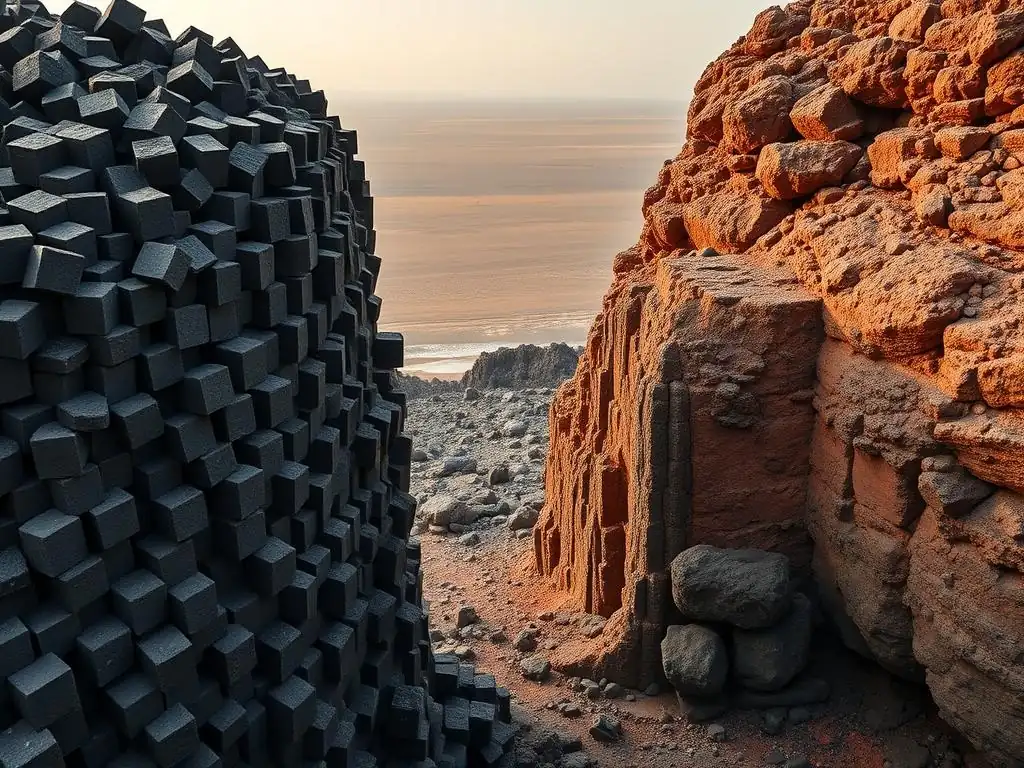
While basalt columns are characterized by their vertical, polygonal structures formed by cooling and contraction in subaerial lava flows, pillow lava represents a distinctly different type of basalt formation that occurs underwater. Pillow lava forms when basaltic lava erupts or flows into water (either seawater or freshwater). The rapid quenching of the lava by water causes the outer surface to solidify quickly, forming a glassy skin. As more lava flows into this solidified skin, it inflates like a pillow or balloon, creating rounded, pillow-shaped lobes that are typically interconnected.
Unlike the ordered, columnar jointing of basalt columns, pillow lava exhibits a chaotic, bulbous structure. Internally, pillow lavas may show radial jointing due to cooling from the outside inwards, but they lack the long, vertical columns characteristic of subaerial flows. Pillow lavas are a key indicator of submarine volcanism and are abundant in oceanic crust. They provide valuable insights into the processes of lava eruption and cooling in underwater environments, contrasting sharply with the formation mechanisms and resulting morphology of basalt columns on land.
Basalt Columns vs. Volcanic Dikes
Basalt columns are surface features formed from lava flows spreading across the landscape, whereas volcanic dikes are subsurface intrusions of magma that solidify within fractures in pre-existing rocks. Dikes are essentially vertical or near-vertical walls of igneous rock that cut across the layering or structure of the surrounding country rock. When magma intrudes into a fracture and cools, it can also exhibit columnar jointing, but the context and overall geometry are different from basalt columns formed in lava flows.
Dikes are often narrower and more elongated than lava flows that produce basalt columns. Columnar jointing in dikes typically occurs perpendicular to the dike walls, resulting in columns that are oriented horizontally or at an angle depending on the dike's orientation. While both basalt columns and columnar dikes are formed by cooling and contraction, their geological setting and overall shape distinguish them. Dikes represent pathways of magma ascent within the Earth's crust, while basalt columns are the solidified remains of lava flows that reached the surface.
Distinguishing Characteristics of Basalt Column Formations
To distinguish basalt column formations from other volcanic rock features, several key characteristics can be observed. Firstly, basalt columns are typically found in layered sequences, representing successive lava flows. The columnar jointing is generally pervasive throughout a lava flow unit, creating a visually striking pattern across a large area. The columns are predominantly vertical, reflecting the cooling direction perpendicular to the flow surface. The polygonal shapes, especially hexagons, are a hallmark of basalt columns, although variations can occur.
In contrast to features like lava tubes (hollow channels within lava flows) or volcanic bombs (ejected fragments of lava), basalt columns are solid rock formations resulting from the systematic fracturing of cooling lava. Their large scale, ordered arrangement, and the presence of polygonal joints are distinctive features. Geological context is also crucial; basalt columns are typically associated with basaltic volcanic regions and landscapes shaped by lava flows. Understanding these distinguishing characteristics allows for accurate identification and appreciation of basalt columns as a unique and remarkable type of volcanic rock formation.
Preserving Basalt Columns: Conservation Efforts and Geological Heritage
Threats to Basalt Column Formations: Erosion and Human Impact
Despite their robust appearance, basalt column formations are susceptible to various threats, both natural and human-induced. Erosion, driven by weathering processes like freeze-thaw cycles, wind, and rain, gradually breaks down the rock, leading to the detachment and collapse of columns. Coastal basalt column sites are particularly vulnerable to wave action and sea-level rise, accelerating erosion rates. Earthquakes and landslides can also cause significant damage to basalt column formations, destabilizing cliffs and causing rockfalls.
Human activities pose additional threats. Quarrying for basalt rock, often used in construction and road building, can directly destroy basalt column sites if not managed sustainably. Tourism, while bringing economic benefits, can lead to physical damage from trampling, vandalism, and infrastructure development if not carefully regulated. Pollution, both air and water, can accelerate weathering processes and degrade the integrity of basalt rock. Recognizing these threats is crucial for implementing effective conservation strategies to protect these geological treasures.
Conservation Strategies for Protecting Basalt Column Sites
Effective conservation of basalt column sites requires a multi-faceted approach, combining scientific understanding, legal protection, and sustainable management practices. Geological monitoring is essential to assess the stability of column formations, track erosion rates, and identify potential hazards. This may involve regular inspections, remote sensing techniques, and geophysical surveys. Legal protection, such as designating basalt column sites as national monuments, parks, or protected areas, provides a framework for regulating activities and preventing destructive exploitation.
Sustainable tourism management is crucial to balance visitor access with site preservation. This includes developing designated trails, viewpoints, and visitor centers to minimize impact on sensitive areas. Education and public awareness campaigns can promote responsible visitor behavior and appreciation for geological heritage. In some cases, physical stabilization measures, such as rock reinforcement or drainage improvements, may be necessary to mitigate erosion and ensure the long-term preservation of basalt column formations. Collaboration between government agencies, scientists, local communities, and tourism operators is vital for successful conservation efforts.
National Park Service Initiatives at Devil's Tower
While Devil's Tower in Wyoming is not composed of basalt columns but rather phonolite porphyry, a different type of igneous rock exhibiting columnar jointing, the National Park Service's (NPS) management and conservation efforts there offer valuable insights applicable to basalt column sites. Devil's Tower National Monument is a prime example of how geological wonders can be protected and managed for both preservation and public enjoyment. The NPS employs a comprehensive approach that includes scientific research, resource monitoring, visitor management, and interpretation.
The NPS conducts ongoing geological studies to understand the Tower's formation, stability, and potential hazards. They monitor rockfall activity, erosion rates, and the effects of weather and climate. Visitor management strategies at Devil's Tower focus on minimizing impact on the natural environment while providing access and educational opportunities.
Designated trails, overlooks, and ranger programs guide visitors and promote responsible behavior. The NPS also works closely with local communities and Native American tribes, recognizing the cultural significance of Devil's Tower. The success of conservation at Devil's Tower demonstrates the effectiveness of integrated management approaches for preserving geological heritage sites, principles that can be adapted for basalt column formations worldwide.
Conclusion: Appreciating the Majesty of Basalt Column Formations
Basalt Columns: A Testament to the Power and Beauty of Volcanic Activity
Basalt columns stand as compelling testaments to the immense power and intricate beauty of volcanic activity. These geometrically precise formations, born from the cooling and contraction of lava flows, are not merely geological curiosities but rather windows into the Earth's dynamic processes. They showcase the fundamental physics of fracture and pattern formation, while simultaneously inspiring awe and wonder with their natural artistry. From the iconic Giant's Causeway to lesser-known sites around the globe, basalt columns enrich our understanding of volcanic landscapes and the planet's geological history.
Their significance extends beyond scientific inquiry. Basalt columns have influenced architecture, inspired mythology, and become integral parts of cultural heritage in many regions. They represent a unique intersection of science, art, and culture, reminding us of the profound connection between humanity and the natural world. Appreciating basalt columns means recognizing both their geological importance and their aesthetic and cultural value, fostering a sense of stewardship for these remarkable formations.
Further Exploration of Volcanic Landscapes with VolcanoExplorers.org
VolcanoExplorers.org invites you to continue your journey of discovery into the captivating world of volcanic landscapes. Basalt columns are just one facet of the diverse and awe-inspiring phenomena associated with volcanoes. Our website offers a wealth of resources to explore further, from the science of eruptions and magma to the beauty of volcanic landforms and the human stories intertwined with volcanic regions. Delve into articles about different types of volcanoes, famous eruptions throughout history, volcanic hazards, and the fascinating field of volcanology.
Discover stunning photography and virtual tours of volcanic landscapes around the world. Learn about the efforts to monitor and understand volcanic activity, ensuring the safety of communities living near these powerful natural forces. Whether you are interested in the geological details, the cultural significance, or simply the breathtaking beauty of volcanoes, VolcanoExplorers.org is your guide to exploring and appreciating these dynamic and often dramatic features of our planet, including the majestic and mysterious basalt columns that grace volcanic landscapes across the globe.
Frequently Asked Questions
What are basalt columns and how are they formed?
Basalt columns are geological formations created when molten basalt lava cools and contracts. As it solidifies, it fractures in a regular, polygonal pattern, forming these distinctive columns.
What is the significance of studying basalt columns?
Studying basalt columns helps us understand lava flow dynamics and the cooling processes of igneous rocks. They also provide insights into Earth's geological history and past volcanic activity.
Where can I find examples of basalt columns around the world?
Examples of basalt columns can be found in various locations, including the Giant's Causeway in Northern Ireland, Devils Postpile National Monument in California, and Fingal's Cave in Scotland.
Are basalt columns only formed from basalt lava?
While basalt is the most common source, similar columnar jointing can occur in other types of igneous rocks, although less frequently. The key factor is the rapid cooling and contraction of the lava.
What role do volcanologists play in understanding basalt column formation?
Volcanologists study basalt columns to analyze lava composition, cooling rates, and fracture patterns. This helps them to reconstruct past volcanic events and improve our understanding of volcanic processes.
Final Reflection: Echoes of Ancient Fire
The enduring allure of basalt columns, as explored throughout this article, lies not just in their striking geometric beauty but also in their profound connection to the Earth's fiery past. These formations are more than just geological curiosities; they are tangible records of volcanic events, whispering tales of immense power and the slow, deliberate artistry of nature. Understanding their formation and significance allows us to appreciate the dynamic processes that have shaped our planet and continue to influence our world today.
The impact of these natural wonders extends beyond scientific understanding. They inspire awe and wonder, fueling artistic expression and serving as potent symbols of resilience and the raw beauty of the natural world. Personally, witnessing these formations evokes a sense of humility and a deep respect for the forces that have sculpted our planet over millennia. The best view comes after the hardest climb,
a sentiment that perfectly encapsulates the rewarding experience of encountering these geological marvels and understanding their intricate origins.
As we conclude this exploration of basalt columns, I invite you to consider your own connection to the natural world. How can you, in your own life, cultivate a deeper appreciation for the Earth's geological wonders and the stories they hold? Let the intricate patterns and enduring strength of basalt columns serve as a reminder of the power and beauty that surrounds us, urging us to protect and cherish the planet that sustains us all.
Okay, here's a CTA I've written for the end of a web article titled "Basalt Columns: Nature's Skyscrapers or Geological Curiosities? You Decide," for the website "Volcano Explorers" (volcanoexplorers.org):
Unearth Your Inner Geologist!
Thanks for exploring the fascinating world of basalt columns with us! We hope you’ve gained a newfound appreciation for these incredible geological formations and the volcanic processes that sculpted them. Now, it’s time to take your exploration beyond the screen.
Here's how you can continue your journey:
- Plan a Visit! Explore a nearby basalt column formation. Discover the awe-inspiring scale and intricate patterns firsthand. Research local sites near you and remember to respect the natural environment during your visit.
- Research a specific site: If you want to go to the Giants Causeway in Northern Ireland, why not check out its Geology?
- Dive Deeper: Read more about the topic online or at your local library.
What other geological wonders have sparked your curiosity, and where will your next adventure take you? Share your thoughts below!