
Can AI Prevent Another Volcanic Tragedy? Lessons from History, Powered by Technology

Welcome to Volcano Explorers!
Ever wondered if we could truly predict the fury of a volcano before it unleashes its devastating power? This isn't just a dream anymore. Dive into our latest exploration of AI in volcanic disaster prevention and discover how cutting-edge technology is learning from history to potentially avert future tragedies. Are we on the cusp of a new era in volcano monitoring, or are we still playing catch-up with nature's most volatile forces? Explore with us and decide.
- Introduction: The Promise of Artificial Intelligence in Volcano Monitoring
-
Frequently Asked Questions
- How can AI help in volcanic disaster prevention?
- What types of data does AI use to predict volcanic eruptions?
- What are some historical volcanic tragedies that could have been mitigated with AI?
- How does VolcanoExplorers.org use AI to provide real-time updates?
- What are the limitations of using AI in volcano monitoring?
- Final Reflection: Harnessing AI for Volcanic Safety
- Unearth New Insights: Join the AI-Powered Volcano Watch!
Introduction: The Promise of Artificial Intelligence in Volcano Monitoring

Volcanoes, awe-inspiring forces of nature, have shaped our planet and captivated humanity for millennia. Yet, their unpredictable and often violent eruptions pose significant threats to communities living in their shadow. Traditional volcano monitoring methods, while valuable, face inherent limitations in predicting eruptions with the accuracy and timeliness needed to prevent disasters.
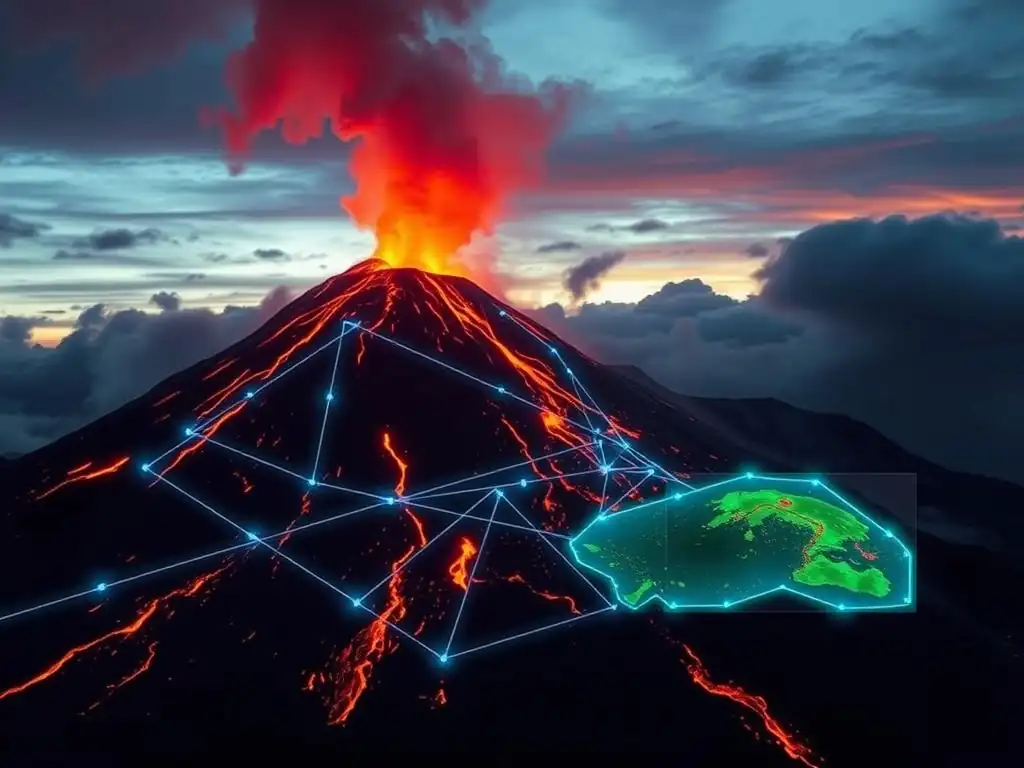
Enter Artificial Intelligence (AI), a transformative technology that offers unprecedented potential to revolutionize volcano monitoring and significantly enhance volcanic disaster prevention. By leveraging the power of machine learning and data analysis, AI promises to unlock new insights from complex volcanic datasets, leading to more accurate predictions and ultimately, saving lives and mitigating the devastating impacts of volcanic eruptions. This article explores the exciting frontier of AI in volcanology, examining its applications, challenges, and the path towards a future where technology and human expertise work hand-in-hand to minimize the risks posed by these formidable geological phenomena.
Volcano Observatories: Embracing AI for Enhanced Volcanic Disaster Prevention
Volcano observatories around the world are the front lines of volcanic hazard mitigation. These scientific institutions are responsible for continuous monitoring of volcanic activity, employing a range of instruments and techniques to detect subtle changes that could indicate an impending eruption. Traditionally, volcanologists meticulously analyze seismic data, ground deformation, gas emissions, and thermal anomalies to assess the state of a volcano. However, the sheer volume of data generated by modern monitoring networks can be overwhelming, and the subtle signals preceding eruptions can be difficult to discern amidst background noise. AI offers a powerful solution by automating data processing, identifying patterns invisible to the human eye, and providing real-time analysis with remarkable speed and accuracy. For instance, machine learning algorithms can be trained to recognize precursory seismic swarms or subtle changes in gas composition that might be missed by traditional analysis methods, thereby enhancing the sensitivity and effectiveness of volcano observatories.
The integration of AI into volcano observatories is not merely about automating existing tasks; it's about fundamentally transforming how we approach volcanic hazard assessment. AI algorithms can be designed to integrate diverse datasets from multiple monitoring networks – seismic, geodetic, gas, and satellite – to create a holistic and dynamic picture of a volcano's state. This integrated approach allows for a more nuanced understanding of volcanic processes and reduces reliance on single-parameter thresholds that can sometimes lead to false alarms or missed events.
Furthermore, AI can assist in developing probabilistic eruption forecasts, providing a more realistic and informative assessment of volcanic risk compared to deterministic predictions. By embracing AI, volcano observatories can significantly enhance their capabilities, moving towards a future of more proactive and effective volcanic disaster prevention, ultimately providing communities with earlier and more reliable warnings.
The Historical Impact of Volcanic Eruptions: A Call for Proactive Measures
Throughout history, volcanic eruptions have left an indelible mark on human civilization, causing immense destruction and loss of life. The eruption of Mount Vesuvius in 79 AD, which buried the Roman cities of Pompeii and Herculaneum, serves as a stark reminder of the sudden and catastrophic power of volcanoes. While this event occurred before modern scientific understanding of volcanoes, it highlights the long-standing threat they pose to human settlements.
More recently, the 1985 eruption of Nevado del Ruiz in Colombia triggered a devastating lahar (volcanic mudflow) that tragically claimed the lives of over 25,000 people in the town of Armero. This tragedy underscored the critical need for effective early warning systems and proactive disaster preparedness measures in volcanically active regions.
The economic and social costs of volcanic eruptions extend far beyond immediate casualties. The 2010 eruption of Eyjafjallajökull in Iceland, while relatively small in terms of explosivity, disrupted air travel across Europe for several days, causing billions of dollars in economic losses.
Similarly, the ongoing volcanic activity at Popocatépetl in Mexico continuously threatens millions of people living in nearby areas, highlighting the long-term societal impact of even moderately active volcanoes. These historical examples, alongside countless others, underscore the urgent need for improved volcanic monitoring and prediction capabilities.
Investing in advanced technologies like AI, coupled with robust disaster preparedness strategies, is not just a scientific endeavor; it is a moral imperative to protect vulnerable communities and build resilience against the inevitable force of volcanic eruptions. The lessons learned from past volcanic tragedies serve as a powerful call to action, urging us to embrace innovative solutions like AI to proactively mitigate the risks and prevent future disasters.
Frequently Asked Questions
How can AI help in volcanic disaster prevention?
AI can analyze vast datasets of volcanic activity and historical eruptions to identify patterns and predict potential future events, providing crucial early warnings. This allows for more effective evacuation planning and resource allocation.
What types of data does AI use to predict volcanic eruptions?
AI systems utilize various data sources, including seismic activity, gas emissions, ground deformation, and thermal imaging, to develop comprehensive models for predicting eruptions. These models are constantly refined with new data.
What are some historical volcanic tragedies that could have been mitigated with AI?
Events like the eruption of Mount Vesuvius in 79 AD or Mount St. Helens in 1980 might have had fewer casualties if AI could have provided earlier warnings for evacuation. AI can analyze precursory activity to improve prediction accuracy.
How does VolcanoExplorers.org use AI to provide real-time updates?
Our website integrates AI-driven monitoring systems that analyze data from global volcano observatories, providing users with up-to-date information on volcanic activity and potential hazards. This helps inform safety guidelines and emergency responses.
What are the limitations of using AI in volcano monitoring?
While AI offers significant advantages, it's not foolproof. Volcanic systems are complex, and AI models are only as good as the data they are trained on. Human expertise remains crucial for interpreting AI outputs and making critical decisions.
Final Reflection: Harnessing AI for Volcanic Safety
The exploration of AI's potential in volcanic disaster prevention reveals a crucial intersection of historical lessons and technological innovation. The tragedies of the past, etched in our collective memory, serve as stark reminders of nature's power and our vulnerability. Today, the promise of AI offers a proactive approach, moving beyond reactive measures to anticipate and mitigate the devastating impacts of volcanic eruptions.
This journey into the realm of AI and volcanology underscores how technology can reshape our relationship with the natural world. The ability to analyze vast datasets, identify subtle patterns, and provide early warnings is not just a scientific advancement; it's a moral imperative. The only way to do great work is to love what you do,
Steve Jobs famously said. In this context, loving what we do means dedicating ourselves to using technology to protect lives and communities from the unpredictable forces of nature.
As we stand on the cusp of a new era in volcanic disaster prevention, let us remember that technology is merely a tool. Its true power lies in the hands of those who wield it with wisdom, compassion, and a deep understanding of the human cost of inaction. Consider how you can contribute to a future where AI empowers us to live in greater harmony with our planet, turning potential tragedies into stories of resilience and preparedness.
Unearth New Insights: Join the AI-Powered Volcano Watch!
Thank you for exploring the potential of AI in volcano monitoring! We hope you found valuable insights into how technology can help prevent future tragedies. Now, it's time to put this knowledge into action and contribute to a safer world.
Here's how you can get involved:
- Explore our interactive map on VolcanoExplorers.org to visualize global volcanic activity and AI-driven risk assessments – you might even discover a volcano you never knew existed!
- Become a Citizen Scientist: Share your local volcano observations and photos with our community. Your insights can help train and improve AI algorithms!
- Spread the Word: Discuss this critical topic with your friends and family. How can we encourage more responsible development near volcanic regions?
What innovative solutions can you imagine using AI to better predict and prepare for volcanic eruptions? Share your ideas in the comments below!